Driving an EV from Sydney to Melbourne: Charging Stops & What If You Run Flat
Sydney to Melbourne on the Hume Highway is the benchmark Australian EV road trip — ultra-rapid charging every 100–150 km, two to three stops, and the country's most forgiving charge-free gaps. Here are the stops and what to do if you run flat.
On this page
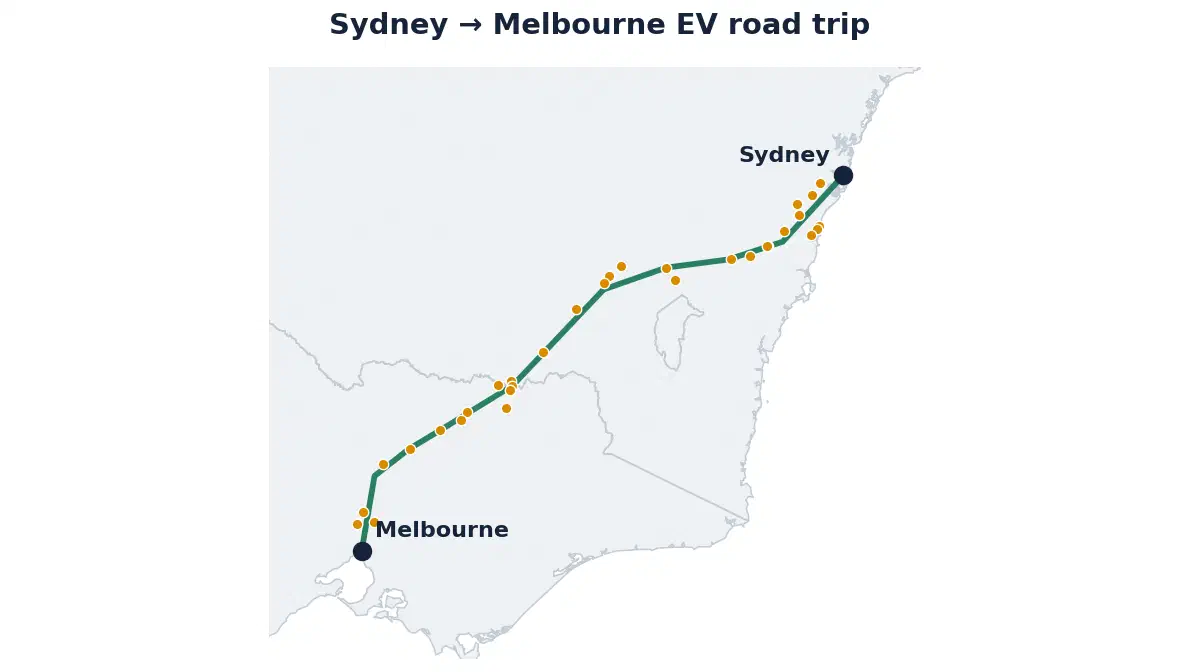
The Sydney to Melbourne run on the Hume Highway is the benchmark Australian EV road trip, and the easiest long one to do on electricity. Ultra-rapid charging sites sit every 100 to 150 km along the corridor, so the question isn’t whether you can do it — almost any EV can — but where to stop and what to do in the unlikely event you run flat. Here’s both, with the charger data drawn live from Open Charge Map and the contingency plan that route planners leave out.
How many stops will your EV need?
3 charging stops
Estimated from about 353 km of real-world range: leave at 90%, arrive with 15% in reserve, charge to 80% on the road. Highway speeds, cold weather and hills all cut range, so treat this as a planning estimate.
Showing a typical 60 kWh EV. Pick your car above for your own estimate.
Can you drive an EV from Sydney to Melbourne?
Yes — comfortably. It’s 878 km via the Hume Highway (M31), about 9 hours of driving before stops. As of mid-2026 the Hume is one of the most densely charged corridors in Australia: Chargefox, NRMA, Evie, Tesla and Ampol AmpCharge all run fast or ultra-rapid sites along it, several capable of adding 300–400 km of range in 15–20 minutes to a compatible car.
For most EVs that means two or three charging stops. You don’t need a long-range car or a Tesla — the stop spacing is forgiving enough that a 300 km real-world range is plenty, provided you top up to around 80% at each stop rather than running the battery to empty.
Fast-charging stops, Sydney → Melbourne
The DC fast-charging stops along the Hume corridor, north to south, drawn live from Open Charge Map:
Pay at most sites through the Chargefox or Evie app. Chargefox is owned by the motoring clubs, so NRMA and RACV members usually get a discount. The ultra-rapid anchors most drivers actually use are Sutton Forest, Goulburn, Tarcutta, Barnawartha North and Euroa — each can add a few hundred kilometres of range in 15–20 minutes to a compatible car.
For plug types, pricing and app logistics, start with our guide to finding public EV charging in Australia.
How to plan your stops
A simple rule beats precise maths on the Hume: leave Sydney at 90–100%, charge to ~80% at two well-spaced stops, and arrive in Melbourne with a comfortable buffer. Most drivers split it as a stop around Goulburn or Gundagai, then one around Albury/Wodonga, with Euroa or Barnawartha North as an optional top-up.
Two things quietly eat range on this drive:
- Highway speed. Sustained 110 km/h uses noticeably more energy than city driving. Your dashboard range estimate, often based on gentler driving, can be optimistic — plan on stops, not the guess-o-meter.
- Weather. Victorian winters and cold pre-dawn starts trim range. In July, add a margin and pre-heat the cabin while still plugged in.
What if you run out of charge between Sydney and Melbourne?
This is the part route planners skip — and it’s exactly when you most want a plan.
The Hume’s close stop spacing means a genuine flat battery is unlikely if you charge to 80% at each stop. But it happens: a closed or queued charger, a detour, a cold snap, or simply misjudging the last leg. The longest charge-free gap on this corridor is well within a single charge for any moderate-range EV — see the stop list above — which is why the Hume is the most forgiving long EV drive in the country. The risk isn’t distance; it’s a charger being out of action when you arrive low.
If you do run flat:
- Get safe. Off the carriageway, hazard lights on, stand behind the barrier. The Hume is a fast road — the verge is not a safe place to stand near traffic.
- Call roadside assistance. 13 11 11 reaches the relevant state motoring club from anywhere on the route — NRMA on the NSW side, RACV once you’re in Victoria. Tesla drivers can request help in the Tesla app.
- Say it’s an EV. Most EVs must be flat-bed towed, not flat-towed on their drive wheels. Saying so up front gets the right truck first time and avoids damage.
- Ask about the options. Depending on your cover and where you are, that’s a tow to the nearest fast charger, or — increasingly — a mobile top-up. RACV has trialled patrol vans with a 20 kW DC charger; treat it as a possibility, not a promise, and ask when you call.
The single most useful thing you can do before you leave: check that your roadside cover actually handles out-of-charge events, and how far it will tow you. Not all do, and tow distance limits matter on a drive this long. Our complete guide to EV roadside assistance in Australia compares what each provider covers, and our out-of-charge guide walks through exactly what happens after you call.
Doing the drive the other way?
The stops are the same in reverse. Melbourne drivers heading north should leave the city at 90%+ and treat Barnawartha North or Euroa as the first proper top-up. If you’re branching off — to Canberra, the coast or beyond — see our guides to charging and roadside assistance by city for where to plug in at the other end.
Frequently asked questions
Can you drive an electric car from Sydney to Melbourne?
Yes. The Hume Highway is one of Australia's best-charged corridors, with ultra-rapid charging roughly every 100–150 km. As of mid-2026 almost any EV with 300 km or more of real-world range can do the 878 km drive comfortably with two or three charging stops, and the longest gap between fast chargers is well within a single charge for most cars. See the live stop spacing below.
How many times do you need to charge an EV between Sydney and Melbourne?
Most drivers stop two or three times. The exact number depends on your car's range, how fast you drive, and the weather — highway speeds and cold weather both cut range. Plan to top up to about 80% at each fast charger rather than waiting until you're nearly empty, and you'll rarely queue or run tight.
How long does it take to drive an EV from Sydney to Melbourne?
The drive itself is about 9 hours over 878 km via the Hume Highway. Add roughly 60–90 minutes across two or three charging stops, so budget around 10.5 hours door to door — comparable to a relaxed petrol run with proper meal and rest breaks.
What happens if my EV runs out of charge on the Hume Highway?
Get safely off the road, hazard lights on, and call your roadside provider — 13 11 11 reaches the relevant state motoring club (NRMA in NSW, RACV in Victoria) from anywhere on the route. Tell them it's an EV so they send a flatbed, not a conventional tow. Depending on your cover and location you'll get a tow to the nearest fast charger; some providers are trialling mobile top-up charging. Confirm your roadside cover handles out-of-charge events before you leave.
What's the longest gap between EV chargers on the Sydney to Melbourne drive?
On the Hume Highway corridor the fast-charging sites are closely spaced — see the stop list below for the current longest charge-free gap from live Open Charge Map data. It's comfortably within a single charge for any EV with moderate range, which is why the Hume is considered the easiest long EV drive in the country.