Driving an EV from Sydney to Melbourne the Coastal Way: Charging & What If You Run Flat
The Princes Highway coastal route — South Coast, Sapphire Coast, East Gippsland, the Lakes — is a genuinely scenic alternate to the Hume, but it is 160 km longer, more remote, and needs careful charging planning, especially through the East Gippsland stretch near Cann River.
On this page
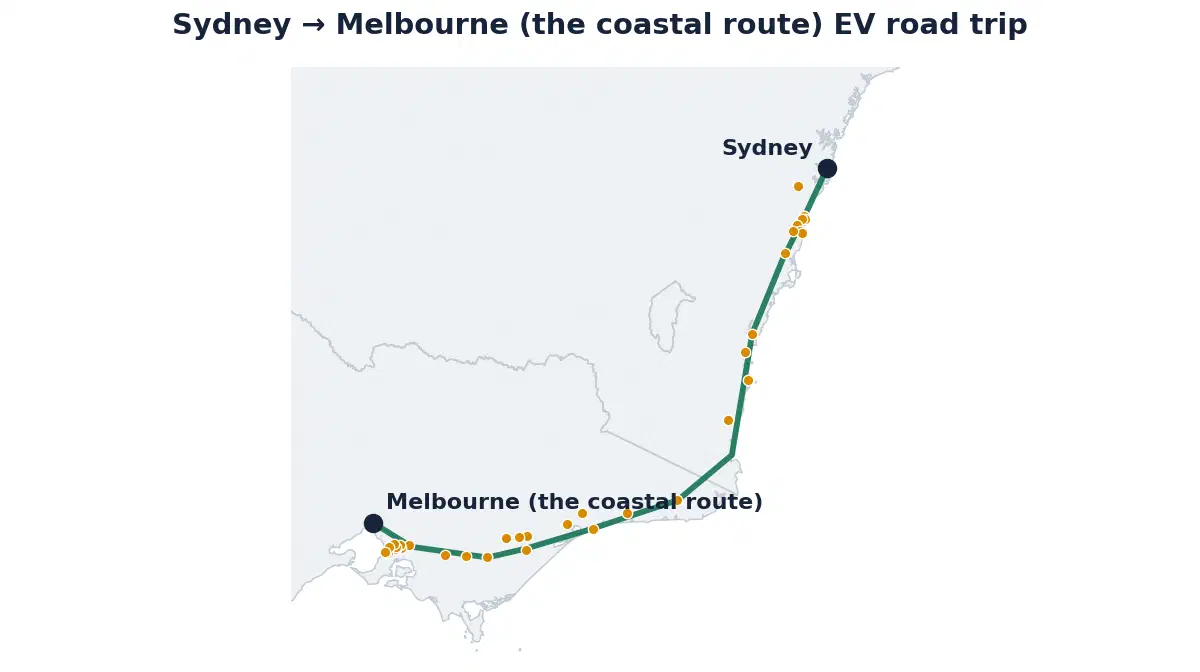
The Sydney to Melbourne coastal route is a different proposition from the Hume — and that’s exactly the point. Where the inland Hume charges you along a dense corridor in about nine hours, the Princes Highway coastal route takes you south through Wollongong, Nowra, Batemans Bay and the Sapphire Coast, across the NSW–Victorian border into East Gippsland, and finally through the Lakes District, Sale, Traralgon and into Melbourne. It’s roughly 1,040 km and 13 hours of driving, and it passes through some of the most rewarding coastal and forest country in south-eastern Australia.
For an EV driver that beauty comes with a trade-off: the route is more remote, charge-free gaps are wider — particularly through far East Gippsland around Cann River — and mobile coverage thins out in sections where you’d most want to check charger status in real time. This is not the route to do on autopilot. It is the route to do if you want the drive to be part of the holiday. Here’s how to plan it properly, and what to do if things go wrong in a remote stretch.
How many stops will your EV need?
4 charging stops
Estimated from about 353 km of real-world range: leave at 90%, arrive with 15% in reserve, charge to 80% on the road. Highway speeds, cold weather and hills all cut range, so treat this as a planning estimate.
Showing a typical 60 kWh EV. Pick your car above for your own estimate.
Can you drive an EV from Sydney to Melbourne via the coast?
Yes, and it’s a rewarding drive — but it’s not the same as the Hume.
The coastal Princes Highway (A1) runs approximately 1,040 km from Sydney to Melbourne, versus the Hume’s 878 km. That extra 160 km isn’t just distance — it’s longer stretches between charging options, more exposure to remote conditions, and far less redundancy if a charger is out of action when you arrive. As of mid-2026, fast-charging infrastructure along the coastal route has improved significantly but remains sparser than the Hume corridor, particularly once you pass Eden and head into East Gippsland.
A real-world range of around 400 km makes the coastal route comfortable. Cars closer to 300 km of real-world range can still do it, but require more disciplined charging habits — top up earlier, arrive at fast chargers with a bigger buffer, and treat the East Gippsland section as the critical planning point, not an afterthought.
Fast-charging stops on the coastal route
The DC fast-charging stops along the Princes Highway coastal corridor, north to south, drawn live from Open Charge Map:
The anchor charging towns are Wollongong, Nowra, Batemans Bay, Eden on the South and Sapphire coasts, then Lakes Entrance, Sale and Traralgon through Gippsland before Melbourne. The section between Eden and the East Gippsland towns is where stop selection matters most — treat the live gap figures in the table as the single most important number on this page.
How to plan your stops
The coastal route rewards a more conservative approach than the Hume. A rough framework that works for most cars with 350 km+ real-world range:
- Leave Sydney at 100%. No negotiation — this is a longer, more remote drive.
- Charge at Wollongong or Nowra. Top up to 80%+ early; the South Coast drive is pleasant and you’ll want range in reserve.
- Charge at Batemans Bay. This is your last reliably busy regional centre before the Sapphire Coast section thins out.
- Charge before the East Gippsland gap. The stretch around Cann River is the critical pinch point — roughly 129 km of charge-free remote highway. Arrive at the last charger before it with a real buffer, not 40%. The table shows the live gap figure.
- Charge at Lakes Entrance or Sale. You’re back in accessible territory and the rest of the drive to Melbourne is well served.
Two factors that quietly erode range on this drive:
- Coastal gradients and headwinds. The South Coast and Gippsland sections involve more elevation change and coastal wind than the inland Hume. Your car’s range estimate may be optimistic — highway speeds into a headwind on a cold morning can cut it substantially.
- Remote sections with no fallback. On the Hume, a closed charger usually means a 30-minute detour to another site. In East Gippsland, it may mean a much longer detour or a call to roadside assistance. Arriving with a margin isn’t pedantic — it’s the strategy.
What if you run out of charge on the coastal route?
Running flat on the coastal Princes Highway is more consequential than it is on the Hume — and the plan is the same in principle but harder in execution.
- Get safe. Off the road, hazard lights on. The highway through the Sapphire Coast and East Gippsland sections can be fast and narrow — the verge is not a safe place to wait near traffic.
- Call roadside assistance. 13 11 11 reaches the relevant state motoring club from anywhere on the route — NRMA in NSW, RACV once you’ve crossed into Victoria. If you’re in a mobile blackspot in far East Gippsland, you may need to wait until you can get a signal or flag down passing traffic.
- Say it’s an EV. Tell the operator immediately so they dispatch a flatbed, not a conventional tow truck. Most EVs cannot be towed on their drive wheels without drivetrain damage.
- Understand the tow-distance limit. In remote East Gippsland, the nearest fast charger may be a significant distance from where you stop. Not all roadside policies cover a long tow — check your limit before you leave, not after you’re stranded.
The most useful preparation is pre-trip: confirm your roadside cover explicitly handles out-of-charge events, know your tow-distance limit, and have the 13 11 11 number in your contacts. Our complete guide to EV roadside assistance in Australia compares what each provider actually covers, and our out-of-charge guide walks through exactly what happens step by step after you call.
Coastal route vs the Hume
The short version: the Hume Highway is faster (878 km, ~9 hours), more densely charged, more forgiving, and needs less planning. The coastal Princes Highway is longer (~1,040 km, ~13 hours), more remote, needs more planning, and is a genuinely beautiful drive through the South Coast, Sapphire Coast and Gippsland.
Neither is the wrong choice — but choose deliberately. If your goal is efficient inter-capital travel, take the Hume. If the drive itself is the experience and you’re happy to spend an extra few hours in exchange for the coast, plan the Princes Highway carefully and enjoy it.
Full guide to the faster inland route: Driving an EV from Sydney to Melbourne via the Hume Highway.
Planning your charging at either end? See our charger guides for Sydney and Melbourne, or browse all EV road trip guides on the trips hub.
Frequently asked questions
Can you drive an EV from Sydney to Melbourne via the coastal route?
Yes, but it takes more planning than the Hume. The Princes Highway coastal route runs roughly 1,040 km through the South Coast, Sapphire Coast and East Gippsland — about 13 hours of driving before stops. Fast-charging sites exist along the corridor, but the gaps are wider and more remote than on the Hume, particularly around the East Gippsland stretch near Cann River. A real-world range of 400 km or more makes the drive significantly more comfortable; if your car sits closer to 300 km, plan your buffer conservatively and charge well before the remote sections.
What is the longest charge-free gap on the Sydney to Melbourne coastal route?
The remote East Gippsland stretch around Cann River is the key pinch point — roughly 129 km of charge-free highway (the live stop table below shows the current figure). This is substantially more exposed than anything you'll encounter on the Hume. Arrive at Cann River territory with a genuine buffer, not a nearly-depleted battery. Mobile coverage is also patchy through far East Gippsland, so you can't always rely on real-time charger status checks en route.
What happens if my EV runs out of charge in East Gippsland or on the Princes Highway?
Get safely off the road, put your hazard lights on, and call roadside assistance — 13 11 11 reaches the relevant motoring club from anywhere on the route: NRMA in NSW, RACV once you're across the Victorian border. Tell the operator it's an EV so they send a flatbed rather than a conventional tow truck; most EVs cannot be flat-towed on their drive wheels. Depending on your cover and your location, you'll be towed to the nearest fast charger. Note that in remote East Gippsland, 'nearest charger' may be a significant distance away, so check your policy's tow-distance limit before you leave.
Is the coastal Princes Highway route harder for EVs than the inland Hume Highway?
Yes — meaningfully so. The Hume (878 km, ~9 hours) is Australia's most densely charged inter-capital corridor and is genuinely easy for almost any EV. The coastal Princes Highway route (~1,040 km, ~13 hours) is longer, has wider charge-free gaps, more remote sections with patchy mobile coverage, and fewer backup charging options if a site is out of action. If your priority is getting between Sydney and Melbourne quickly and with low planning overhead, the Hume is the better choice. See our full guide to the Hume: /trips/sydney-to-melbourne-ev/. If scenic coast and the journey itself matter most to you, the coastal route is worth it — just arrive at each charger earlier in your buffer than you would on the Hume.
How many charging stops does the Sydney to Melbourne coastal route need?
Most drivers will need three to five charging stops depending on their car's real-world range. The route is long enough and the gaps wide enough that running it on two stops requires a genuinely high-range car driven conservatively. A practical plan: charge at or near Wollongong or Nowra, then Batemans Bay, then somewhere along the Sapphire Coast before the East Gippsland gap, then Lakes Entrance or Sale, with an optional top-up before Melbourne. See the live stop table below for current spacing.