Driving an EV from Sydney to Coffs Harbour: Charging Stops & What If You Run Flat
Sydney to Coffs Harbour is a 530 km run up the well-charged Pacific Highway, with one or two stops for most EVs. Here are the charging stops, summer holiday tips and what to do if you run flat.
On this page
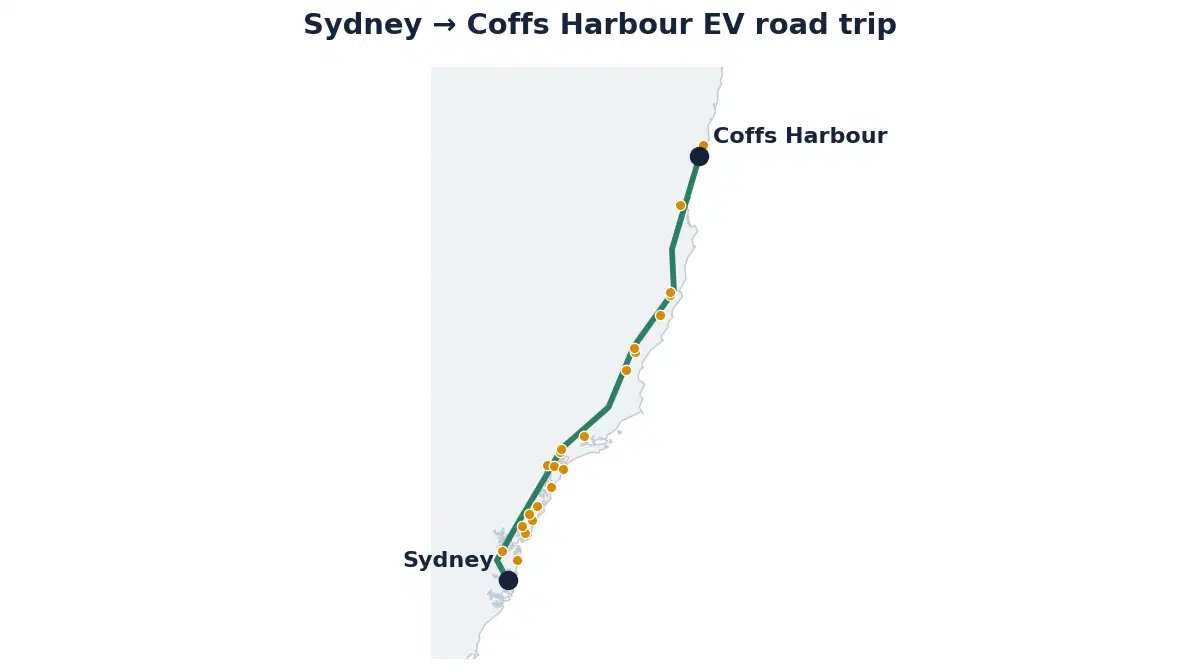
Coffs Harbour is one of the classic summer drives out of Sydney: the beaches, the Jetty, the Big Banana and the hinterland behind them. It’s about 530 km up the M1 Pacific Motorway and Pacific Highway, and in an EV it’s one of the easier long drives in the country, with fast chargers in most towns along the way. The questions worth answering before you go are where to stop, how to cope with the school-holiday crowds, and what to do if you’re caught low. Here are all three, with the charger data drawn live from Open Charge Map.
How many stops will your EV need?
2 charging stops
Estimated from about 353 km of real-world range: leave at 90%, arrive with 15% in reserve, charge to 80% on the road. Highway speeds, cold weather and hills all cut range, so treat this as a planning estimate.
Showing a typical 60 kWh EV. Pick your car above for your own estimate.
Can you drive an EV from Sydney to Coffs Harbour?
Yes, comfortably. It’s roughly 530 km, about six hours of driving without stops, up the M1 Pacific Motorway and the Pacific Highway (A1). As of October 2026 the corridor is densely charged. Chargefox, Evie, NRMA, Tesla, bp pulse and Ampol all run fast or ultra-rapid sites between the Central Coast and Coffs Harbour.
For most EVs that’s one or two charging stops. Chargers sit close together from the Central Coast to Newcastle. North of the Hunter the towns spread out, yet stops are still close enough that you can pick them for food and rest rather than range.
Fast-charging stops, Sydney → Coffs Harbour
The DC fast-charging stops along the corridor, north-bound, drawn live from Open Charge Map:
The first stretch is the same drive as our Sydney to Newcastle guide. There’s plenty of charging on the Central Coast around Tuggerah and Lake Haven, and near Newcastle at Cameron Park and Raymond Terrace (our Newcastle charging guide has more). North of the Hunter, the main stops in the list are Karuah, Nabiac, Taree, Kew, Port Macquarie (Thrumster) and Macksville. The last stop in the list is at North Boambee Valley, on the southern side of Coffs Harbour.
You pay through each network’s app: Chargefox, Evie, NRMA, bp pulse, Ampol AmpCharge or Tesla. Some of the Tesla Superchargers on this route are open to other brands through the Tesla app and some are still Tesla-only, so check the app before you count on one. The kW figure in the list is each site’s top speed. Your own car’s limit decides how fast it actually charges.
Carrying on north? This drive is the first part of our Sydney to Brisbane route.
How to plan your stops
Two patterns work well:
- One stop. Leave Sydney full and charge around Nabiac or Taree, roughly halfway, then run through to Coffs. This suits cars with 400 km or more of real-world range.
- Two stops. Charge around Karuah, about two and a half hours out of Sydney, then again at Kew or Port Macquarie before the final run north.
Whichever you choose, charge to about 80% and move on. The last 20% is the slowest part of any fast charge.
Summer holidays need a bit more care:
- Traffic. Transport for NSW expects the busiest holiday traffic around Christmas, New Year’s Eve and 1–2 January. In December 2025 it warned of significant delays heading north on the M1 and Pacific Highway from 27 December, and it lists Hexham and Coffs Harbour among the known pinch points on the Pacific Highway. Check the Live Traffic NSW app before each leg, and keep some charge in reserve for running the aircon through a long delay on a hot day.
- Charger queues. Over the week between Christmas and New Year in 2022–23, the ABC reported drivers waiting a few hours to charge at a Port Macquarie winery’s Tesla chargers, with similar queues at a Coffs Harbour Tesla site. Many more chargers have opened on the route since then. Even so, arrive at each stop with 20–30% left so a queue is a wait rather than a problem, and have a second site in mind. The stop list shows how close the alternatives are.
- The new Coffs Harbour bypass. Transport for NSW expects the 14 km bypass, from Englands Road in the south to Sapphire in the north, to open in December 2026. It takes through-traffic around the town centre and its traffic lights. If you’re staying in Coffs you’ll still leave the motorway, so follow the signs on the day, as sat-nav maps can take a while to catch up with new roads.
Charging at Coffs Harbour and on the Coffs Coast
Arrive with a buffer and charging in Coffs Harbour is easy. The Chargefox site at North Boambee Valley, on the southern side of town, is the last stop in the list above. If you’d rather charge closer to where you’re staying, the live map shows the other fast and destination chargers around town.
For a week at the beach, overnight charging is the easy option. If your hotel, holiday park or rental has a charger, a night plugged in covers most local driving. If all it has is an ordinary power point, read our guide to charging with an extension cord before you plug in.
The day trip that needs a little planning is the Waterfall Way, inland to Bellingen and Dorrigo. According to NSW National Parks, it leaves the Pacific Highway near Urunga, about 20 minutes south of Coffs Harbour, and from Bellingen it’s around 30 km of winding road along the river and up the escarpment to Dorrigo. Climbing uses noticeably more charge than the same distance on the flat, and you’ll win some back through regenerative braking on the way down. Leave Coffs with a good charge and the round trip is no trouble.
What if you run out of charge between Sydney and Coffs Harbour?
Charge to 80% along the way and a flat battery is unlikely. Stops on this corridor are close together, and the longest charge-free stretch (see the live figure in the stop list above) is well within a single charge for any moderate-range EV. The realistic risk is arriving low at a charger that’s busy or out of action on a holiday weekend.
If you do run flat:
- Get safe. Off the carriageway, hazard lights on, stand well clear of traffic behind the barrier.
- Call roadside assistance. 13 11 11 reaches NRMA in NSW. Tesla drivers can request help in the Tesla app.
- Say it’s an EV. Most EVs need a flatbed tow truck. Saying so up front gets the right truck first time.
- Ask about the options. Usually that’s a tow to the nearest fast charger. Ask whether mobile top-up charging is available where you are.
Before you leave, check that your roadside cover handles out-of-charge events and how far it will tow you. Our complete guide to EV roadside assistance in Australia compares what each provider covers, and the out-of-charge guide walks through what happens after you call.
Frequently asked questions
Can you drive an electric car from Sydney to Coffs Harbour?
Yes, comfortably. It's about 530 km, roughly six hours of driving, up the M1 Pacific Motorway and the Pacific Highway, one of the best-charged corridors in Australia. As of October 2026 there's fast charging on the Central Coast, around Newcastle and at Karuah, Nabiac, Taree, Port Macquarie and Macksville, so most EVs with 300 km or more of real-world range need one or two stops.
How many times do you need to charge an EV from Sydney to Coffs Harbour?
One or two stops for most EVs. With one stop, charge around Nabiac or Taree, roughly halfway. With two, a common split is Karuah and then Kew or Port Macquarie. Charge to about 80% each time and you'll reach Coffs Harbour with a buffer.
What's the longest gap between EV chargers from Sydney to Coffs Harbour?
The gaps get longer north of Newcastle, where the towns are further apart. See the live figure in the stop list below. Even the longest stretch is well within a single charge for any moderate-range EV, so on this route a busy charger on a holiday weekend is a bigger risk than distance.
What happens if my EV runs out of charge between Sydney and Coffs Harbour?
Get safely off the road, hazards on, and call NRMA on 13 11 11. Tell them it's an EV so they send a flatbed tow truck. Depending on your cover, you'll usually be towed to the nearest fast charger. Check that your roadside cover handles out-of-charge events before you leave.