Driving an EV from Melbourne to Adelaide: Charging Stops & What If You Run Flat
Melbourne to Adelaide on the Western Highway used to be a thin EV corridor — it isn't any more. Ultra-rapid charging now covers the goldfields, the Wimmera and the SA towns. Here are the stops and what to do if you run flat.
On this page
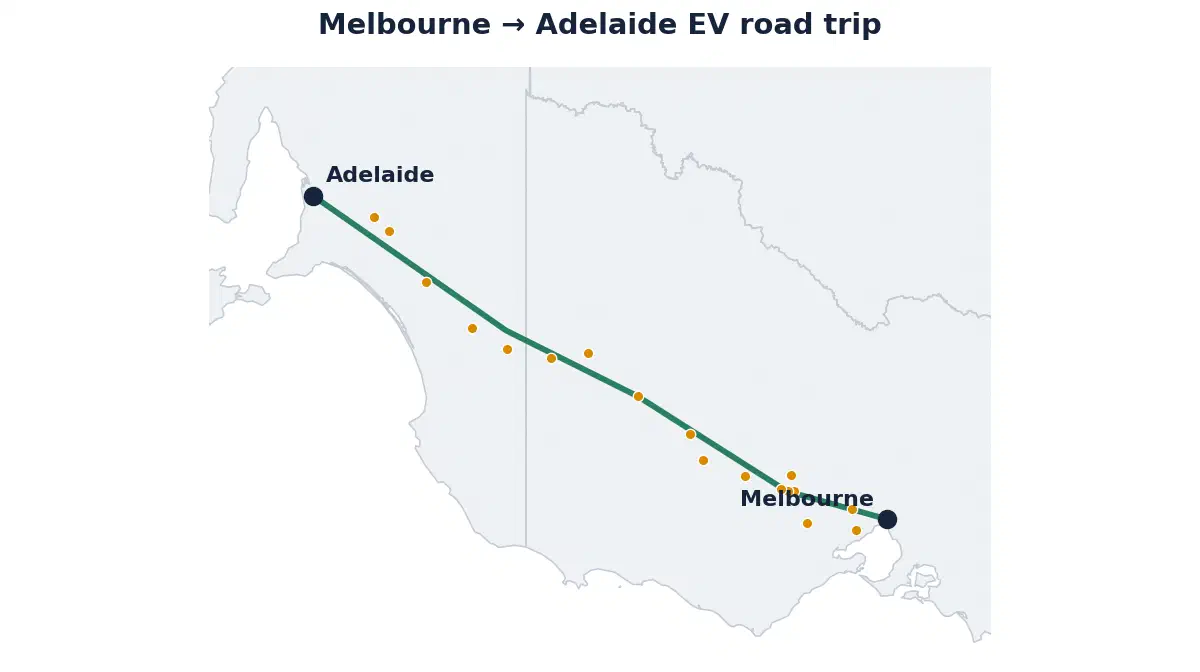
The Melbourne to Adelaide run used to be the drive EV sceptics pointed to — long, with big gaps between towns. That’s no longer true. The Western and Dukes highways have filled in with fast and ultra-rapid charging through the Victorian goldfields, across the Wimmera and through the South Australian towns. It’s now a comfortable two-or-three-stop trip. Here are the stops, and the contingency plan for the quieter stretches where help is further away.
How many stops will your EV need?
3 charging stops
Estimated from about 353 km of real-world range: leave at 90%, arrive with 15% in reserve, charge to 80% on the road. Highway speeds, cold weather and hills all cut range, so treat this as a planning estimate.
Showing a typical 60 kWh EV. Pick your car above for your own estimate.
Can you drive an EV from Melbourne to Adelaide?
Yes. It’s roughly 730 km via the Western Highway (A8) and Dukes Highway (M8/A8), about 8 hours of driving. As of mid-2026 the corridor is well charged: Chargefox, Evie and Tesla run fast or ultra-rapid sites through Ballarat, Ararat, Stawell and Horsham on the Victorian side, and Bordertown, Keith, Tailem Bend and Murray Bridge on the South Australian side, many at 250–350 kW.
For most EVs that means two or three charging stops. The discipline that matters here, more than on the Hume, is topping up before the quieter Wimmera and Mallee stretches rather than after — the towns are smaller and the chargers fewer than on the east-coast corridors.
Fast-charging stops, Melbourne → Adelaide
The DC fast-charging stops along the Western and Dukes highway corridor, drawn live from Open Charge Map:
Pay through the Chargefox, Evie or Tesla app. The ultra-rapid anchors most drivers use are Ballarat, Horsham, Bordertown, Keith and Tailem Bend — each can add a few hundred kilometres in 15–20 minutes to a compatible car.
How to plan your stops
A reliable split is a first proper charge around Ballarat or Ararat, a second around Horsham or Bordertown, and arrive in Adelaide via Murray Bridge with a buffer. If your car has 400 km-plus of real range you can do it in two stops; smaller-battery cars are more comfortable with three.
Two things to watch on this corridor:
- Smaller towns, fewer backups. Unlike the Hume, if a charger is busy or down out here the next option can be 60–80 km on. Arrive at the Wimmera and Mallee stops with margin, not at 5%.
- Heat and headwinds. The open country west of Ballarat can be hot and windy, both of which cut range. Plan on the stops, not the dashboard guess.
What if you run out of charge between Melbourne and Adelaide?
Charge to 80% at the anchor towns and a flat battery is unlikely. The longest charge-free stretch is in the Wimmera between the larger towns — within a single charge for any moderate-range EV (see the stop list above for the live figure). The thing that makes this corridor different from the east coast isn’t the distance between chargers; it’s that if something goes wrong, the nearest town and the nearest tow truck are further away.
If you do run flat:
- Get safe. Off the road, hazard lights on, stand clear of traffic. On quiet highways people misjudge approach speeds — stay well back from the carriageway.
- Call roadside assistance. 13 11 11 reaches RACV in Victoria and RAA once you cross into South Australia. Tesla drivers can request help in the Tesla app.
- Say it’s an EV. Most EVs must be flat-bed towed, not flat-towed — saying so up front gets the right truck first time, which matters more when it’s coming from further away.
- Ask about the options. Usually a tow to the nearest fast charger; ask whether mobile top-up charging reaches where you are.
This is the drive where checking your roadside cover before you leave matters most — confirm it handles out-of-charge events and check the tow distance limit, because out here a tow to the nearest charger can be a long one. Our complete guide to EV roadside assistance in Australia compares what each provider covers, and the out-of-charge guide walks through what happens after you call.
At either end
Charging in town is straightforward at both ends — see our guides to EV charging and roadside assistance in Melbourne and Adelaide. For more routes, see the EV road trips hub.
Frequently asked questions
Can you drive an electric car from Melbourne to Adelaide?
Yes. The Western and Dukes highways are now well covered by fast charging — what used to be a thin EV corridor has filled in with ultra-rapid sites through the Victorian goldfields, the Wimmera and the South Australian towns. As of mid-2026 any EV with around 300 km of real-world range can do the roughly 730 km drive with two or three stops.
How many times do you need to charge an EV from Melbourne to Adelaide?
Most drivers stop two or three times over the ~730 km. Ballarat, Ararat, Stawell and Horsham anchor the Victorian leg, and Bordertown, Keith, Tailem Bend and Murray Bridge cover the South Australian side. Charge to about 80% each time and the gaps are easy.
What's the longest gap between EV chargers from Melbourne to Adelaide?
The longest charge-free stretch is in the Wimmera between the larger towns — see the live stop list below for the current figure. It's within a single charge for any moderate-range EV, but the towns out here are smaller and chargers fewer, so it pays to top up before the quiet stretches rather than after.
How long does it take to drive an EV from Melbourne to Adelaide?
The drive is about 8 hours over roughly 730 km via the Western Highway. Add around an hour across two or three charging stops, so budget a full day. The Princes Highway coastal route via the Coorong is longer and more scenic but has sparser fast charging.
What happens if my EV runs out of charge between Melbourne and Adelaide?
Get safely off the road, hazards on, and call roadside assistance — 13 11 11 reaches RACV in Victoria and RAA once you cross into South Australia. Tell them it's an EV so they send a flatbed. Out here towns are further apart, so confirm before you leave that your roadside cover handles out-of-charge events and how far it will tow you.