Driving an EV on the Great Ocean Road: Charging Stops & What If You Run Flat
The Great Ocean Road is the Australian EV drive that needs the most planning — fast charging is good to Torquay, then sparse along the coast. Charge full at Geelong, and here's what to do if you run flat on a winding, remote road.
On this page
The Great Ocean Road is one of the world’s great drives — and the Australian EV trip that needs the most thought. Fast charging is excellent as far as Geelong and Torquay, then thins out fast along the coast through Lorne and Apollo Bay, where you’re mostly relying on slower destination charging. Add a winding, hilly road that uses more range than the map suggests, and patchy mobile coverage, and the contingency plan matters more here than on any highway. Here’s how to do it without range stress.
How many stops will your EV need?
No charging stop needed
Estimated from about 353 km of real-world range: leave at 90%, arrive with 15% in reserve, charge to 80% on the road. Highway speeds, cold weather and hills all cut range, so treat this as a planning estimate.
Showing a typical 60 kWh EV. Pick your car above for your own estimate.
Can you drive an EV on the Great Ocean Road?
Yes, with a bit of planning. From Melbourne it’s about 240 km to Apollo Bay via Geelong and Torquay, but distance isn’t the issue — charger spacing is. As of mid-2026, fast and ultra-rapid charging is strong through Geelong, Waurn Ponds and Torquay (Jan Juc). Past Torquay, the coastal road has mostly slower AC charging at towns and accommodation, with limited fast charging.
The winning strategy is simple: arrive on the coast with a full or near-full battery, charged at Geelong or Waurn Ponds, and top up overnight at your accommodation rather than hunting for a fast charger mid-drive. Treat the Great Ocean Road as a destination you charge for, not on.
Charging stops, Melbourne → the Great Ocean Road
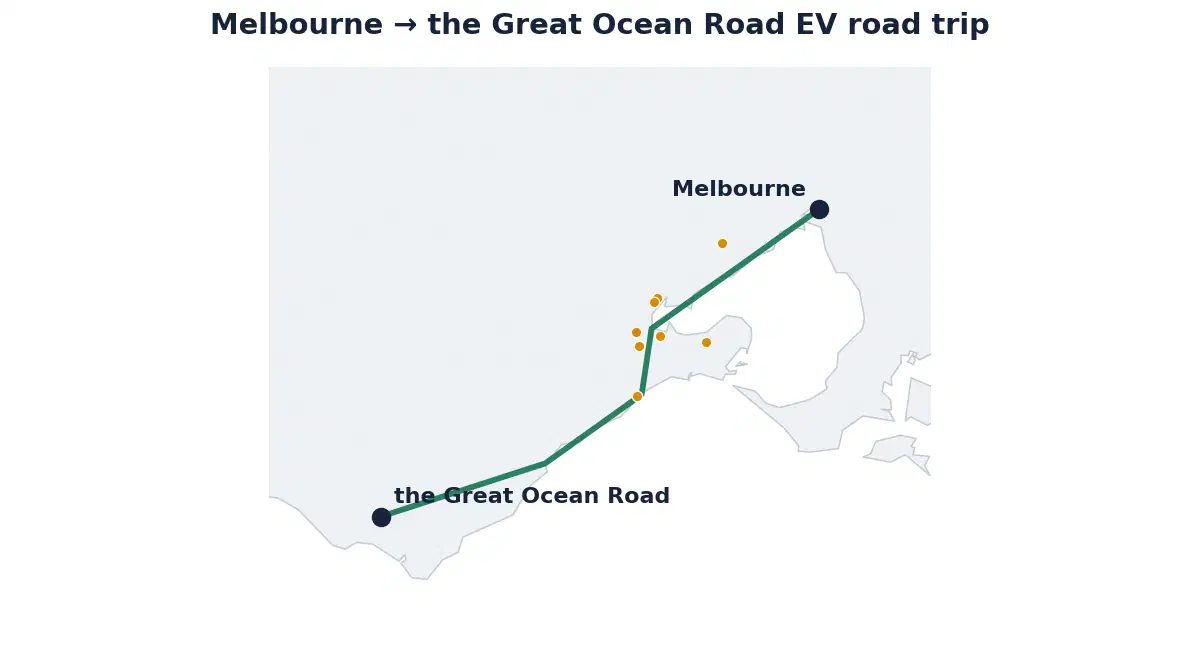
The DC fast-charging stops from Melbourne out to the start of the coast, drawn live from Open Charge Map:
Pay through the Chargefox, Evie or Tesla app. Waurn Ponds and the Geelong sites, plus Jan Juc at Torquay, are your last reliable fast charging before the coast gets sparse — fill up here. For charging once you’re back in town, see our guide to EV charging and roadside assistance in Geelong.
How to plan it
- Leave Geelong/Torquay full. The single most useful habit on this trip. From a full battery near Torquay, even a modest EV reaches Apollo Bay and back to fast charging comfortably — but only if you start full, because the hills and corners eat range.
- Use destination charging. Most Great Ocean Road accommodation and many town car parks have AC charging. It’s slow, but overnight is plenty. Book somewhere with a charger if you can, and check it before you arrive.
- The road costs more range than the distance. Constant climbing, descending and cornering uses more energy per kilometre than a flat highway. Don’t plan to the dashboard estimate — plan to arrive with a real buffer.
What if you run out of charge on the Great Ocean Road?
This is the route where the contingency plan earns its keep. Fast chargers and tow trucks are both further away than on a highway, the road is narrow and winding, and mobile coverage is patchy in places — so prevention beats rescue. The longest fast-charging gap is the coastal stretch past Torquay (see the live figure above); the practical rule is to fill up before you head down the coast and rely on destination charging, not roadside top-ups.
If you do run flat:
- Get safe — carefully. The Great Ocean Road is narrow, winding and busy with tourists. Find a genuine pull-off or lookout rather than stopping on a bend; hazard lights on, and get well clear of the road.
- Note your last signal. If coverage is dropping, the last town or lookout with bars is the place to make the call. RACV is reachable on 13 11 11; Tesla drivers can use the Tesla app.
- Say it’s an EV and give a clear location. Most EVs need a flatbed, and on a road like this an accurate location (nearest town, lookout name or marker) saves a lot of time.
- Expect a longer wait, and a tow rather than a top-up. Mobile charging is unlikely to reach the coast quickly, so the realistic outcome is a flatbed to the nearest fast charger at Torquay or Geelong.
Before you go, check your roadside cover handles out-of-charge events and what its tow distance limit is — on the Great Ocean Road a tow back to fast charging can be a long one. Our complete guide to EV roadside assistance in Australia compares providers, and the out-of-charge guide covers what happens after you call.
More Victorian drives
Charging in Geelong and Melbourne is easy — see our guides to Geelong and Melbourne. For more routes, including the run west to Adelaide, see the EV road trips hub.
Frequently asked questions
Can you drive an electric car on the Great Ocean Road?
Yes, but it needs more planning than a highway run. Fast charging is good as far as Geelong and Torquay, then becomes sparse and slower along the coast through Lorne and Apollo Bay. The smart approach is to arrive on the coast with a full or near-full battery, charged at Geelong or Waurn Ponds, and rely on slower destination charging at your accommodation.
Where do you charge an EV on the Great Ocean Road?
Your last reliable fast charging is around Geelong, Waurn Ponds and Torquay (Jan Juc). Past there, charging along the coast is mostly slower AC at towns like Lorne and Apollo Bay and at accommodation. Charge to full before Torquay and plan to top up overnight rather than mid-drive. See the live stop list below.
What's the longest gap between chargers on the Great Ocean Road?
The longest fast-charging gap is the coastal stretch past Torquay toward Apollo Bay — see the live figure in the stop list below. The road is also winding and hilly, which uses more energy than the distance suggests, so treat your last fast charge near Torquay as the point to fill up.
What happens if my EV runs out of charge on the Great Ocean Road?
Get safely off the road — the Great Ocean Road is narrow, winding and busy, so finding a safe spot matters. Hazards on, and call RACV on 13 11 11; mobile coverage can be patchy, so note where you last had signal. Tell them it's an EV so they send a flatbed. Because help and chargers are further away here, plan to arrive with a buffer rather than relying on rescue.