Driving an EV from Hobart to Launceston: Charging Stops & What If You Run Flat
Hobart to Launceston is about 198 km up the Midland Highway — doable on a single charge for many EVs, with Campbell Town as the natural top-up point. Here's how to plan the stops and what to do if you run flat in the Tasmanian Midlands.
On this page
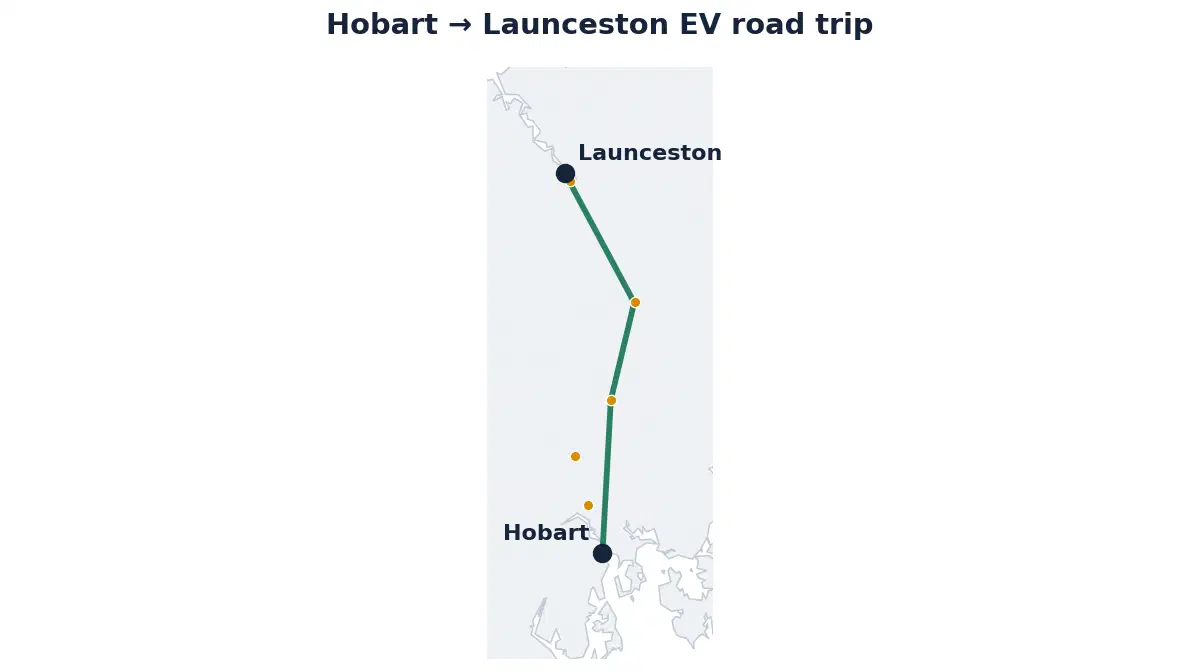
Hobart to Launceston is a straightforward EV drive, but Tasmania has its own quirks: a younger charging network than the mainland capitals, and cooler temperatures that trim range — especially across the central plateau in winter. At about 198 km up the Midland Highway, it’s comfortably within a single charge for many EVs, and a one-stop trip at Campbell Town for the rest. Here’s what you need to know before you leave.
How many stops will your EV need?
No charging stop needed
Estimated from about 353 km of real-world range: leave at 90%, arrive with 15% in reserve, charge to 80% on the road. Highway speeds, cold weather and hills all cut range, so treat this as a planning estimate.
Showing a typical 60 kWh EV. Pick your car above for your own estimate.
Can you drive an EV from Hobart to Launceston?
Yes, easily enough — with some Tasmanian caveats. It’s roughly 198 km, about 2.5 hours, straight up the Midland Highway. Modern EVs with 350 km-plus of real-world range can do it on a single charge from Hobart, arriving in Launceston with a comfortable buffer.
Smaller-battery cars should plan one stop at Campbell Town, the classic midlands halfway stop, roughly the midpoint of the route. The charging network in Tasmania is younger and sparser than in mainland capital corridors, so the practical advice is to top up at the main towns — Brighton, Oatlands, and Campbell Town — rather than relying on finding something in between.
The other factor is temperature. Tasmania runs cooler than the mainland, and the central plateau in winter can be genuinely cold. Cold weather reduces battery capacity, which means real-world range is lower than the figures your car shows in warmer conditions. In winter, leave Hobart with a full charge and build in a margin.
Fast-charging stops on the Midland Highway
The DC fast-charging stops along the corridor, drawn live from Open Charge Map:
The anchor towns to look for are Brighton (just north of Hobart), Oatlands (midlands), and Campbell Town — the natural top-up stop about halfway. After Campbell Town it’s a clear run north into Launceston.
How to plan your stops
If your car comfortably does 300 km-plus of real range in mild conditions, leave Hobart at 90–100% and you should reach Launceston with 20–30% to spare. If you’re in a smaller EV, it’s winter, or you’re carrying a full load, stop at Campbell Town for 15–20 minutes and the rest of the drive is relaxed.
Because the Tasmanian network is less dense than the mainland, don’t count on an opportunistic top-up between the main towns. Check the live stop list above before you leave, note which sites are working, and treat Campbell Town as your insurance stop even if your range looks fine when you leave Hobart.
Pre-heat the cabin while still plugged in at home if your car supports it — this saves meaningful range on cold mornings before you even reach Brighton.
What if you run out of charge between Hobart and Launceston?
The longest charge-free stretch is through the central Midlands (see the live figure in the stop list above). With Campbell Town as a reliable top-up, running flat is unlikely if you’ve planned ahead. The simple rule is to leave Hobart with a full charge and stop at Campbell Town if there’s any doubt.
If you do run flat:
- Get safe. Move off the road if possible, hazard lights on, stay behind the barrier and clear of passing traffic.
- Call RACT. 13 11 11 reaches RACT across Tasmania. Tesla drivers can also request help through the Tesla app.
- Say it’s an EV. Most EVs need a flatbed, not a conventional tow — telling them upfront gets the right truck first time.
- Ask for the nearest charger. Most likely a tow to Campbell Town or into Launceston; ask whether a mobile top-up service is available in your area.
It’s worth confirming your roadside cover handles out-of-charge events before you leave — see our complete guide to EV roadside assistance in Australia, and the out-of-charge guide for what to expect after you call.
Heading further?
Continuing to Devonport for the Spirit of Tasmania, or exploring the rest of the island? See the EV road trips hub for more routes and our EV roadside assistance guide for Tasmania-specific coverage details.
Where to sleep and charge
Frequently asked questions
Can you drive an EV from Hobart to Launceston?
Yes. It's about 198 km up the Midland Highway — roughly 2.5 hours. Most modern EVs with 350 km-plus of real-world range can do it on a single charge from Hobart, and cars with smaller batteries should plan one stop, most conveniently at Campbell Town, the classic midlands halfway point.
Where do you charge an EV between Hobart and Launceston?
The main charging opportunities are at the anchor towns along the Midland Highway: Brighton, Oatlands, and Campbell Town. The charging network in Tasmania is younger and sparser than on the mainland, so the practical advice is to top up at the main towns rather than rely on anything in between. See the live stop list below for current locations and speeds.
What's the longest gap without a charger between Hobart and Launceston?
The longest charge-free stretch is through the central Midlands — see the live figure in the stop table below. As a rough guide it's around the Campbell Town corridor; the exact gap shifts as new chargers are added. It's within a single charge for any moderate-range EV, but Tasmania's colder climate, particularly in winter on the central plateau, means leaving Hobart with a full charge and adding a margin is good practice.
Does cold weather affect EV range on the Midland Highway?
Yes, meaningfully. Tasmania runs cooler than mainland capitals, and the central plateau in winter can be genuinely cold. Cold temperatures reduce battery capacity, so real-world range is lower than warm-weather figures. In winter, leave Hobart at 90–100%, pre-heat the cabin while plugged in if your car supports it, and build in a stop at Campbell Town even if your range says you don't strictly need one.
What happens if my EV runs out of charge on the Midland Highway?
Get safely off the road, hazards on, and call roadside assistance — 13 11 11 reaches RACT across Tasmania. Tell them it's an EV: most EVs need a flatbed tow rather than a conventional hook, so saying so up front gets the right vehicle first time. You'll typically be towed to the nearest fast charger, which is likely Campbell Town or Launceston. Confirm your roadside cover handles out-of-charge events before you leave.