Driving an EV from Hobart to Cradle Mountain: Charging Stops & What If You Run Flat
Hobart to Cradle Mountain is about 320 km: the well-charged Midland and Bass highways, then a winding climb onto the plateau. Here are the charging stops, how to handle the climb and the cold, charging at the mountain, and what to do if you run flat.
On this page
Cradle Mountain is one of Tasmania’s best-loved national parks, and it’s a very doable EV drive from Hobart as long as you respect the last hour. The first three hours run on the island’s best-charged roads, the Midland and Bass highways. Then you leave the highway for narrow, winding roads that climb onto a plateau where it can be cold in any month. Here’s how to plan it as of October 2026.
How many stops will your EV need?
1 charging stop
Estimated from about 353 km of real-world range: leave at 90%, arrive with 15% in reserve, charge to 80% on the road. Highway speeds, cold weather and hills all cut range, so treat this as a planning estimate.
Showing a typical 60 kWh EV. Pick your car above for your own estimate.
Can you drive an EV from Hobart to Cradle Mountain?
Yes. It’s roughly 320 km and a little over four hours of driving: north up the Midland Highway, west along the Bass Highway past Westbury and Deloraine, then via Sheffield to Cradle Mountain Road. With a rest stop, the Cradle Mountain Hotel suggests allowing four and a half hours.
For most EVs that’s one or two charging stops. The quickest route bypasses Launceston on the Illawarra Road, so the city’s chargers are a short detour. The planning point is the end: Elizabeth Town is the last fast charger before you leave the highway, and from there it’s a bit over an hour of winding, hilly driving that finishes with a long climb to the visitor centre.
Fast-charging stops, Hobart → Cradle Mountain
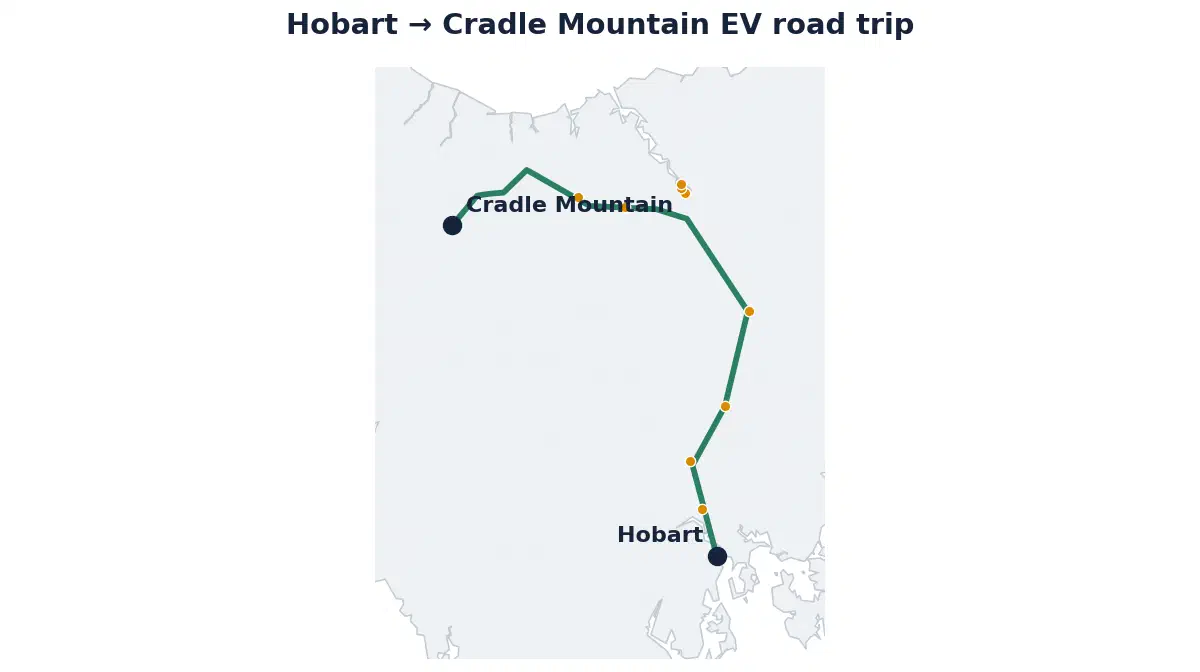
The DC fast-charging stops along the corridor, drawn live from Open Charge Map:
The anchors most drivers use are Campbell Town (Evie, 350 kW, right on the Midland Highway), Westbury (Evie, 350 kW, at the IGA just off the Bass Highway) and Elizabeth Town (NRMA, on Christmas Hills Road just off the Bass Highway, across from the raspberry farm café). Closer to Hobart, Bennett’s Petroleum runs a 50 kW charger at the Mood Food service centre in Kempton, and Electric Highway Tasmania has an 80 kW site at Oatlands. If you do go into Launceston, Chargefox’s 350 kW charger at Kings Meadows is on the city’s southern edge.
You’ll want three or four apps. Evie runs Westbury and Campbell Town. Chargefox covers Kings Meadows and the Electric Highway Tasmania sites, which the NRMA has owned since September 2025; as of October 2026 the NRMA says tap-and-pay on those chargers is temporarily unavailable, so use the app. The NRMA site at Elizabeth Town works through the My NRMA app or Chargefox, and Kempton uses Bennett’s Smart Charge app. Our guide to paying for public charging has the details.
How to plan your stops
Leave Hobart at 90–100%. A comfortable plan is a charge at Campbell Town in the Midlands, then a top-up to 80–90% at Westbury or Elizabeth Town before you leave the highway. Cars with 400 km-plus of real range can sometimes skip Campbell Town. Don’t skip the Bass Highway top-up, though: it’s your buffer for the climb, the cold and a day of driving around the park.
Campbell Town is a two-stall site that almost everyone uses, so it can queue on busy summer days. Oatlands is a good alternative heading north, especially if your car can’t take full advantage of a 350 kW charger anyway. On cold mornings, pre-heat the cabin while the car is still plugged in. Our guide to how far an EV can go explains how hills and cold eat into range.
The climb onto the plateau
After Sheffield the roads narrow and wind. The route drops to the Forth River near Cethana and then climbs steadily onto the plateau. Cradle Valley sits at about 900 metres above sea level (the Bureau of Meteorology lists its old Waldheim weather station there at 903 m). Climbing uses noticeably more energy than flat highway driving, and you’ll get some of it back through regenerative braking on the way down, as the Tasmanian Government’s EV guidance points out.
Weather is the other variable. The Parks and Wildlife Service says snow, rain, wind and sun are all possible at any time of year in Tasmania’s alpine areas, and the Cradle Mountain Hotel warns of cold and possibly snow in any month. Cold reduces range and can slow charging. Discover Tasmania tells EV drivers to add a 20% buffer for cold weather and mountain roads, and this is the drive to take it on. PWS also asks drivers to avoid driving in its reserves at night where possible, because wildlife is on the roads.
Charging at Cradle Mountain
Plan to charge overnight where you sleep. Discover Tasmania notes that several Cradle Mountain hotels offer chargers, including Discovery Resorts and Cradle Mountain Wilderness Village, and the Cradle Mountain Hotel says its Tesla charging station works with other EVs too. Staying somewhere else, such as Peppers Cradle Mountain Lodge? Ask about charging when you book. Discover Tasmania warns that accommodation with EV charging books up quickly in high season.
The visitor centre, where everyone parks for the shuttle, has a single AC charger in its car park. With one plug for a busy car park, treat it as a bonus. The faster option is the Electric Highway Tasmania site in the Cradle Mountain Hotel car park, which appears as the Cradle Mountain stop in the table above: the Tasmanian Government’s ChargeSmart map lists a fast charger at Cradle Mountain, and EV drivers report four stalls of up to 80 kW, open to any EV through the Chargefox app. It’s the only fast charger up on the plateau, so don’t plan your return on it being free the moment you want it. Sheffield, the mural town on the way up, has a slower charger at its visitor information centre (about 24 kW, through the Chargefox app): handy for a top-up over coffee, too slow to be your main stop. Check the Chargefox app or PlugShare for what’s working around Cradle Valley before you set off.
Parking, the shuttle and park passes
You can’t drive to Dove Lake during the day. The Parks and Wildlife Service runs a shuttle bus from the Cradle Mountain Visitor Centre seven days a week, stopping at the Interpretation Centre and Ranger Station, Snake Hill, Ronny Creek and Dove Lake; the ride to Dove Lake takes about 20 minutes. Private cars can’t enter the park during shuttle hours, which run 8.10am to 7pm from late December to February (as of October 2026). Campervans, motorhomes, caravans and trailers can’t use Dove Lake Road at any time.
You’ll also need a parks pass. The standard Daily Pass doesn’t cover Cradle Mountain. The Icon Daily Pass, for Cradle Mountain only, includes the shuttle. The Holiday Pass covers all Tasmanian national parks for up to two months for one vehicle and up to eight people, but not the shuttle, so adults without an Icon pass need a shuttle ticket ($15.50 as of October 2026, valid for 72 hours). Under-18s ride free.
What if you run out of charge between Hobart and Cradle Mountain?
On the highways a flat battery is unlikely. The longest stretch without a listed fast charger is the run from the Bass Highway up to Cradle Mountain (see the live figure in the stop list above), and it’s the stretch that climbs. Leave Westbury or Elizabeth Town with a generous charge and it’s a non-event.
Mobile coverage is the other reason for care up there. The Cradle Mountain Hotel says only Telstra and Optus work at Cradle Mountain, with numerous black spots because of the terrain, and Discover Tasmania recommends downloading offline maps before you go.
If you do run flat:
- Get safe. Off the road, hazard lights on, stand clear of traffic. On narrow mountain roads, get the car as far off the road as you safely can.
- Call roadside assistance. 13 11 11 reaches RACT in Tasmania. Tesla drivers can use the Tesla app.
- Say it’s an EV. Most EVs must be flat-bed towed, and saying so up front gets the right truck first time.
- Ask about the options. Usually a tow to the nearest fast charger; ask whether mobile top-up charging can reach you.
Confirm your roadside cover handles out-of-charge events and check the tow distance limit before you leave, because it’s a long way back to the highway from the plateau. Our RACT EV roadside page covers the Tasmanian club, our complete guide to EV roadside assistance in Australia compares providers, and the out-of-charge guide explains what happens after you call.
Heading further?
Coming off the Spirit of Tasmania instead? Cradle Mountain is about 80 km from Devonport: our Spirit of Tasmania and Devonport to Hobart page covers the ferry rules and where to charge first. For the cities, see our Hobart and Launceston charging guides, or the EV road trips hub for more routes.
Frequently asked questions
Can you drive an electric car from Hobart to Cradle Mountain?
Yes. It's about 320 km, a little over four hours of driving, up the Midland Highway, west along the Bass Highway and then into the hills via Sheffield to Cradle Mountain Road. Fast chargers on the two highways make it a one- or two-stop drive for most EVs. Elizabeth Town is the last fast charger before you leave the highway, and the final hour ends with a long climb to around 900 metres, so leave with a generous charge.
How many times do you need to charge an EV from Hobart to Cradle Mountain?
Most EVs stop once or twice. Campbell Town in the Midlands is the natural first charge, then a top-up to 80–90% at Westbury or Elizabeth Town on the Bass Highway sets you up for the climb. Plan to charge overnight at your accommodation at the mountain so you start the next day full.
What's the longest gap between EV chargers from Hobart to Cradle Mountain?
The longest stretch without a listed fast charger is the final run from the Bass Highway up to Cradle Mountain: see the live figure in the stop list below. It climbs most of the way and the plateau can turn cold in any month, so treat Westbury or Elizabeth Town as your last proper top-up and arrive with a buffer.
What happens if my EV runs out of charge on the way to Cradle Mountain?
Get safely off the road, hazards on, and call roadside assistance: 13 11 11 reaches RACT in Tasmania. Tell them it's an EV so they send a flatbed. The Cradle Mountain Hotel says only Telstra and Optus work at Cradle Mountain, with black spots in the hills, so don't count on a signal on the mountain roads. Confirm your cover handles out-of-charge events before you leave.