Taking an EV on the Spirit of Tasmania: Devonport to Hobart Charging Stops
Bringing your EV across on the Spirit of Tasmania? There's no charging on board, so you charge in Geelong and roll off in Devonport early in the morning. From there it's about 280 km to Hobart with one easy stop at Campbell Town. Here are the ferry's EV rules, the charging stops and what to do if you run flat.
On this page
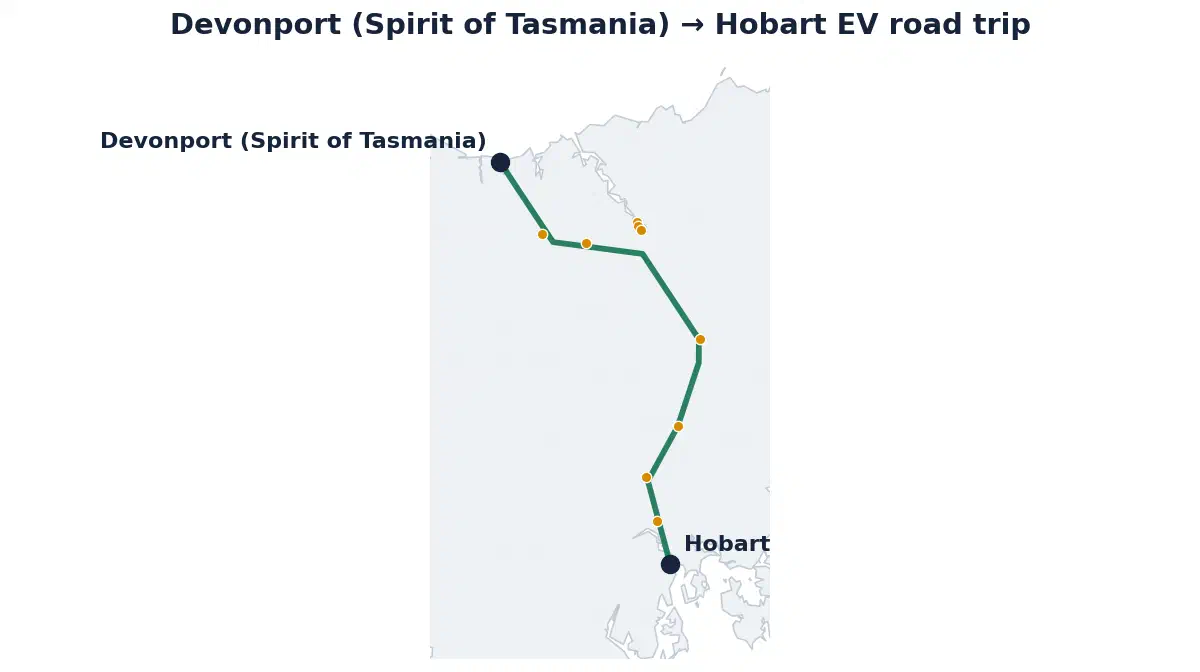
If you’re bringing your EV across Bass Strait on the Spirit of Tasmania, Devonport is where the Tasmanian part of the holiday starts. The drive south to Hobart is about 280 km on the island’s best-charged road, so the charging itself is easy. Two things are worth planning: the ferry, where you can’t plug in, and the first hour after you roll off in the early morning. Here’s how it all works as of October 2026.
How many stops will your EV need?
1 charging stop
Estimated from about 353 km of real-world range: leave at 90%, arrive with 15% in reserve, charge to 80% on the road. Highway speeds, cold weather and hills all cut range, so treat this as a planning estimate.
Showing a typical 60 kWh EV. Pick your car above for your own estimate.
Can you drive an EV from Devonport to Hobart?
Yes, and it’s a relaxed one. It’s roughly 280 km, about three and a half hours of driving: south-east along the Bass Highway towards Launceston, then south down the Midland Highway. Both are part of National Highway 1.
For most EVs that’s one charging stop, usually Campbell Town in the Midlands. One quirk: the quickest route bypasses Launceston on the Illawarra Road, so using the city’s chargers means a short detour.
Fast-charging stops, Devonport → Hobart
The DC fast-charging stops along the corridor, drawn live from Open Charge Map:
One row needs explaining. The 250 kW figure at Devonport is Tesla’s Supercharger on the Esplanade in East Devonport, at the terminal Spirit is moving out of on 24 October, and the Tasmanian Government’s EV guidance notes it’s for Tesla drivers only. Tesla owners should check its status in the Tesla app before counting on it. Everyone else’s fast charger in town is Electric Highway Tasmania’s unit in the Best Street multi-storey car park in central Devonport, about 5 km from the terminal across the Mersey.
South of Devonport, the anchors are NRMA’s site at Elizabeth Town (on Christmas Hills Road just off the Bass Highway, across from the raspberry farm café), Evie at Westbury (at the IGA, just off the highway), Chargefox’s 350 kW charger at Kings Meadows on Launceston’s southern edge, Evie again at Campbell Town, Electric Highway Tasmania’s 80 kW site at Oatlands, and a 50 kW charger run by Bennett’s Petroleum at the Mood Food service centre in Kempton.
Set the apps up before you sail. Chargefox covers Kings Meadows and every Electric Highway Tasmania site; the NRMA has owned that network since September 2025 and says, as of October 2026, that its tap-and-pay readers are temporarily unavailable. Evie runs Westbury and Campbell Town, the NRMA site works through the My NRMA app or Chargefox, and Kempton uses Bennett’s Smart Charge app or a Bennett’s Z Card. See our guide to paying for public charging.
How to plan your stops
The planning starts in Victoria. Charge to 80–90% in Geelong before you check in, because you can’t plug in on board and you’ll be driving off in Devonport around dawn. The six-stall Tesla Supercharger at Corio, about 6 km from the terminal, takes other EVs as well as Teslas; our Geelong guide covers the rest of the city’s chargers. Check-in closes strictly 45 minutes before departure, so allow time for that charge.
Once you’re in Tasmania, a reliable split is a short top-up at Elizabeth Town or Westbury if you need one, then a proper charge at Campbell Town, then an easy run into Hobart. Came off the ship with plenty in the battery? Go straight to Campbell Town.
Campbell Town is a two-stall site that nearly everyone uses, so on busy summer days you may wait. Oatlands, the next charger south, is a sensible backup. On cool mornings leave a margin: the Tasmanian Government’s EV guidance notes that cold trims range and can slow charging.
Taking your EV on the Spirit of Tasmania
As of October 2026, Spirit of Tasmania’s conditions for electric vehicles are short and practical. They cover hybrids and plug-in hybrids as well as fully electric cars:
- Declare it when you book. You have to tell Spirit you’re travelling with an EV at the time of booking.
- Have enough charge to drive on and off. Spirit’s conditions don’t set a percentage. The requirement is simply enough charge to embark and disembark.
- No charging on board. Charging EVs on board is prohibited, and Spirit’s FAQs confirm the ships have no charging facilities or power outlets for EVs.
- Expect an inspection. Crew may inspect your car and mark it as an EV, and EVs go on designated decks and spaces. Tell the crew about any warning lights or messages, or if the car has been in a collision.
- Check for recalls. Your EV must not be under a recall. Spirit can refuse to load an EV with an indicated battery fault or one that has been in a collision.
Neither terminal lists EV charging among its facilities on Spirit’s website, so do your charging before you reach Geelong and after you leave the Devonport terminal.
When you arrive, and where to charge first in Devonport
The fleet is changing this season. The new ships, Spirit of Tasmania IV and V, take over from 31 October 2026 after a planned break in sailings in the last week of October. Spirit says the new ships will start with night sailings only, and it will look at adding day sailings if demand outgrows their extra capacity. From 24 October the Devonport terminal moves to Spirit Quay at 112 Wright Street, East Devonport.
As of October 2026, the timetable has the ship leaving Geelong at 6.45pm and reaching Devonport at 6.00am, changing to 6.30am from 8 December through the summer. There’s a wake-up call 45 minutes before disembarkation, and Spirit says unloading is usually finished within 90 minutes of the ship tying up. So you’ll be driving out of the terminal somewhere between dawn and breakfast, with whatever charge you had in Geelong.
Where to charge first depends on what’s left:
- Plenty left: skip Devonport and head for Elizabeth Town, Westbury or straight to Campbell Town.
- Running low: use the Best Street car park charger in central Devonport, a few minutes from the terminal, or NRMA’s site at Elizabeth Town, roughly half an hour down the Bass Highway.
- Driving a Tesla: check the Devonport Supercharger in the Tesla app first, and fall back on the options above.
Heading to Cradle Mountain before Hobart? It’s about 80 km from Devonport. Our Hobart to Cradle Mountain page covers charging at the mountain.
What if you run out of charge between Devonport and Hobart?
Charge at the anchor towns and a flat battery is unlikely. The longest charge-free stretch is on the Midland Highway between Launceston and Campbell Town (see the live figure in the stop list above), and it’s longer if you take the Illawarra Road bypass and skip Launceston’s chargers. Top up at Westbury or Elizabeth Town and either way is comfortable. The bigger risk is starting the day with a battery you ran down in Victoria.
If you do run flat:
- Get safe. Off the road, hazard lights on, and stand well clear of traffic.
- Call roadside assistance. 13 11 11 reaches RACT in Tasmania. Tesla drivers can use the Tesla app.
- Say it’s an EV. Most EVs must be flat-bed towed, and saying so up front gets the right truck first time.
- Ask about the options. In Tasmania that’s usually a tow to the nearest fast charger. Ask whether mobile top-up charging can reach you.
If your roadside cover comes from a mainland club or your insurer, check before you sail how it works in Tasmania and how far it will tow. Our RACT EV roadside page explains what the Tasmanian club does and doesn’t publish about EVs, our complete guide to EV roadside assistance in Australia compares providers, and the out-of-charge guide covers what happens after you call.
At the Hobart end
Hobart has fast chargers across the suburbs: see our Hobart charging guide. Going home, the ferry rule applies in reverse, so reach the Devonport terminal with enough charge to drive off in Geelong and find a charger. Our Hobart to Launceston page and the EV road trips hub cover more routes.
Frequently asked questions
Can you drive an EV from Devonport to Hobart?
Yes. It's about 280 km, roughly three and a half hours, along the Bass and Midland highways (National Highway 1), with fast chargers at Elizabeth Town, Westbury, Launceston, Campbell Town, Oatlands and Kempton. Most EVs need one stop. If you're arriving on the Spirit of Tasmania, there's no charging on board, so charge up in Geelong before you sail.
How many times do you need to charge an EV from Devonport to Hobart?
Usually once. Campbell Town, roughly halfway, has Evie's 350 kW chargers right on the Midland Highway. If you roll off the ferry with a low battery, add a short top-up at Elizabeth Town or Westbury first. Long-range cars that leave Devonport well charged may not need to stop at all, but Campbell Town is cheap insurance.
What's the longest gap between EV chargers from Devonport to Hobart?
The longest charge-free stretch is on the Midland Highway between Launceston and Campbell Town: see the live figure in the stop list below. It's longer if you take the Illawarra Road bypass and skip Launceston's chargers. Either way it's within a single charge if you topped up at Westbury or Elizabeth Town.
What happens if my EV runs out of charge between Devonport and Hobart?
Get safely off the road, hazards on, and call roadside assistance: 13 11 11 reaches RACT in Tasmania. Tell them it's an EV so they send a flatbed. In Tasmania a flat EV usually means a tow to the nearest charger, so check before you sail how your own club or insurer covers you on the island, including how far it will tow.