Can You Drive an EV from Darwin to Adelaide? (Stuart Highway, 2026)
As of 2026 the major Stuart Highway towns (Katherine, Tennant Creek, Alice Springs, Coober Pedy) have EV fast chargers, but the long gaps between the NT towns make Darwin to Adelaide a frontier drive. Here's the honest, sourced rundown.
On this page
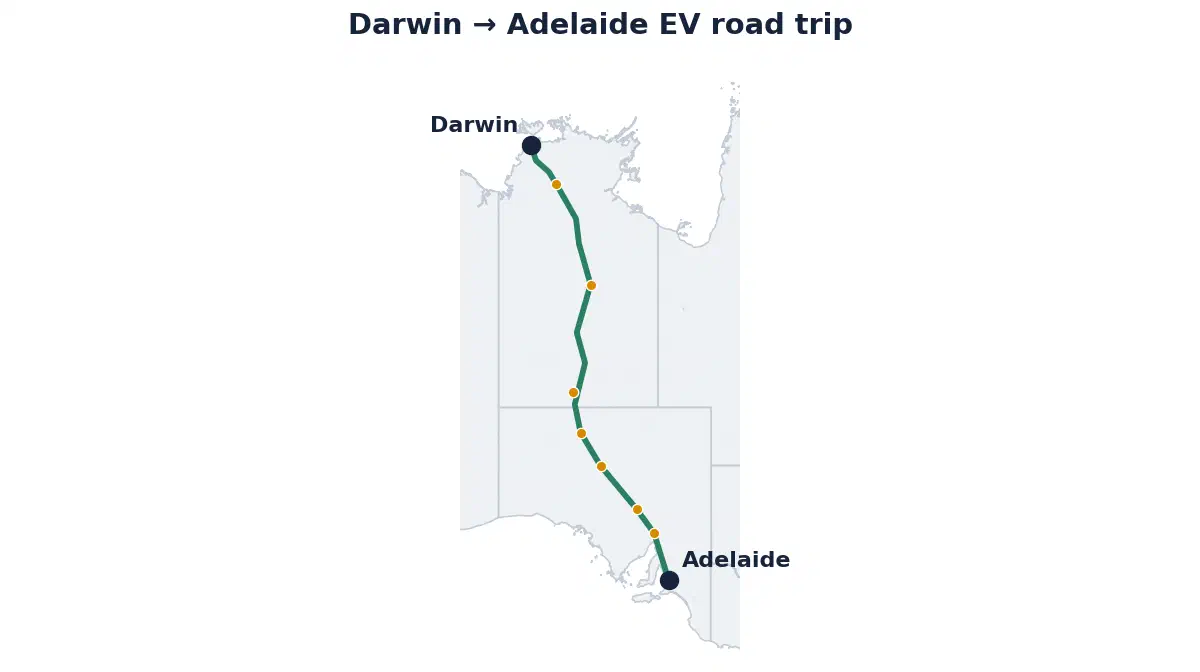
The Stuart Highway — Darwin to Adelaide, roughly 3,000 km straight up the centre of the country — is the last great Australian EV crossing that isn’t quite solved. The major towns now have fast chargers: NRMA opened sites at Katherine, Tennant Creek and Alice Springs in 2024, and the RAA Charge network covers the South Australian leg. But the gaps between the Territory towns are long — up to around 670 km — and whether a typical EV can bridge them depends on intermediate roadhouse chargers that are still being rolled out. Here’s the honest, sourced picture as of 2026, so you can judge it for your car and your trip.
How many stops will your EV need?
13 charging stops
Estimated from about 353 km of real-world range: leave at 90%, arrive with 15% in reserve, charge to 80% on the road. Highway speeds, cold weather and hills all cut range, so treat this as a planning estimate.
Showing a typical 60 kWh EV. Pick your car above for your own estimate.
That count assumes chargers are spaced within your car’s range. The Territory gaps below run up to 670 km, well beyond what most EVs can bridge in one hop, so treat the number above as illustrative, not a real plan for this crossing.
Can you drive an EV from Darwin to Adelaide in 2026?
Right now it’s a frontier drive: doable for some EVs and well-planned trips, but not a sure thing for a typical mainstream car. The route divides into two very different halves.
The South Australian leg (Port Augusta up to Marla) is the easy part. The RAA Charge network — Australia’s first statewide EV network — serves Port Augusta, Pimba, Glendambo, Coober Pedy and Marla, with stops generally under 250 km apart. A modern EV handles this leg comfortably.
The Northern Territory leg is the hard part. Fast chargers exist at Katherine, Tennant Creek and Alice Springs, but the gaps between them are the problem:
- Katherine → Tennant Creek: ~670 km
- Tennant Creek → Alice Springs: ~500 km
Both exceed the usable range of most mainstream EVs. Completing them means charging at intermediate roadhouses (places like Daly Waters, Elliott, Renner Springs, Barrow Creek or Ti Tree) — and as of 2026 we can’t confirm reliable fast charging at all of those. The federal Driving the Nation program is funding 16 fast-charging locations across the NT, so coverage is improving, but it isn’t finished. Check the latest charger map (PlugShare) for your specific car’s range before you commit to this crossing.
The charging network, Darwin → Adelaide
Charging on this route is CCS2 for DC fast charging and Type 2 for AC. Tap any confirmed location to open it on our live charging map. North to south:
| Leg | Town | Network | Notes |
|---|---|---|---|
| NT | Katherine | NRMA | DC fast, opened March 2024 |
| (Daly Waters / Elliott / Renner Springs) | Driving the Nation rollout | intermediate — verify status | |
| Tennant Creek | NRMA | DC fast, opened March 2024 | |
| (Barrow Creek / Ti Tree) | Driving the Nation rollout | intermediate — verify status | |
| Alice Springs | NRMA | DC fast, opened March 2024 | |
| SA | Marla | RAA Charge | northern end of the SA network |
| Coober Pedy | RAA Charge | DC fast | |
| Glendambo, Pimba | RAA Charge | ||
| Port Augusta | RAA Charge | 200 kW ultra-rapid (on National Highway 1) |
The NT sites are part of the $78.6 million Commonwealth–NRMA Driving the Nation partnership funding 16 NT fast-charging locations; the three town sites launched in March 2024 and more intermediate sites are progressively coming online. The SA leg is the RAA Charge network.
We’ve deliberately kept this table to towns and networks rather than naming specific roadhouse chargers, because exact remote-site details and live status change fast and some couldn’t be verified. Treat it as a planning starting point and confirm each charger before you rely on it.
How to plan it (if you attempt it)
- The NT inter-town legs are the whole ballgame. If your EV can’t cover ~670 km (Katherine–Tennant Creek) and ~500 km (Tennant Creek–Alice Springs) on a single charge, you must confirm a working intermediate roadhouse charger before each of those legs. No confirmed charger, no go.
- Heat is severe. Central Australia runs extremely hot for much of the year — thermal throttling slows charging and aircon cuts range. The cooler months are far more forgiving.
- Be fully self-sufficient. Long distances, sparse traffic, and patchy-to-no mobile coverage between towns. Carry plenty of water, tell someone your route and timing, and never run the battery to the margin.
- The SA leg is the reward. Once you’re at Marla heading south, the RAA network makes the rest of the run to Adelaide straightforward.
What if you run out of charge on the Stuart Highway?
This is one of the most remote highways in the country, so the entire strategy is not to start a leg without a confirmed charger at the far end. If you do stop:
- Get safe and stay put. Pull well off the road, stay with the vehicle, conserve water and phone battery. Passing traffic and the next roadhouse are your nearest help.
- Call roadside assistance. 13 11 11 reaches the AANT in the Northern Territory and RAA in South Australia. Tell them it’s an EV so they send a flatbed — and expect long response times out here.
- Use the roadhouses. Roadhouse staff know local charger status and power options; they’re the practical lifeline on this road.
Confirm your roadside cover handles out-of-charge events and check the tow distance limit before you go — see our complete guide to EV roadside assistance in Australia and the out-of-charge guide.
Sources & the easier alternative
Network details here come from the federal Driving the Nation announcement, The Driven, and the RAA Charge network. Charger coverage on this corridor is improving month to month — re-check live data before you drive.
If you want a great-crossing drive that’s more settled for EVs in 2026, the Nullarbor (Adelaide to Perth) now has charger spacing generally under 200 km. For more routes, see the EV road trips hub and our Adelaide city guide.
Frequently asked questions
Can you drive an electric car from Darwin to Adelaide?
As of 2026 it's right at the frontier — possible for some EVs and trips, but not a sure thing for a typical car. Fast chargers now exist at the major Stuart Highway towns: Katherine, Tennant Creek and Alice Springs (NRMA, opened 2024) in the Northern Territory, and Marla, Coober Pedy, Glendambo, Pimba and Port Augusta (RAA) on the South Australian leg. The problem is the long gaps between the NT towns — up to around 670 km — which exceed most EVs' range unless intermediate roadhouse chargers are available and working. More chargers are being rolled out, so check the latest before you commit.
What's the longest gap between EV chargers on the Stuart Highway?
The hardest stretches are in the Northern Territory: roughly 670 km from Katherine to Tennant Creek and about 500 km from Tennant Creek to Alice Springs. Both are longer than the usable range of most mainstream EVs, so completing them depends on charging at intermediate roadhouses. The South Australian leg from Marla south to Port Augusta is far easier, with stops generally under 250 km apart.
Which EV chargers are on the Stuart Highway?
In the Northern Territory, NRMA opened fast chargers at Katherine, Tennant Creek and Alice Springs in March 2024 under the federal Driving the Nation program, which is funding 16 fast-charging locations across the NT — so more intermediate sites are progressively coming online. On the South Australian leg, the RAA Charge network serves Marla, Coober Pedy, Glendambo and Pimba, with an ultra-rapid 200 kW site at Port Augusta on National Highway 1.
Is the Stuart Highway harder than the Nullarbor for an EV?
Yes, as of 2026. The Nullarbor crossing (Adelaide to Perth) now has charger spacing generally under 200 km thanks to the WA EV Network and RAA, so a 400 km EV can do it with planning. The Stuart Highway still has 500–670 km gaps between the NT towns that aren't yet reliably bridged by intermediate chargers, so it's the less-settled of the two great crossings. Treat it as a frontier drive and verify every leg before you go.
What happens if my EV runs out of charge on the Stuart Highway?
This is one of the most remote roads in Australia, so prevention is everything — never start a long leg without a confirmed working charger at the other end. If you do stop, get safely off the road, stay with the vehicle, and call roadside assistance: 13 11 11 reaches the AANT in the Northern Territory and RAA in South Australia. Tell them it's an EV so they send a flatbed, and expect long response times. Carry plenty of water and a charged phone, and tell someone your plan and timing.