Driving an EV from Canberra to Thredbo: Charging, the Cold & What If You Run Flat
Canberra to Thredbo is about 200 km, but a sustained alpine climb and genuine cold both eat range hard. Treat Jindabyne as your last reliable charger, arrive with a strong charge, and carry snow chains in winter.
On this page
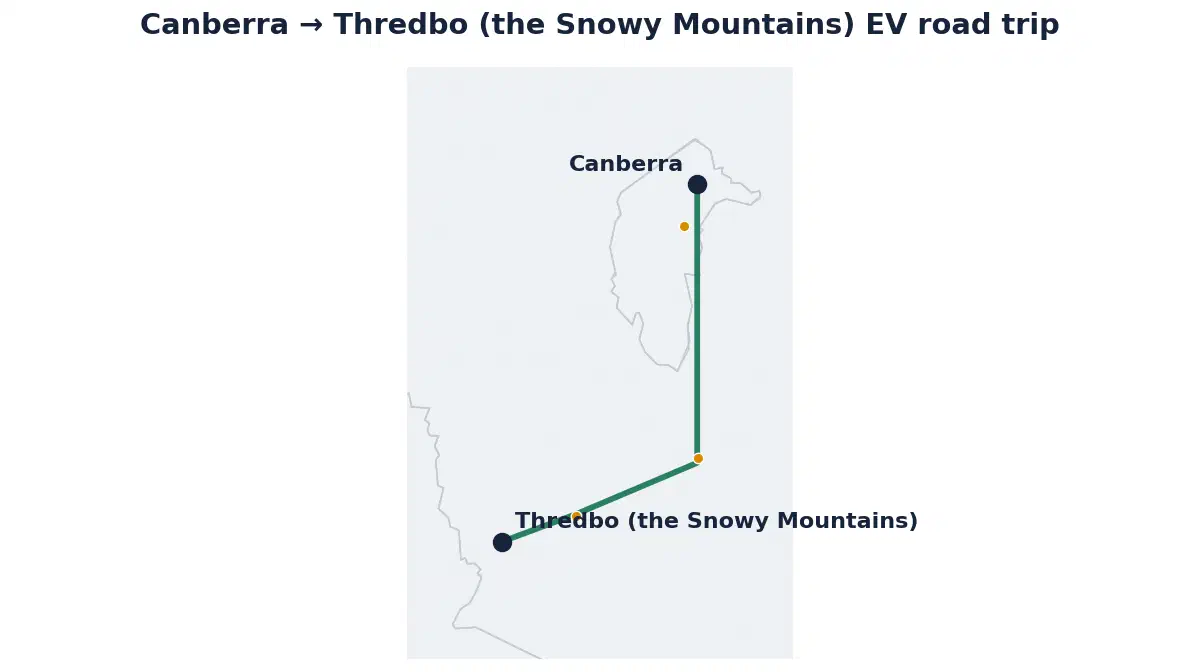
Canberra to Thredbo is manageable in an EV, but it is the most range-demanding drive on the NSW alpine circuit. At roughly 200 km via the Monaro Highway and Alpine Way, the distance alone is fine — but the sustained climb to Thredbo village at around 1,360 m, combined with genuine sub-zero cold in winter, can cut real-world range by 20–30% compared with a flat highway run. This is the page to read before you drive.
How many stops will your EV need?
No charging stop needed
Estimated from about 353 km of real-world range: leave at 90%, arrive with 15% in reserve, charge to 80% on the road. Highway speeds, cold weather and hills all cut range, so treat this as a planning estimate.
Showing a typical 60 kWh EV. Pick your car above for your own estimate.
Can you drive an EV from Canberra to Thredbo?
Yes — but it requires more planning than a flat highway trip of similar distance. The route climbs steadily from Canberra’s plateau through Cooma and Jindabyne, then winds up through Kosciuszko National Park to the resorts. Cooma is the main fast-charging stop along the Monaro Highway, and Jindabyne is the last town with reliable charging before the alpine section. Past Jindabyne, charging at the resorts is mostly slower destination AC — treat it as overnight convenience, not a fast top-up you can rely on to arrive with.
Leave Canberra with a full charge. Top up at Cooma or Jindabyne (or both, especially in winter), and arrive at Thredbo with meaningful range in reserve.
Charging stops, Canberra → Thredbo
The anchor towns are Cooma (the main Monaro stop, roughly halfway), Jindabyne (last town before the mountains, treat this as a mandatory top-up in winter or with a smaller-battery EV), and then Thredbo itself for overnight destination charging. The Canberra–Cooma Monaro stretch is the longest gap early on — check the live figure above. Charging becomes genuinely sparse once you leave Cooma and Jindabyne behind.
Cold, climbing, and range
This is the section to read carefully. The drive to Thredbo stacks two range penalties that compound each other.
The climb. Thredbo village sits at around 1,360 m. From Canberra you gain the bulk of that altitude after Jindabyne, on the winding Alpine Way through the national park. Sustained uphill driving uses substantially more energy than flat-road cruise speed — you will not recover it all on the descent, unlike a day-trip where you return on the same road. Budget for it.
The cold. The Snowy Mountains regularly see sub-zero overnight temperatures in winter, and daytime temperatures on the mountain can stay very low. Cold does two things to an EV: it reduces the battery’s usable capacity, and it means the cabin heater (a significant load) runs constantly. Real-world range can be 20–30% lower than a mild-weather figure from the same car.
What to do about it:
- Leave Canberra with a full charge, not 80% or “plenty.”
- Pre-heat the cabin while still plugged in at Jindabyne before the final leg — this is the single most effective way to reduce heater load during the drive.
- In winter, check the NSW National Parks conditions report before you leave Jindabyne. Snow chains are legally required on the road into Kosciuszko National Park when there is snow or ice — EVs are not exempt. Carry approved chains and know how to fit them. Cold also reduces tyre pressure; check it before the mountain section.
- Note where you last had reliable mobile coverage in the mountains. Signal is patchy past Jindabyne — make calls while you still have it.
Destination charging at Thredbo and the other alpine resorts is mostly slower AC. It is fine for overnight charging but plan to arrive with enough charge already on board, not to rely on a rapid top-up after you get there.
What if you run out of charge in the Snowy Mountains?
Prevention is the real answer here — the alpine section between Jindabyne and Thredbo is remote, winding, and has limited options. But if you do run flat:
- Get safe — carefully. Mountain roads are narrow with limited shoulder and steep drop-offs in places. Find a genuine pull-off, not just a wide point on a bend. Hazard lights on, stay well clear of the road.
- Call NRMA while you have signal. 13 11 11 reaches NRMA across both NSW and the ACT. Mobile coverage is patchy past Jindabyne — call as soon as you know you are in trouble, before you lose signal. If you have already lost coverage, drive or walk to a point where you can get one bar.
- Say it’s an EV and give a clear location. Most EVs need a flatbed, not a conventional tow — say so immediately so the right truck is dispatched. Give the nearest town, kilometre marker, or a landmark. Park Rangers in the national park can also assist.
- Ask about the options. Usually a tow back to Jindabyne or to a charger — recovery in the national park can take time, especially in poor weather.
Before you leave, confirm your roadside cover specifically handles out-of-charge events in regional and alpine areas. See our complete guide to EV roadside assistance in Australia and the out-of-charge guide for what to expect once you call.
For charging at your starting point, see our Canberra EV charging and roadside assistance guide. If you drove to Canberra from Sydney first, the Sydney to Canberra EV guide covers that leg. And for more alpine and regional routes, see the EV road trips hub.
Frequently asked questions
Can you drive an electric car from Canberra to Thredbo?
Yes, but it takes planning. It's about 200 km via the Monaro Highway and Alpine Way, with anchor charging towns at Cooma (roughly halfway) and Jindabyne (the last town before the alpine resorts). The big factors aren't the distance — they're the sustained climb to Thredbo village at around 1,360 m, genuine cold (often sub-zero in winter), and sparse charging past Jindabyne. Leave Canberra full, top up at Cooma or Jindabyne, and arrive with a buffer.
Where do you charge an EV between Canberra and Thredbo?
Cooma is the main fast-charging stop on the Monaro Highway, roughly halfway. Jindabyne, the last town before the mountains begin in earnest, is your final reliable top-up before Thredbo. Charging at the alpine resorts themselves is mostly slower destination AC — do not rely on it to arrive on fumes.
How does cold weather affect EV range on the drive to Thredbo?
Significantly. Cold battery temperatures reduce range, and the cabin heater draws extra power when it's sub-zero. Combined with the sustained climb to Thredbo's 1,360 m elevation, you can see 20–30% more energy use than the same flat drive in mild weather. Pre-heat the cabin while still plugged in, arrive at Jindabyne with a strong charge, and leave a real buffer — not just a small one.
Do I need snow chains to drive to Thredbo in an EV?
If there is snow or ice on the road in Kosciuszko National Park, chains are legally required and enforced. EVs are not exempt. Carry approved chains (or fit winter tyres where permitted), know how to fit them, and check the NSW National Parks conditions report before you leave. Cold also reduces tyre pressure — check it before the mountain section.
What happens if my EV runs out of charge in the Snowy Mountains?
Get safely off the road, hazard lights on, and call roadside assistance. Dialling 13 11 11 reaches NRMA, which covers both NSW and the ACT. Tell them it's an EV so they send a flatbed — most EVs cannot be tow-started or flat-towed. Note that mobile coverage is patchy past Jindabyne, so make the call while you still have signal, and give a clear location (nearest town or landmark). This is genuinely remote alpine terrain, so the strongest advice is to treat Jindabyne as a mandatory top-up and avoid the situation entirely.