Driving an EV from Brisbane to Cairns: Bruce Highway Charging & Summer Tips
Brisbane to Cairns is about 1,700 km up the Bruce Highway: a multi-day EV drive with fast chargers the whole way, many of them older 50 kW sites. Here are the stops, sensible overnight towns, and how to plan around summer floods.
On this page
Brisbane to Cairns is the classic Queensland family road trip: about 1,700 km up the Bruce Highway, past cane fields, the Whitsundays and the wet tropics. In an EV it’s very doable, with fast chargers along the whole route. It is a different drive from the Sunshine Coast run, though. North of Gin Gin the towns spread out, many of the chargers are older and slower, and if you’re going in the summer holidays you’re driving into the wet season. Here’s how to plan the stops, and what to do if the weather turns.
How many stops will your EV need?
7 charging stops
Estimated from about 353 km of real-world range: leave at 90%, arrive with 15% in reserve, charge to 80% on the road. Highway speeds, cold weather and hills all cut range, so treat this as a planning estimate.
Showing a typical 60 kWh EV. Pick your car above for your own estimate.
Can you drive an EV from Brisbane to Cairns?
Yes. The Bruce Highway is the main route, and the Department of Transport and Main Roads puts the highway itself at 1,671 km from Brisbane to Cairns. From the CBD it’s about 1,700 km, and at least 19 hours behind the wheel before you add charging, meals and rest. Very few families do that in one hit. Plan on three days at a push, and four or five with kids.
Charging is there the whole way. The southern end, through Caboolture and the Sunshine Coast hinterland, has fast modern sites from Evie and Tesla. Further north, many of the stops belong to the Queensland Electric Super Highway (QESH), a state government network. As of October 2026, Transport and Main Roads says the network is complete at 54 locations with no plans to expand it. Its owner and operator, Yurika, says the original coastal sites each have a 50 kW DC charger plus a 22 kW AC charger, and you pay through the Chargefox app.
A 50 kW charger does the job, but it’s slow by today’s standards. Allow 45 minutes to an hour for a decent top-up in a typical EV. Many QESH sites have a single DC charger, so if another car is already plugged in, you wait your turn. That is the main thing to plan around on this trip.
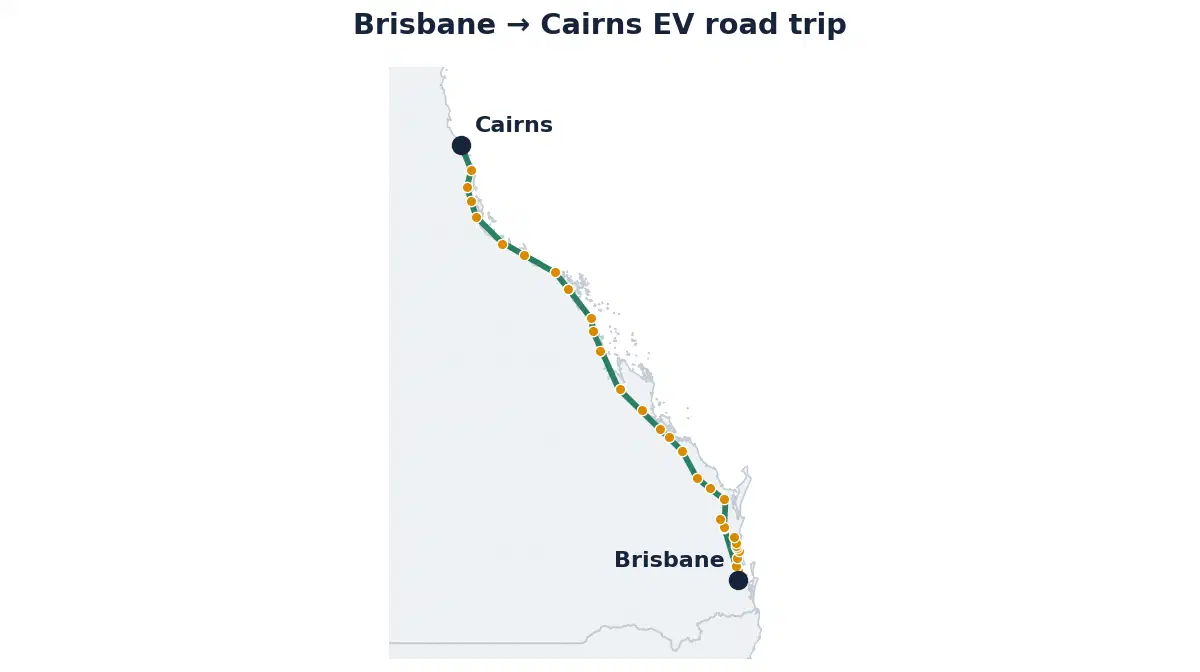
Fast-charging stops, Brisbane → Cairns
The DC fast-charging stops along the Bruce, drawn live from Open Charge Map:
The faster anchors in the list are worth knowing by name:
- Caboolture (Evie, at Coochin Creek) and Palmview (Tesla): ultra-rapid sites just north of Brisbane, handy if you didn’t leave home full.
- Tesla Superchargers the whole way up: as of October 2026 the Tesla Superchargers at Yandina, Gympie, Maryborough, Gin Gin, Calliope, Rockhampton, Carmila, Mackay, Bowen, Townsville and Tully are listed as open to other EVs. Non-Tesla drivers pay in the Tesla app, so check there that the site accepts your car before you count on it.
- Whitsunday Gold, near Proserpine: a 350 kW Evie site roughly two-thirds of the way up. Evie also has a site in Rockhampton, at Glenmore.
- Townsville: another 350 kW Evie site, and a natural overnight stop.
- Ingham: an NRMA fast-charging site in the town centre, between Townsville and Cardwell.
The QESH stops fill the spaces in between, at towns such as Childers, Miriam Vale, Rockhampton, Marlborough, Carmila, Mackay, Bowen, Ayr, Cardwell, Tully and Innisfail. Get your apps set up before you leave (Chargefox, Evie and Tesla at a minimum). Our guide to paying for public charging walks through each one.
How to plan your stops
Think of the drive in days. End each one in a town with a fast charger, or better, at accommodation with a charger so you start every morning full. A relaxed five-day plan looks like this:
- Brisbane to Gin Gin. An easy first day. Gin Gin has a Tesla Supercharger and a QESH charger side by side, with Childers as a backup before it.
- Gin Gin to Rockhampton, with the QESH stops at Miriam Vale and Mount Larcom along the way.
- Rockhampton to Mackay. A long, quiet stretch through Marlborough and Carmila with few towns between. Leave Rockhampton with a high charge.
- Mackay to Townsville, stopping at the Evie site near Proserpine. Airlie Beach is a short detour from there if you want a night by the water.
- Townsville to Cairns, through Ingham, Cardwell, Tully and Innisfail.
Short on time? Four days works if you push through to Rockhampton on day one, then stay in Proserpine and Townsville. Three days is possible, but it means long days of driving plus 50 kW charging stops, which isn’t much of a holiday with kids in the back.
Two habits make the northern half far easier. Take a charge whenever one is free. If you reach a QESH site and nobody’s waiting, plug in, because the next one may be busy. And arrive at each charger with a margin, so a queue or a faulty unit costs you time rather than a tow. Check live status in the network apps or on our live map before each leg. For a realistic idea of your car’s range at highway speed with the aircon on, see how far an EV can go.
Driving the Bruce in summer: wet season, floods and heat
The December–January holidays land in the middle of north Queensland’s wet season. The Bureau of Meteorology says the northern wet season runs from October to April and is the peak time for heavy rain, severe thunderstorms and tropical cyclones. The official cyclone season runs from November to April. The 2025–26 wet season was the seventh wettest on record.
That matters because the Bruce floods at known places. Transport and Main Roads says the 16 km section from Ingham’s southern outskirts to the Cardwell Range foothills experiences regular flooding and road closures, with the Gairloch floodway under water for an average of 1.4 days a year. In early February 2025, police fined drivers for ignoring flood closures on the Bruce at Goorganga Plains, south of Proserpine. Days later, a temporary single-lane bridge at Ollera Creek, north of Townsville and open to emergency vehicles only, was the only road into Ingham from the south.
What that means for an EV driver:
- Check QLDTraffic before every leg. It’s the Queensland Government’s official road information service: the website, the QLDTraffic app (which can push alerts for routes you save) and the 13 19 40 phone line. Its map shows flooding alerts and flood cameras. Check the Bureau’s Queensland warnings at the same time.
- Carry a bigger buffer than usual. A closure can mean waiting for the water to drop or taking a long detour, and you want to do either with charge to spare. In summer, aim to arrive at each charger well above the 15% reserve the calculator above assumes.
- Charge higher before the long stretches. Where you’d normally unplug at 80%, consider 90% or more before the quiet sections, or charge to full overnight in Rockhampton, Mackay or Townsville. A few extra minutes is cheap insurance.
- If it’s flooded, forget it. That’s the Queensland Government’s advice: obey closure signs, never drive through floodwater, and don’t drive a flooded road until it’s officially open again. Get Ready Queensland says driving into floodwater is the main cause of flood-related deaths in the state.
- Be ready to stop early. If the road ahead is closed, a night in a town with a charger beats hours at a roadblock with the aircon running.
The heat counts too. The air conditioning will run all day, and our range guide puts that at roughly 10 to 15 per cent of range on a 35°C day. Pre-cool the cabin while you’re still plugged in, and keep water in the car for everyone. Get Ready Queensland’s road-trip checklist suggests an emergency kit, weather alerts for the areas you’re passing through, and enough spare fuel to reach the next outlet. In an EV, that spare fuel is charge in the battery. Tropical downpours at the charger are nothing to worry about: charging in the rain is safe.
What if you run out of charge between Brisbane and Cairns?
Charge well at the anchor towns and a flat battery is unlikely. The longest charge-free stretch (see the live figure in the stop list above) is within a single charge for any current EV. The real risks on this drive are a busy or broken single-plug charger, and a flood closure that leaves you waiting with less charge than you planned. Help can also be further away than on a city motorway.
If you do run flat:
- Get safe. Off the road, hazard lights on, stand clear of traffic. If anyone is in danger, call 000 first.
- Call roadside assistance. 13 11 11 reaches RACQ anywhere in Queensland (see RACQ’s EV cover). Tesla drivers can use the Tesla app.
- Say it’s an EV. Most EVs must be flat-bed towed, and saying so up front gets the right truck first time.
- Ask about the options. Usually a tow to the nearest fast charger; ask whether mobile top-up charging is available where you are.
Confirm your roadside cover handles out-of-charge events and check the tow distance limit before you leave, because a tow to the next town on the Bruce can be a long one. See our complete guide to EV roadside assistance in Australia, and the out-of-charge guide for what happens after you call.
At either end
Leave Brisbane with a full battery: our Brisbane guide covers charging in the city, and the first leg overlaps our Brisbane to Sunshine Coast and Brisbane to Noosa trips. Once you’ve reached Cairns, Cairns to Port Douglas is an easy day out. For the bigger picture on where Australia’s charging gaps are, see EV charging gaps in Australia, and for more routes, the EV road trips hub.
Frequently asked questions
Can you drive an electric car from Brisbane to Cairns?
Yes. The Bruce Highway has DC fast chargers from one end to the other, so any current EV can make the roughly 1,700 km drive. Treat it as a multi-day trip. Many of the stops north of Gin Gin are older 50 kW Queensland Electric Super Highway sites, so charging takes longer than on southern motorways, and over the December–January holidays you also need to allow for wet-season road closures.
How many times do you need to charge an EV from Brisbane to Cairns?
A typical EV with about 350 km of real-world range needs around seven charging stops over the 1,700 km, spread across four or five days of driving. You'll need fewer if your car has more range or your accommodation lets you charge overnight. Charge to about 80% at fast sites, and higher before long or uncertain stretches.
What's the longest gap between EV chargers from Brisbane to Cairns?
See the live figure in the stop list below, which updates from Open Charge Map. It's within a single charge for any current EV. In the wet season, though, a flood closure can turn a short hop into a long wait, so leave each town with more charge than the distance alone suggests.
What happens if my EV runs out of charge between Brisbane and Cairns?
Get safely off the road, hazard lights on, and call roadside assistance: 13 11 11 reaches RACQ anywhere in Queensland, and Tesla drivers can use the Tesla app. Tell them it's an EV so they send a flatbed. Never drive into floodwater to reach a charger; if a road is closed, wait or turn back. Check that your cover includes out-of-charge events before you go.