Can You Drive an EV Across the Nullarbor? (Adelaide to Perth, 2026)
As of 2026 you can drive an EV across the Nullarbor from Adelaide to Perth — WA's WA EV Network and SA's RAA Charge closed the gaps in 2024–25. Here's the charger-by-charger crossing, the real gaps, and why you still need a Plan B.
On this page
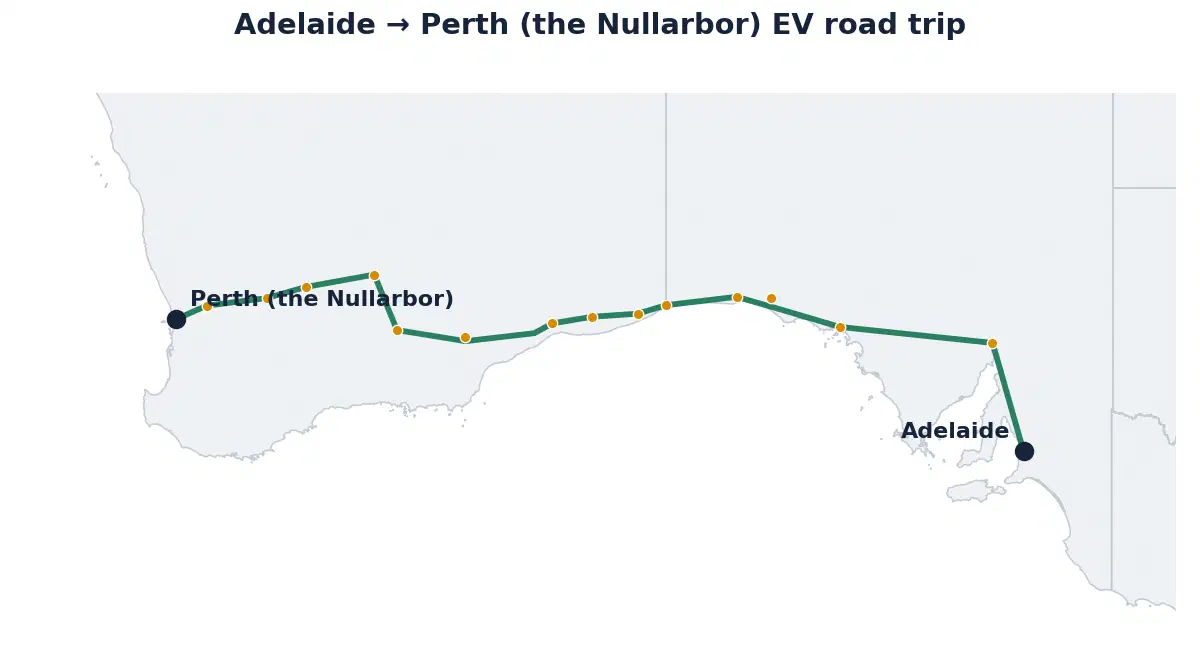
For years the Nullarbor was the drive that proved you “couldn’t” road-trip an EV across Australia. That changed in 2024–25. Western Australia’s WA EV Network — built by Synergy and Horizon Power and completed in January 2025 — and South Australia’s RAA Charge network closed the gaps, including the notorious 480 km off-grid stretch from Ceduna to the WA border. As of 2026 a mainstream EV with around 400 km of range can cross the Nullarbor. But this is still the most remote drive in the country, and the honest story is about reliability and planning, not range. Here’s how it actually works.
How many stops will your EV need?
11 charging stops
Estimated from about 353 km of real-world range: leave at 90%, arrive with 15% in reserve, charge to 80% on the road. Highway speeds, cold weather and hills all cut range, so treat this as a planning estimate.
Showing a typical 60 kWh EV. Pick your car above for your own estimate.
Can you drive an EV across the Nullarbor in 2026?
Yes — with planning. The Adelaide to Perth run is roughly 2,700 km via the Eyre Highway (A1), and charger spacing is now generally under 200 km the whole way, with one longer stretch of about 260 km (Mundrabilla to Nullarbor). That means distance between chargers is rarely the problem for a modern EV.
The real constraint is charger reliability and speed. Many of the Nullarbor chargers run off-grid (solar, battery and diesel) and have suffered outages, blackouts and slow “shared” charging through 2026. First-hand crossing reports from the Australian Electric Vehicle Association and The Driven make the same point: you can do it, but you need a Plan B — slower AC or 3-phase charging at roadhouses and caravan parks — for when a fast charger is down.
The charging network, Adelaide → Perth
Three networks cover the crossing. Charging is overwhelmingly CCS2 for DC fast charging and Type 2 for slower AC (bring your own Type 2 cable for AC). Tap any location to open it on our live charging map.
| Leg | Where | Network | Speed |
|---|---|---|---|
| SA — Eyre Peninsula | Port Augusta, Kimba, Wudinna, Streaky Bay, Poochera | RAA Charge | DC 60–200 kW (CCS2); some 7 kW AC |
| SA — closing the black spot | Ceduna (150 kW, opened Feb 2024) | RAA Charge | DC 150 kW |
| Yalata (~200 km west of Ceduna) | RAA Charge | DC 50 kW (off-grid; can behave as ~25 kW) | |
| The crossing | Border Village | WA EV Network | DC 50 kW |
| Nullarbor | NRMA | DC ~180 kW | |
| Mundrabilla, Madura, Cocklebiddy, Caiguna, Balladonia | WA EV Network / community | DC 50 kW, plus ~20 kW backup units | |
| WA — to Perth | Norseman, Coolgardie/Kalgoorlie, Southern Cross, Merredin, Northam | WA EV Network | DC 75–150 kW (CCS2) + 7 kW AC backup |
The WA EV Network is the backbone of the western two-thirds: dual-outlet DC fast chargers (so two cars can charge at once) at 75 kW and 150 kW with integrated CCS2 cables, plus a 7 kW Type 2 AC backup, spanning 49 locations from the SA border to the state’s north. On the SA side, RAA Charge is Australia’s first statewide network (140+ sites), and its Ceduna and Yalata sites are what finally closed the 480 km Ceduna-to-Border-Village black spot that used to make the crossing impossible.
Charger status changes month to month out here. Through 2026, reports have included a roadhouse charger limited to 11 kW AC after blackouts, fast chargers running at 30 kW shared between two cars, and the Border Village fast charger knocked out for weeks after a truck struck its solar canopy. Always check live status (PlugShare) the day before each leg. The figures above are the installed hardware, not a promise it’s working today.
How to actually plan the crossing
- Treat every leg as “confirm the charger at the far end before you leave.” With chargers under 200 km apart, the danger isn’t the distance — it’s arriving at a dead charger with no margin. Leave each stop full and verify the next one is online.
- Carry a Plan B. The most reliable chargers on the route in early 2026 were modest ~20 kW community DC units (at Balladonia and Cocklebiddy); slower AC and 3-phase at roadhouses and caravan parks are the fallback when a fast charger is down. A long AC top-up is slow but it gets you to the next town.
- Plan for heat. Summer crossings are brutally hot; battery thermal throttling slows charging and aircon eats range. Cross in the cooler months if you can, and don’t plan to the dashboard estimate.
- Go self-sufficient. Plenty of water, a charged phone, and a realistic schedule (this is a multi-day drive). Mobile coverage is patchy to non-existent between towns.
What if you run out of charge on the Nullarbor?
This is the drive where the contingency plan matters most, because help is genuinely far away. The whole strategy is to never start a leg without a confirmed charger at the other end — so that running flat doesn’t happen in the first place.
If you do stop:
- Get safe and conserve. Pull well off the road, stay with the vehicle, and conserve phone battery and water. On the Eyre Highway, other traffic (including the roadhouses) is your nearest help.
- Call roadside assistance. 13 11 11 reaches RAA in South Australia and RAC in Western Australia. Tell them it’s an EV so they send a flatbed — and be realistic that out here a tow or mobile top-up can be hours away.
- Ask the roadhouses. Roadhouse staff know the local charger status and often have AC or 3-phase options; they are the practical lifeline on this route.
Before you set out, confirm your roadside cover handles out-of-charge events and check the tow distance limit — on the Nullarbor a tow to the nearest charger is a long, expensive one. Our complete guide to EV roadside assistance in Australia compares what each club covers, and the out-of-charge guide walks through what happens after you call.
Sources & further reading
The charger network details here come from the operators and governments themselves — Synergy’s WA EV Network, Horizon Power, RAA Charge and the SA statewide network — plus first-hand 2026 crossing reports from the AEVA and The Driven. Charger status is time-sensitive — re-check live data before you drive.
For more routes, see the EV road trips hub and our city guides to Adelaide and Perth.
Frequently asked questions
Can you drive an electric car across the Nullarbor?
Yes, as of 2026 you can. The historic charging black spots on the Eyre Highway were closed in 2024–25 by Western Australia's WA EV Network (Synergy and Horizon Power) and South Australia's RAA Charge network. Charger spacing across the crossing is now generally under 200 km, so a mainstream EV with around 400 km of range can do it. The catch is reliability, not distance — several remote roadhouse chargers are slow or intermittently out of service, so you must plan around them and carry a Plan B.
How far apart are the EV chargers on the Nullarbor?
As of 2026, most charging stops on the Adelaide–Perth Eyre Highway crossing are under 200 km apart, with one longer stretch of around 260 km (Mundrabilla to Nullarbor). That is within a single charge for most modern EVs. However, when a remote charger is out of service the effective gap to the next working one can be 150 km or more, which is why a buffer and a backup plan matter.
Is it risky to cross the Nullarbor in an EV?
The main risk is a charger being offline when you arrive, not running out of range between stops. Remote Eyre Highway chargers run on off-grid solar, battery and diesel and have suffered outages and slow shared charging in 2026. The reliable fallback is slower AC or 3-phase charging at roadhouses and caravan parks, which adds hours. Always check live charger status (for example on PlugShare) the day before each leg, arrive with a comfortable buffer, and tell someone your plan — this is one of the most remote drives in the country.
What charging networks cover the Adelaide to Perth crossing?
Three main networks. In South Australia, the RAA Charge (Charge@Large) statewide network covers the Eyre Peninsula and the run to the WA border. The Nullarbor roadhouses and the entire Western Australian leg are covered by the WA EV Network, built by Synergy and Horizon Power and completed in January 2025. NRMA has also added a fast charger at Nullarbor. Chargers are overwhelmingly CCS2 for DC fast charging and Type 2 for slower AC.
What happens if my EV runs out of charge on the Nullarbor?
Help is a very long way away on the Eyre Highway, so prevention beats rescue. If you do stop, get safely off the road, and call roadside assistance — 13 11 11 reaches RAA in South Australia and RAC in Western Australia. Tell them it's an EV so they send a flatbed, and be realistic that a tow or a mobile top-up could be hours away. Carry plenty of water, fuel for any range-extender, and a charged phone, and never set out onto a long leg without a confirmed working charger at the other end.