Driving an EV from Adelaide to Melbourne the Coastal Way: Charging & What If You Run Flat
The coastal Adelaide to Melbourne drive via the Coorong and Limestone Coast is the scenic long way round — about 906 km, more spectacular than the inland route, and manageable in an EV if you treat the Coorong gap between Tailem Bend and Kingston SE with respect.
On this page
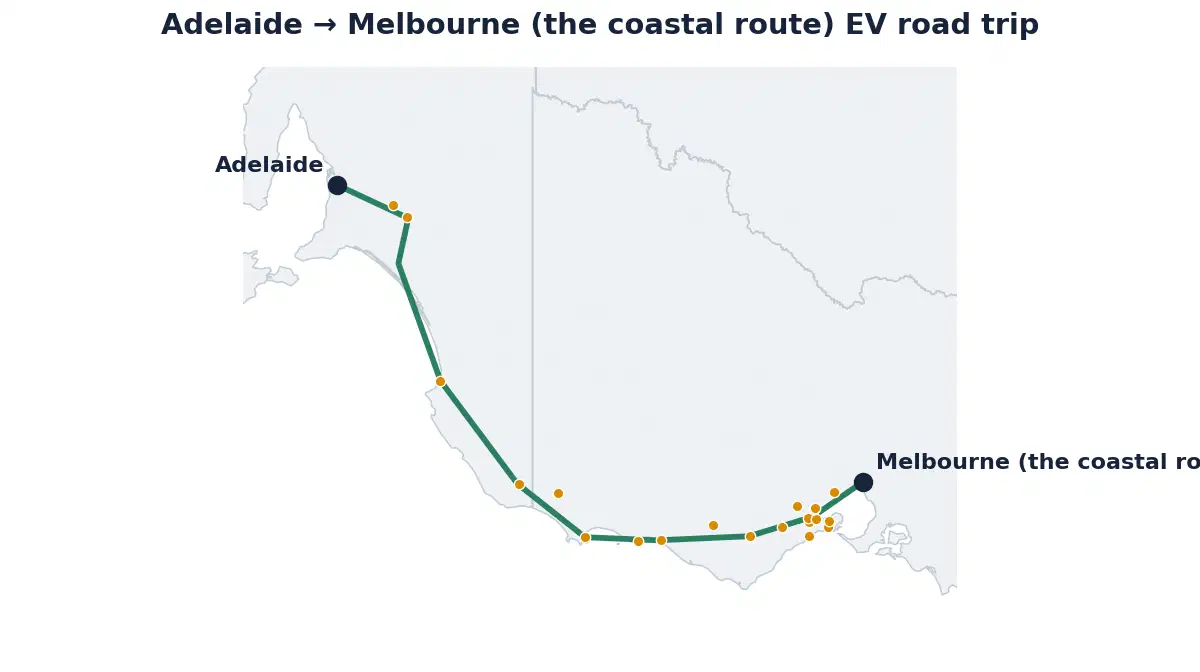
Most people asking about Adelaide to Melbourne in an EV are looking at the inland Western Highway — the fast, well-charged 730 km route through the Victorian goldfields. This is the other one. The Princes Highway hugs the lower South Australian coast through the Coorong, winds through Limestone Coast wine country around Mount Gambier, touches the Victorian border near Portland, and joins the western fringe of the Great Ocean Road at Warrnambool. It’s roughly 906 km and takes about 11 hours of driving. It’s longer, slower, sparser on chargers, and considerably more beautiful. With the right planning it’s a fine EV road trip.
How many stops will your EV need?
3 charging stops
Estimated from about 353 km of real-world range: leave at 90%, arrive with 15% in reserve, charge to 80% on the road. Highway speeds, cold weather and hills all cut range, so treat this as a planning estimate.
Showing a typical 60 kWh EV. Pick your car above for your own estimate.
Can you drive an EV from Adelaide to Melbourne via the coast?
Yes. It’s roughly 906 km via the Princes Highway (B1), about 11 hours of driving — around 3 hours longer than the inland route. The corridor is manageable but demands more attention than the Western Highway: chargers are spaced further apart, towns in far south-east SA and far south-west Victoria are smaller, and the Coorong is a long, flat, beautiful stretch of national park with little help between Tailem Bend and Kingston SE.
As of mid-2026 the anchor charging towns are Murray Bridge, Tailem Bend, Kingston SE, Mount Gambier, Portland, Warrnambool, Camperdown, Colac and Geelong before Melbourne. Most EVs with 350 km or more of real-world range can do this with three stops; smaller-battery cars should plan four.
The discipline that sets this route apart is the Coorong. Top up to at least 80% at Tailem Bend before you enter it, not afterwards.
Fast-charging stops on the coastal route
The DC fast-charging stops along the Princes Highway coastal corridor, drawn live from Open Charge Map:
Pay through the Chargefox, Evie or Tesla app where applicable. In the smaller towns, double-check the charger type before you rely on it — ultra-rapid options thin out east of Mount Gambier, and some stops are AC-only or lower-power DC. The main anchor towns most drivers use are Tailem Bend, Kingston SE, Mount Gambier, Warrnambool and Geelong.
How to plan your stops
A reliable rhythm for the coastal route:
- Murray Bridge or Tailem Bend — first top-up out of Adelaide, whichever suits your departure charge. These are your last comfortable options before the Coorong. Charge to at least 80% here.
- Kingston SE — welcome sight after the Coorong. Top up before continuing south along the Limestone Coast.
- Mount Gambier or Portland — cross the SA–VIC border in this stretch. Roadside assistance switches from RAA to RACV at the border; both on 13 11 11.
- Warrnambool — well-provisioned town, natural break, good charging. From here it’s the final run via Camperdown, Colac and Geelong.
- Geelong — quick top-up if needed before the suburban run into Melbourne.
Two things to keep front of mind on this corridor:
- The Coorong gap. The stretch between Tailem Bend and Kingston SE is approximately 187 km of national park highway with no fast-charging options in between (see the live stop list above for the current figure). It’s within a single charge for most modern EVs, but it leaves no room for a depleted battery at Tailem Bend or a serious headwind. Charge aggressively before entering.
- Smaller towns, fewer backups. The far south-east of South Australia and far south-west of Victoria have less charging redundancy than the Hume or Pacific corridors. If a charger is busy or out of action, the next one may be 60 km on. Arrive with margin, not at 5%.
What if you run out of charge on the coastal route?
Charge to 80% at the anchor towns and you’re unlikely to run flat — the gaps are long but they’re manageable. What’s different about this route compared to the east-coast drives is the remoteness: if something does go wrong, help takes longer to arrive.
If you do run flat:
- Get safe. Off the road, hazard lights on, stand well clear of traffic. Highway speed approaches can be hard to judge from behind — stay back from the carriageway.
- Call roadside assistance. 13 11 11 reaches RAA throughout South Australia and RACV once you cross into Victoria. Tesla drivers can request help in the Tesla app.
- Say it’s an EV. Most EVs must be flatbed-towed, not flat-towed — saying so up front gets the right truck dispatched first time. In a remote area this matters: you don’t want a second wait for a second truck.
- Ask about tow distance. A tow to the nearest fast charger from the Coorong or far south-east could be substantial. Confirm your cover handles out-of-charge events and check the tow limit before you leave.
For a full breakdown of what each Australian roadside provider covers for EVs, see our complete guide to EV roadside assistance in Australia. The out-of-charge guide walks through what happens step by step after you call.
Coastal vs inland: which should you drive?
| Coastal (Princes Highway) | Inland (Western Highway) | |
|---|---|---|
| Distance | ~906 km | ~730 km |
| Drive time | ~11 hours | ~8 hours |
| Key towns | Coorong, Kingston SE, Mount Gambier, Warrnambool | Ballarat, Horsham, Bordertown, Keith |
| Longest charge-free gap | ~187 km (Tailem Bend → Kingston SE) | Shorter gaps through the Wimmera |
| EV difficulty | Higher — sparse Coorong stretch | Lower — denser charging corridor |
| Scenery | Coorong, Limestone Coast, western Great Ocean Road | Victorian goldfields, Wimmera plains |
If your priority is getting between the two cities efficiently, take the inland route — it’s shorter, faster and better charged. See our full guide to the Melbourne to Adelaide EV trip via the Western Highway.
If you want the Coorong at sunset, Limestone Coast cellar doors and the Warrnambool foreshore, the coastal route rewards the extra planning. Just charge to 80% at Tailem Bend.
At either end
Charging in town is straightforward at both ends — see our guides to EV charging and roadside assistance in Adelaide and Melbourne. Arriving into Melbourne from the west? Our Melbourne to Great Ocean Road EV guide picks up where this route leaves off, heading back east along the Great Ocean Road. For more routes, see the EV road trips hub.
Frequently asked questions
Can you drive an EV from Adelaide to Melbourne via the coastal route?
Yes, but it takes more planning than the inland run. The Princes Highway via the Coorong, Limestone Coast and Warrnambool is around 906 km and about 11 hours of driving — longer and slower than the Western Highway, with sparser fast charging, especially through the Coorong and far south-east South Australia. Leave Tailem Bend with a strong charge and plan your stops around the anchor towns: Murray Bridge, Tailem Bend, Kingston SE, Mount Gambier, Portland, Warrnambool, Camperdown, Colac and Geelong.
What's the longest gap between EV chargers on the Adelaide to Melbourne coastal route?
The longest charge-free stretch is the Coorong — roughly the 187 km between Tailem Bend and Kingston SE. See the live stop list below for the current figure. It's within a single charge for most moderate-to-long-range EVs, but the key discipline is leaving Tailem Bend with a healthy battery, not arriving there at 10%. Charging infrastructure in far south-east SA and far south-west Victoria is thinner than on the east-coast corridors.
What happens if my EV runs out of charge on the Coorong or Princes Highway?
Get safely off the road, hazard lights on, and stand well clear of traffic. Call roadside assistance — 13 11 11 reaches RAA in South Australia and RACV once you cross into Victoria. Tell them it's an EV so they send a flatbed rather than a conventional tow. Response times in the Coorong and far south-east can be longer than in major cities, so confirming your cover handles out-of-charge events and checking the tow distance limit before you leave is especially important on this route.
Is the coastal Adelaide to Melbourne route better or worse for EVs than the inland Western Highway?
Worse for EV logistics, better for scenery. The inland Western Highway route (about 730 km, 8 hours) has more frequent fast charging through the Victorian goldfields and the Wimmera. The coastal Princes Highway is around 176 km longer, takes roughly 3 hours more, and the Coorong stretch between Tailem Bend and Kingston SE is the single sparsest gap on either route. If you want the Coorong, Limestone Coast and the western Great Ocean Road tail, plan more carefully — charge to 80% at Tailem Bend, not 50%. See our full guide to the [inland Melbourne to Adelaide route](/trips/melbourne-to-adelaide-ev/) for a direct comparison.
How many charging stops does the coastal Adelaide to Melbourne route need?
Most EVs will need three to four stops over the 906 km. A reliable plan is Murray Bridge or Tailem Bend in SA, Kingston SE after the Coorong, then Mount Gambier or Portland, then Warrnambool before the final run to Melbourne via Colac and Geelong. Smaller-battery cars may want an extra top-up — add Camperdown or Colac if your range is under 350 km.