Vehicle-to-Load (V2L) in Australia: Which EVs Have It and Can It Rescue Another EV?
V2L turns your EV into a power source: what it can run, which Australian models have it, and the slow-but-real trick of one EV rescuing another.
On this page
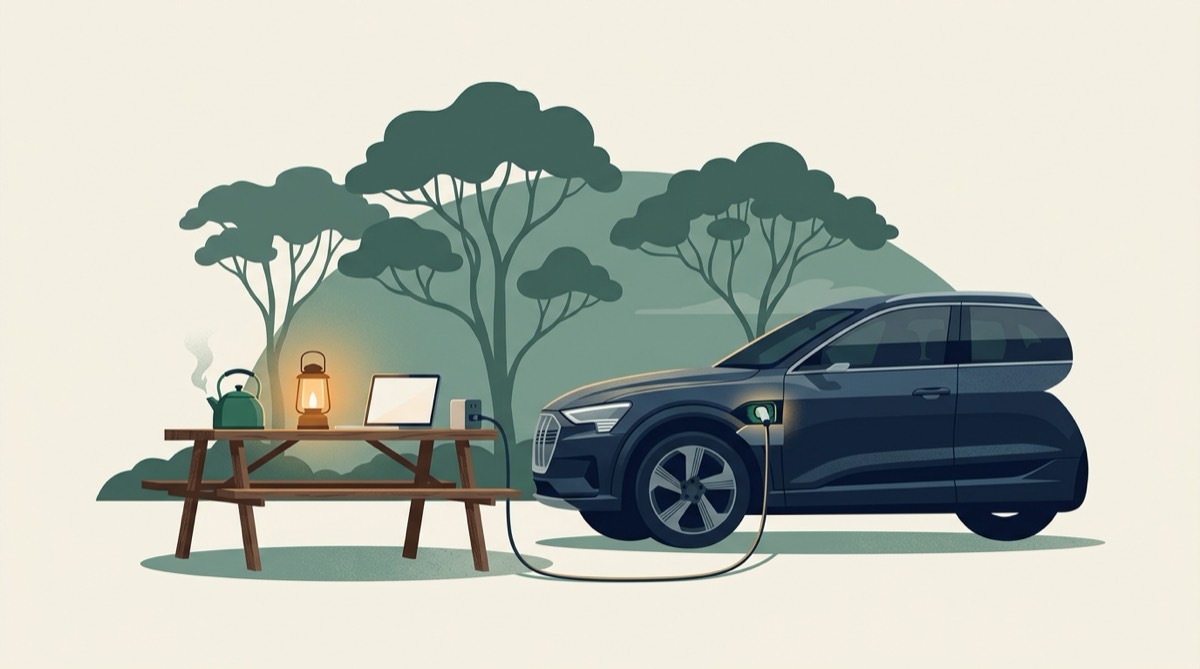
Vehicle-to-load, or V2L, lets an electric car push power out of its drive battery through a normal powerpoint. On most V2L-equipped EVs sold in Australia that means up to 3.6kW on tap anywhere the car can park: enough for a campsite, a power outage, a job site, or the most on-brand use case we cover on this site, giving a stranded EV enough charge to reach a real charger.
Pick your car above and this answer is yours: 3600 W . About a third of the EVs we track don’t have V2L at all, and no adapter can add it after the fact: it’s a factory feature or it isn’t.
What is V2L, and how is it different from V2G?
The alphabet soup is simpler than it looks. V2L (vehicle-to-load) powers appliances directly from the car: a socket, some watts, done. V2G (vehicle-to-grid) exports power back into the electricity grid through special hardware, and V2H (vehicle-to-home) feeds your house. V2G and V2H became genuinely buyable in Australia in 2026, though the hardware still costs $4,850-plus; our bidirectional charging guide covers it. V2L needs none of that, which is why it is the version most drivers can use today; if you want the house-battery version, our guide to running your home from the car works out how many days a full battery lasts.
Depending on the model, the power comes from a powerpoint inside the cabin or boot, an adapter that plugs into the charge port, or both. The car’s electronics limit output (3.6kW on most Hyundai, Kia and BYD models) and shut things down if the battery gets low; most cars let you set a discharge floor so you cannot accidentally strand yourself while running a campsite.
Which EVs sold in Australia have V2L?
| Model | V2L output | Where the power comes out |
|---|---|---|
| Hyundai Ioniq 5 / Ioniq 6 | 3.6kW | Cabin socket + charge-port adapter |
| Kia EV3 / EV5 / EV6 / EV9 | 3.6kW | Cabin socket + charge-port adapter |
| BYD Atto 3 / Dolphin / Seal | 3.6kW (adapter rated 2.2kW) | Charge-port adapter |
| MG4 / MG5 | 2.2kW | Charge-port adapter |
| Genesis GV60 | 3.6kW | Cabin socket + charge-port adapter |
Two fine-print points. First, V2L is a factory capability: if the car did not ship with it, no accessory can add it, and that includes every Tesla sold in Australia as of mid-2026. Second, the adapter matters: BYD’s car hardware supports 3.6kW but its official adapter is rated at 2.2kW, so the adapter, not the car, sets your real-world ceiling.
Adapters run roughly $70 to $200 from Australian retailers. Buy one that explicitly lists your model, because the handshake protocols differ between brands. For the bigger question of which of these cars can also do V2H or V2G, our list of V2G and V2H cars in Australia tracks every model’s status.
What can 3.6kW actually run?
More than you might expect, as long as you respect the ceiling. A fridge, lights, laptops and a coffee machine together sit well under 1kW. A circular saw or electric barbecue fits. What does not fit is anything with a big heating element plus company: a 2.4kW fan heater leaves little headroom, and a kettle plus almost anything else will trip the limit.
The battery maths is comfortable, though. A 77kWh Ioniq 5 running a steady 1kW load loses about 6 to 7 kilometres of range per hour of camping. Run it all evening and you have spent less range than a trip to the shops.
Can one EV really charge another?
Yes, and it is less of a party trick than it sounds. The recipe: the donor car’s V2L outlet, plus an ordinary 10-amp portable EV charger, plugged into the stranded car. The donor exports about 2.2kW, the EVSE draws about 2kW, and the flat car gains roughly 10 kilometres of range per hour.
Worked example: your friend’s Atto 3 is flat 15 kilometres short of a fast charger, and you drive an Ioniq 5. Sixty to ninety minutes of V2L donation transfers enough for those 15 kilometres with margin. That is slow enough to be a last resort and fast enough to beat waiting for a tow in the regional areas where mobile charging vans do not operate. It is also the same speed as charging from a petrol generator, without the earthing faults or the fuel bill.
The professional version of this idea has arrived in Australia too: Alpine Energy’s MGEN M40, unveiled in June 2026, draws from a donor vehicle and delivers up to 40kW of DC fast charging, about 65 kilometres of range per 15 minutes, aimed at roadside recovery operators and remote industries. Same concept, thirty times the speed. For businesses running EVs beyond the grid, that class of gear is covered in our mobile charging for business guide.
A candid caveat: EV-to-EV charging via V2L drains the donor, so check both cars’ numbers before playing hero, and if the stranded car is on a highway shoulder rather than somewhere safe to park two cars for an hour, skip the experiment and call roadside assistance.
Should V2L influence which EV you buy?
If you camp, tow, work from remote sites or live somewhere with unreliable power, genuinely yes: it is a several-hundred-dollar generator you were buying anyway, minus the fuel, noise and servicing. For contingency-minded EV drivers it also buys quiet insurance: any V2L-equipped friend is a potential rescue, and our guide to what happens when an EV runs out of charge explains where that fits in the full picture. If none of that describes you, V2L is a nice-to-have you will use twice a year at a barbecue, which, to be fair, is still more use than most spare tyres get.
Frequently asked questions
What is vehicle-to-load (V2L)?
Vehicle-to-load lets an electric car export power from its drive battery through an ordinary powerpoint, either a socket inside the cabin or an adapter that plugs into the charge port. Most V2L-equipped EVs in Australia can supply up to 3.6kW, enough to run camping gear, power tools, a fridge, or another EV's portable charger.
Which EVs in Australia have V2L?
As of mid-2026 the main V2L-equipped models sold in Australia include the Hyundai Ioniq 5 and Ioniq 6 (3.6kW), Kia's EV3, EV5, EV6 and EV9 (3.6kW), the BYD Atto 3, Dolphin and Seal (3.6kW car limit, though BYD's adapter is rated at 2.2kW), the MG4 and MG5 (2.2kW), and the Genesis GV60. Teslas sold in Australia do not offer V2L.
Can one EV charge another EV using V2L?
Yes. Plug a standard 10-amp portable charger into the donor car's V2L outlet and the other end into the flat car, and energy flows at about 2kW, roughly 10 kilometres of range per hour. It is slow, but 30 to 60 minutes of donation is often enough for a stranded EV to reach a real charger.
How much does a V2L adapter cost in Australia?
Roughly $70 to $200 as of mid-2026, depending on brand and where you buy. The adapter must match your car's V2L system, and it only works if the car shipped with V2L capability from the factory; no adapter can add V2L to a car that does not support it, which includes every Tesla currently sold in Australia.