Mobile EV Charging in Australia: How It Works and Who Offers It
Who will bring a charge to your stranded EV in Australia, how much range a roadside top-up really gives you, and what happens where the service doesn't exist.
On this page
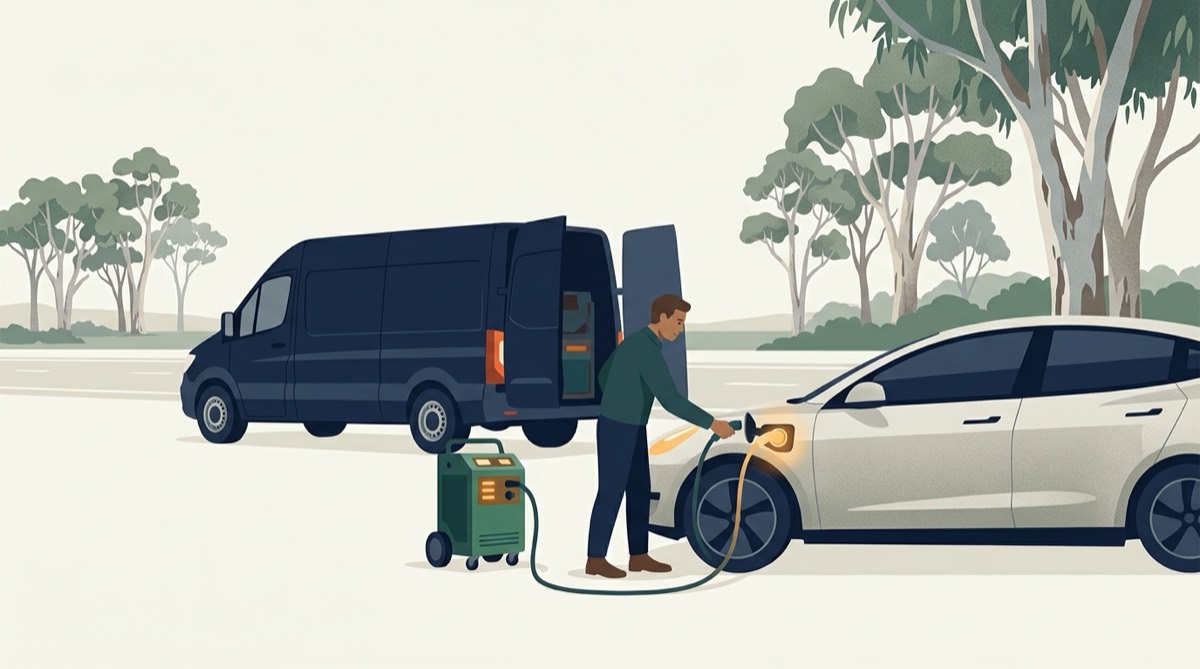
Mobile EV charging is exactly what it sounds like: instead of your electric car going to a charger, a charger comes to your electric car. In Australia, as of mid-2026, it is offered by some motoring clubs in some cities (NRMA in Sydney and Canberra, RAC in Perth, RAA in Adelaide, AANT in Darwin, with RACV trialling fast-charging units in Victoria) plus a handful of commercial operators. A roadside top-up typically gives you 10 to 20 kilometres of range in 15 to 30 minutes, enough to reach a real charging station, where the service does not operate, you get a flatbed tow to a charger instead.
What is mobile EV charging?
A mobile EV charger is a battery pack or generator-fed charging unit mounted in a van or truck, with a standard CCS2 (or sometimes AC) plug on the end. The operator parks next to your car, plugs in, and transfers enough energy for you to drive to the nearest charging station under your own power.
The key word is enough. These units are not rolling Superchargers. Club-grade units store a few kilowatt-hours, which is a few percent of a typical EV battery. The economics and physics both point the same way: the job of a mobile charger is to rescue you, not refuel you.
That distinction matters because “mobile EV charging” gets used loosely. It can mean three different things:
- Roadside rescue charging: a club patrol or commercial van tops you up so you can reach a charger. This article’s main subject.
- On-demand commercial charging: a van charges your car at your home or workplace as a paid service, sometimes used by fleets.
- Portable chargers you carry yourself: a cable-and-box unit in your boot that plugs into a power point. Different thing entirely, covered in our portable EV chargers guide and, for Tesla’s own cable, our Tesla Mobile Connector guide.
How does the technology actually work?
Three designs are in service in Australia, and the differences explain why some rescues take five minutes and others take thirty.
Battery-bank AC units are the first generation: a lithium battery pack in the van feeding an onboard charger. The NRMA’s units pair a 4.8 kWh pack with a 9.6 kW charger, and RAC’s Perth van charges at 7 kW. Simple and reliable, but AC charging is inherently slow, which is why the numbers are quoted in kilometres per twenty minutes.
Portable DC fast-charge units are the second generation, and the one the clubs are moving towards. DC bypasses the car’s onboard charger and feeds the battery directly, so a unit like the Re:Start hardware RACV has trialled can push around 20 km of range in minutes rather than half an hour.
Vehicle-to-vehicle DC platforms are the newest arrivals: hardware like Alpine Energy’s MGEN M40, unveiled in June 2026, draws from a donor vehicle’s own battery to fast-charge a stranded one. The pitch is to recovery operators and remote industries, where carrying a dedicated energy trailer does not stack up.
All of them plug into the same CCS2 port your car uses at any public fast charger, so there is nothing for the driver to learn.
Who offers mobile EV charging in Australia?
As of mid-2026, here is the honest picture: coverage is real but patchy, concentrated in capital cities, and changing quickly.
| Provider | Where | What you get |
|---|---|---|
| NRMA | Sydney, Canberra (NSW expansion planned) | 9.6 kW van-mounted charger, ~1 km of range per 2 minutes |
| RAC | Perth metro | Electric patrol van, ~15 km of range in ~20 minutes |
| RAA | Adelaide metro | 7 kW patrol-van charger, ~15 km of range in 15 minutes, permanent since 2024 |
| RACV | Victoria (trial) | Portable DC fast-charge units, ~20 km in minutes |
| RACQ | Queensland | “Charge top-up” where available, otherwise tow to charger |
| AANT | Greater Darwin | Mobile charging van, included for all roadside members |
The NRMA was first to fit mobile chargers to its patrol fleet, pairing a 9.6 kW charger with a 4.8 kWh lithium battery pack. Ten minutes on the plug buys you roughly 5 kilometres, which sounds modest until you remember most people run flat frustratingly close to a charger.
RACV’s approach is more ambitious: it invested in Melbourne start-up Re:Start, whose portable DC unit is designed to push a meaningful 20 kilometres of range into a stranded EV in around six minutes, and has trialled the units in its roadside fleet. Club Assist, the battery-services company owned by the motoring clubs, has also trialled a mobile EV charger with customers in South Australia and WA that adds roughly 10 to 15 kilometres in 15 minutes.
If you are outside these areas, you are not out of options; you are just getting a tow instead. Every club will take an out-of-charge EV to the nearest accessible charging station under your plan’s normal towing entitlement. The full picture of who covers what is in our complete guide to EV roadside assistance in Australia.
Which states and territories have mobile EV charging?
As of mid-2026, the motoring clubs run some form of roadside charging in six of Australia’s eight states and territories, in every case confined to metropolitan areas. State by state:
- New South Wales: NRMA mobile charging vans operate in Sydney, with wider NSW expansion planned. See NRMA’s EV coverage for plans and towing.
- ACT: covered by the NRMA’s Canberra-based vans, the same hardware as Sydney.
- Victoria: no permanent club service yet. RACV has trialled portable DC fast-charge units that add around 20 km of range in minutes; until they roll out, its Total Care plan leans on up to 200 km of out-of-charge towing instead. See RACV’s EV coverage.
- Queensland: RACQ offers a roadside charge top-up “where available” and a tow to a charging station otherwise. See RACQ’s EV coverage.
- South Australia: RAA made mobile EV charging a permanent part of road service in metropolitan Adelaide after a successful 2024 trial. Its 7 kW patrol-van unit adds roughly 15 km of range in 15 minutes. See RAA’s EV coverage.
- Western Australia: RAC’s all-electric patrol van covers metropolitan Perth, delivering about 15 km of range in around 20 minutes as part of standard roadside membership. See RAC’s EV coverage.
- Tasmania: no mobile charging service. RACT publishes no EV-specific roadside terms, and an out-of-charge EV should expect a tow. See what RACT does cover.
- Northern Territory: AANT runs a mobile EV charging van in greater Darwin, available to all roadside members at no extra cost. See AANT’s EV coverage.
Commercial operators fill some of the gaps, for a fee and without a membership. Mobile EV Charging lists 24/7 callouts in every state and territory except Tasmania, from $210 a callout, which matters most in Victoria, where the club has no permanent van. Rapid Fuel Rescue covers Perth and the Peel region. Both are built around the capitals; our guide to commercial mobile EV charging compares the two.
Outside these metro zones the answer is the same everywhere: a flatbed tow to the nearest charger under your plan’s towing entitlement. That makes towing distance, not charging hardware, the number to compare when choosing a plan, especially in the states where chargers thin out fastest; our state charger maps show exactly where those gaps are.
How much range does a roadside top-up actually give you?
Less than you would like, and almost always enough.
Work the numbers: a club unit storing around 5 kWh, transferring most of that, gives a typical EV (using 15 to 20 kWh per 100 km) somewhere between 15 and 30 kilometres of driving. Field figures from the clubs land in the same band: 1 km per two minutes for NRMA, 15 km in 20 minutes for RAC.
In urban Australia that is nearly always sufficient, because public fast chargers in the capitals are rarely more than a few kilometres apart. The maths gets uncomfortable in regional areas, where the next charger might be 80 km away, which is precisely why regional out-of-charge calls usually end in a tow rather than a top-up, and why higher-tier club plans with longer towing entitlements earn their keep outside the cities.
What about commercial mobile charging companies?
A small commercial sector has grown up alongside the clubs, and it is worth knowing about because it fills two gaps: drivers without any roadside membership, and situations where you want more than a trickle.
Mobile EV Charging (mobileevcharging.com.au) operates a 24/7 callout service with vans carrying 60 kW DC fast chargers with CCS2 plugs, and says most vehicles can charge from near empty to 80 percent in around 40 to 45 minutes. Daniel Henry, who runs the company, describes what actually happens when a call comes in:
“The first thing that happens on any callout is triage: is this an emergency, someone stranded or blocking traffic with nothing left, or is it something we can schedule, like a booked top-up before a long trip or fleet charging? That distinction shapes everything: response time, callout priority and pricing. From there, dispatch locates the nearest unit and works out distance to the job.”
Daniel Henry, Mobile EV Charging
Rapid Fuel Rescue offers emergency mobile EV charging around Perth. And in June 2026, Australian firm Alpine Energy unveiled the MGEN M40, a vehicle-to-vehicle DC fast-charging platform pitched at roadside recovery operators and remote industries, a sign the rescue-charging toolkit is moving from slow top-ups towards genuine fast charging. For fleets, construction and mining sites that need charging beyond the grid, that whole category is covered in our mobile EV charging for business guide.
Pricing for commercial callouts varies by operator, distance and how much energy you take, so check the operator’s current rates before you book. We compare what each operator charges, and what they will and will not tell you about their equipment, in our guide to commercial mobile EV charging. None of these services are emergency services; if you are stopped somewhere dangerous, deal with safety first.
What does a mobile charging callout cost?
It depends entirely on who turns up.
Through a club membership, a roadside top-up is handled like any other callout: it is part of what your annual fee buys, the same way a petrol member gets emergency fuel. Clubs do not charge EV members extra for the privilege, though service areas are limited and the fine print on each club’s entitlement is worth a read before you rely on it.
Through a commercial operator, you pay per job. Mobile EV Charging, the only operator publishing rates, lists from $210 for a one-off callout or $190 a year for unlimited emergency and scheduled charges under a fair use policy (as of September 2026), with no travel fee within 20 km of a capital city CBD for non-members and 50 km for members. Beyond that radius, distance charges apply that the operator does not quantify, so get a total when you book. The comparison that matters: a single uncovered callout or commercial tow generally costs more than a year of club membership, which is why even drivers who never expect to run flat tend to keep a membership as the cheap version of insurance.
One more honest note: because out-of-charge calls are a small minority of EV breakdowns, no provider builds its economics around them. Mobile charging exists as a service differentiator, which is good news for coverage growth and a reason capability is spreading club by club.
What if mobile charging isn’t available where you are?
Then the system falls back to the tow, and the tow works fine. Tell your provider you have run out of charge and that your car is an EV, and they will send a flatbed to carry you to the nearest accessible charging station (most EVs should not be towed with wheels rolling). RACQ, for instance, explicitly frames its EV entitlement as a top-up where available or a tow to a charging station within your normal entitlements.
There are also two DIY contingencies worth knowing about. If a friend’s EV has vehicle-to-load, it can donate roughly 10 km of range per hour through an ordinary portable charger; our V2L guide explains which cars can do it. And while a generator can technically charge an EV, the earthing quirks and glacial speed make it a last resort, as our generator charging explainer sets out.
Two practical notes. First, “nearest accessible charger” may not be your preferred network or speed, so if your plan’s towing distance allows a choice, say so on the phone. Second, once the car is at the charger you will need your charging app or card working, so keep at least two networks’ apps set up. What the car itself does as the battery empties, the warnings, the reduced-power crawl, the stop, is covered step by step in what happens if your EV runs out of charge.
Should you just carry a portable charger instead?
A portable charger in the boot is a reasonable belt-and-braces move, with one honest caveat: it only helps if you run out of charge near a power point. A standard portable unit plugging into a household socket adds roughly 10 to 15 kilometres of range per hour, so it is a slow rescue, but parked at a friend’s house, a caravan park or a country pub, slow beats stranded.
For most metro drivers, roadside membership plus well-charged habits make a portable unit optional. For regional and outback driving, it earns its boot space. We weigh sizes, speeds and prices in our portable EV chargers guide.
Where this is heading
Mobile EV charging in Australia is in the same phase fast-charging networks were in around 2019: real, useful, and thin on the ground. The clubs are scaling from slow AC top-ups towards portable DC fast charging, commercial operators are proving there is a market, and out-of-charge callouts remain a small slice of EV breakdowns anyway. The sensible posture for 2026: plan as if the service does not exist where you drive, enjoy it if it does, and let the tow truck be your worst case rather than your surprise. Check what your own club currently offers before a big trip, because this is the fastest-moving corner of roadside assistance, and the coverage map will look different again by next summer.
Frequently asked questions
Is there a service that will charge my EV on the side of the road?
Yes, in some places. The NRMA runs mobile charging vans in Sydney and Canberra, RAC operates a charging-equipped patrol van in metropolitan Perth, RAA offers permanent mobile charging in metropolitan Adelaide, and AANT runs a charging van in greater Darwin. A few commercial operators also run charging vans. Elsewhere, roadside assistance will tow you to the nearest charger instead.
How much charge does a mobile EV charging service give you?
Enough to reach a proper charger, not a full battery. Club units typically add somewhere between 10 and 20 kilometres of range in 15 to 30 minutes. Commercial DC charging vans can deliver much more, but you pay accordingly. Treat any roadside charge as a bridge to the nearest charging station.
Is mobile EV charging free with roadside assistance?
Where a club offers it, a roadside top-up is generally treated like any other callout under your membership, the same way running out of petrol would be. Commercial mobile charging operators charge per callout. Check your provider's current terms, because service areas and entitlements are still evolving.
Can a mobile charging van fully charge my EV?
Generally no, and that is by design. Roadside units carry limited stored energy and exist to get you moving again. Some commercial vans with DC fast chargers claim they can charge most EVs to 80 percent in under an hour, but for routine charging a fixed station is faster and cheaper.