Mobile EV Charging for Business: Fleets, Construction, Mining and Events
How Australian businesses charge EVs beyond the grid: battery-storage skids, vehicle-to-vehicle DC platforms, hire options, and the questions to ask suppliers.
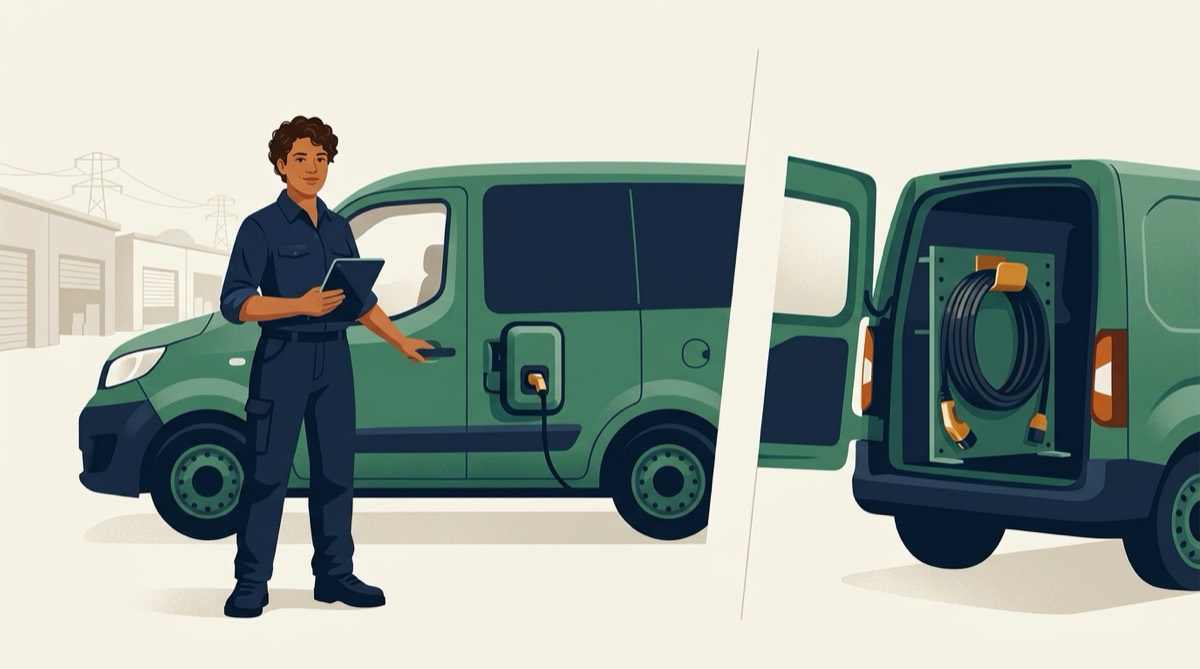
Mobile EV charging for business solves a problem the public network never will: vehicles that need charge where there is no grid connection, or where the work, and therefore the charging demand, keeps moving. In Australia that increasingly means battery-storage charging units on trailers or skids for mines and construction sites, vehicle-to-vehicle DC platforms for recovery and remote operations, and hire-based charging for events and short projects.
Who actually needs mobile charging?
Four situations keep coming up, and they are the same queries that bring readers to this page.
Construction sites run for months or years, electrify their utes, light vehicles and increasingly their plant, and often sit on a temporary power supply that has no headroom for vehicle charging. A transportable unit charges the fleet without touching the site’s builder’s supply, then moves to the next job.
Mining operations have the strongest economics: long distances to town, diesel logistics they are actively trying to shrink, and safety cases that reward electric light vehicles underground. WA-based suppliers build high-capacity mobile storage and charging specifically for this environment.
Fleets and logistics need charging that follows demand. The most ambitious Australian example is on the heavy side: New Energy Transport is deploying six skid-mounted units, each pairing a 640kW dual-dispenser charger with 125kWh of battery storage, to support 20 electric prime movers along NSW freight corridors, targeted for the end of 2026. The same logic scales down to a courier depot that is not ready to commit to permanent chargers.
Events and film production need serious charging for days, not years, which is where hire units earn their keep: charge capacity delivered to a paddock on Thursday, gone the following Tuesday.
What does the equipment actually look like?
Battery-storage charging units are the workhorse: a battery energy storage system (BESS) paired with AC or DC chargers, packaged as a trailer, skid or container. The battery recharges from whatever the site has (grid off-peak, generation, or solar) and dispenses fast charging on demand. This decoupling is the whole point: a site with a weak supply can still deliver 50kW-plus to a vehicle, because the battery does the buffering.
Vehicle-to-vehicle DC platforms are the newest category. Alpine Energy’s MGEN M40, unveiled in June 2026, draws from a donor vehicle’s battery and delivers up to 40kW DC, about 65 kilometres of range per 15 minutes, with CCS2 and CHAdeMO connectors and OCPP-compliant telemetry. It is pitched at roadside recovery operators and remote industries, and Alpine is recruiting fleet and recovery partners for early deployment. It is the industrial-strength cousin of the consumer V2L rescue trick.
Callout charging vans, the service that rescues stranded commuters in the capitals, also serve businesses: some commercial operators offer scheduled fleet top-ups at depots or workplaces. Coverage and economics are covered in our main mobile EV charging guide.
What none of this looks like is a portable generator wired to a charging cable; why that is nobody’s answer at commercial scale is covered in our generator charging explainer.
Buy, hire, or contract it out?
The honest framework: hire when the need is short or you are validating demand (events, shoots, pilot fleets); buy when a unit will be busy for years and the alternative is trenching permanent infrastructure into a temporary site; contract callouts when the need is occasional rescue or top-up rather than daily energy supply. Several suppliers, including Australian EVS and Grid Rig, operate across purchase and project-hire models for exactly this reason.
What to ask before you sign
- The load case. Vehicles, daily kilometres per vehicle, and the window in which charging must happen. Every sizing decision falls out of these three numbers.
- The refill story. A mobile charger is a bucket, not a spring: what fills it, how fast, and does that fit the site’s supply or generation?
- Connectors and rates. CCS2 covers the current Australian light-vehicle fleet; check anything older or imported, and confirm the charge rate your vehicles can actually accept.
- Compliance. Site electrical safety rules, and for mining, the approvals regime for the specific site.
- Telemetry. OCPP compliance means the unit plugs into fleet and energy management systems instead of becoming a data island.
Mobile charging for business is where Australia’s EV transition meets its geography: the grid ends, the work does not. The equipment now exists in every size from a 40kW donor-vehicle unit to a 640kW freight skid; the planning discipline, matching the bucket to the load case, is the part the brochure will not do for you. For where the public network can and cannot help your drivers in the meantime, start with our state-by-state charger maps.
Frequently asked questions
How do you charge EVs on a construction or mining site with no grid connection?
With transportable charging infrastructure: battery energy storage units paired with EV chargers, delivered as trailers or skids and recharged from site generation, off-peak grid access or solar. Several Australian suppliers build these for mining, construction and industrial sites, and the units relocate as the work moves.
What is vehicle-to-vehicle EV charging?
Hardware that draws energy from one vehicle's battery and delivers it to another as DC fast charging. Alpine Energy's Australian-built MGEN M40, launched in June 2026, outputs up to 40kW, about 65 kilometres of range per 15 minutes, with CCS2 and CHAdeMO connectors, and is aimed at roadside recovery operators and remote industries.
Can a business hire mobile EV charging instead of buying it?
Increasingly yes. Commercial mobile charging operators offer callout charging for fleets, and equipment suppliers offer transportable charging units for hire for events, film shoots and short-duration projects, so capacity can follow the work instead of being fixed to one site.
What should a business ask before buying or hiring mobile charging equipment?
The load case first: how many vehicles, what daily kilometres, and what charging window. Then the energy source that refills the unit (grid, generator or solar), the connector types and charge rate your fleet needs, site safety compliance, and telemetry, since OCPP-compliant units integrate with fleet and energy management systems.