Towing an Electric Car: Why Flatbeds Matter
Why almost every EV must be moved on a flatbed, what a wheels-down tow does to the drivetrain, and how towing entitlements work for Australian EV owners.
On this page
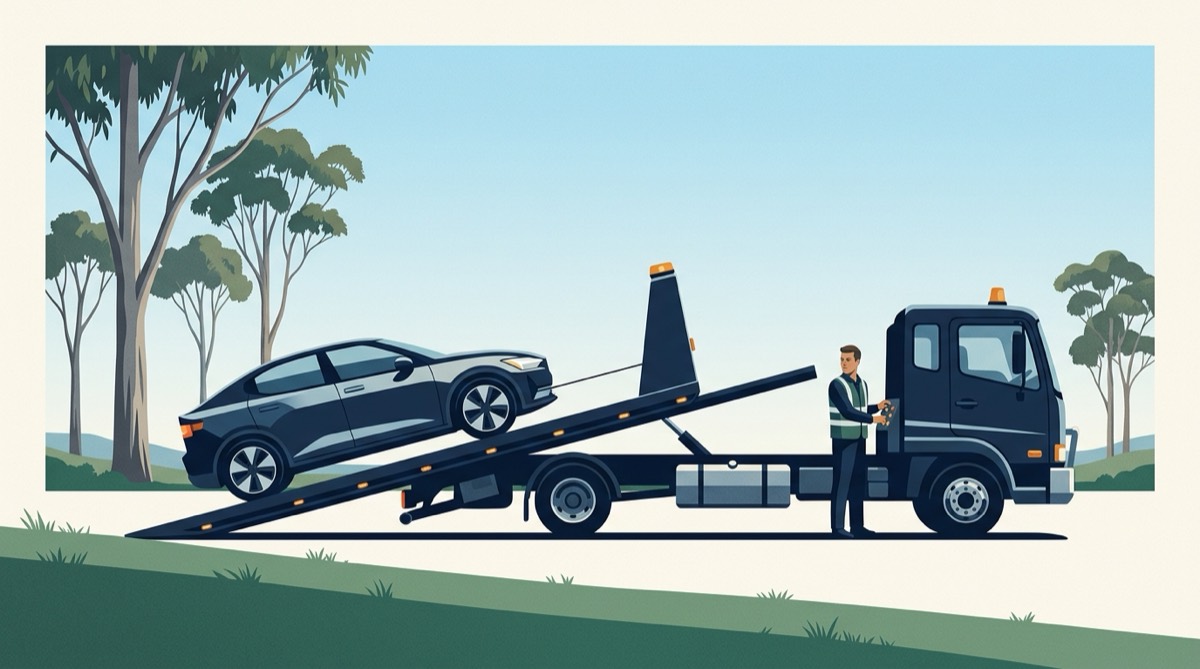
Yes, you can tow an electric car, but almost certainly not the way petrol cars get towed. Nearly every EV manufacturer requires the car to be transported with all four wheels off the road, which in Australia means a flatbed or tilt-tray truck. Tow an EV with its driven wheels rolling and the motor spins like a generator, pushing uncontrolled current into the drivetrain; that can damage the motor, inverter and battery, and it can void your warranty. The one sentence that protects you: when you call for help, say “it’s an EV” so a flatbed is sent first time.
Why can’t you tow an EV with its wheels on the road?
In a petrol car, putting the transmission in neutral disconnects the engine from the wheels, so the car can roll without the engine turning. Most EVs have no equivalent. The electric motor is permanently geared to the driven wheels, so whenever those wheels turn, the motor turns with them.
A spinning electric motor is a generator. Tow an EV at road speed with its driven wheels down and the motor produces current continuously, in a car that is switched off and not managing where that energy goes. The consequences stack up:
- Inverter and motor-controller damage from voltage the electronics were never meant to absorb in that state.
- Heat building in the motor and transmission components without the cooling systems running.
- Battery damage from uncontrolled charging pushed into the pack.
None of this is theoretical, which is why the requirement shows up in essentially every EV owner’s manual: Tesla, Hyundai, Kia, BYD, Polestar and the rest all specify transport with no driven wheels on the road. Repair estimates for getting it wrong range from a few thousand dollars for power-electronics damage to five figures if the battery pack is harmed, and manufacturers can and do refuse warranty claims for damage caused by improper towing.
For rear-wheel-drive EVs, lifting only the rear wheels (a wheel-lift tow) leaves the front wheels rolling harmlessly, but most modern EVs are available with dual motors driving all four wheels, and roadside operators rarely gamble on which variant you own. The safe, universal answer is the flatbed.
What does a flatbed tow look like in practice?
Routine, once the right truck arrives. The sequence usually runs:
- You confirm the car is an EV when you call. This is the step that matters most, because it determines what gets dispatched. Our complete EV roadside assistance guide covers who to call and what plans include.
- The car goes into transport or tow mode. Most EVs have a setting (sometimes called tow mode, transport mode or free-roll) that disengages the parking lock and lets the car roll at walking pace. You will usually find it in the service or settings menu; check your manual now rather than in the dark on a shoulder.
- The car is winched or driven slowly onto the tilt-tray. Short, slow movement of a few metres at walking pace is what transport mode exists for, and manufacturers permit it for loading.
- It is strapped down by the wheels or approved tie-down points, not by suspension or drivetrain components, and carried to the destination.
If the car is completely dead, including the 12-volt system, operators have procedures for that too: jump-packs to wake the 12-volt system so transport mode can be engaged, and skates or dollies to move a locked car the short distance onto the tray.
Are there any exceptions to the flatbed rule?
A few narrow ones, and they all come with the same caveat: the owner’s manual outranks anything you read on the internet, including this site.
- Short, slow repositioning. Moving a car a few metres at walking pace, to get it off a driveway or onto a tray, is generally fine in transport mode.
- Wheel dollies. A conventional tow truck can sometimes lift one axle and put the other on free-rolling dollies, so no driven wheel touches the road. This achieves the same outcome as a flatbed and some operators use it where a tray cannot access the car, such as some underground car parks.
- Single-motor cars, non-driven axle lifted. Technically possible for some models over short distances, but only if the manufacturer explicitly allows it. Most simply say: flatbed.
And one non-exception worth killing off: flat-towing an EV behind a motorhome (all four wheels down, the “toad” setup popular with grey nomads) is prohibited for essentially every EV sold in Australia, for the same motor-generation reasons, applied continuously over hundreds of kilometres.
Do hybrids and plug-in hybrids follow the same rule?
Mostly, yes. Conventional hybrids and PHEVs put electric motors in the driveline too, so many carry the same instruction: driven wheels off the road, or a flatbed. Some hybrids with conventional transmissions tolerate short, slow wheel-lift tows of the non-driven axle, but the era of assuming any car can be dragged behind a hook truck is over. The operator’s safe default for anything electrified is the tilt-tray, and the owner’s manual is the only document that can say otherwise.
Why does EV weight matter when the truck arrives?
Two practical wrinkles come with the battery pack. First, EVs are heavy, commonly 1,800 to 2,600 kg, which is well within a standard tilt-tray’s capacity but relevant when a car needs winching out of soft ground or an awkward angle; recovery takes the right rigging, not just any strap. Second, and more important for your wallet: the underbody is the battery. Jacking, dragging or grounding the car on its floor pan risks damaging the most expensive component in it. Professional operators use the designated lifting points and approach ramps carefully on low cars; if you ever find yourself directing an unfamiliar operator, the words “the battery is under the floor, please use the jacking points” are worth saying out loud.
What about an EV doing the towing? Different question entirely. Plenty of EVs sold in Australia are rated to tow trailers and caravans; the relevant numbers are the braked towing capacity on the spec sheet, and the range hit, which is substantial. If it’s a work vehicle you’re after, our guide to electric utes in Australia covers towing ratings and range with a trailer. This guide is about your EV being moved, not doing the moving.
Who pays for the tow, and how far will they take you?
The provider-by-provider answer, including which clubs send a mobile charger instead of a truck, is on our who tows an EV to a charger page. In summary:
If you have roadside assistance, the tow is part of your entitlement, and EVs are covered under standard plans by every Australian motoring club at no extra cost. The variable is distance:
| Cover | Indicative towing entitlement (as of mid-2026) |
|---|---|
| Club entry plans | Shorter tows suited to metro areas (NRMA’s entry tier includes 25 km) |
| Club top-tier plans | Long-distance towing; RACV Total Care includes up to 200 km out-of-charge towing |
| Tesla roadside assistance | Warrantable breakdowns transported up to 800 km to the nearest service centre |
| No cover | Commercial flatbed rates, which vary by distance and location |
For out-of-charge calls specifically, clubs will tow you to the nearest accessible charging station rather than your home or a dealer, unless your entitlement covers more. That is normally exactly what you want, since ten minutes on a fast charger solves the actual problem; what happens in the car as the battery empties, and how to avoid the situation entirely, is covered in what happens if your EV runs out of charge.
Tesla owners have a parallel path: roadside assistance through the Tesla app for the duration of the warranty, including flat-tyre support and transport for warrantable breakdowns. Where it shines and where a club membership still adds value is covered in our Tesla roadside assistance breakdown.
If you have no cover at all, you will pay commercial rates, which scale with distance and time of day. One uncovered regional tow typically costs more than several years of club membership, which is the whole argument for membership in one sentence.
What should you do after the tow?
A few minutes of admin at the drop-off point closes the loop properly.
If you were towed to a charger because you ran flat, charge to at least 40 or 50 percent before continuing, not just enough to limp home; the car has earned a buffer and so have you. Once moving, charge again at the next convenient stop and let the battery settle back into its normal operating range.
If you were towed for a fault, keep the job number and the operator’s details. If the underlying problem turns into a warranty claim, a record showing the car was transported correctly, on a tray, in transport mode, forecloses any argument about transit damage. Photograph the car before loading if you have the chance; it takes ten seconds and settles questions later.
If anything was scraped or strapped badly, raise it with the provider immediately rather than weeks later. Reputable clubs and operators carry insurance for exactly this, and prompt reports get resolved; stale ones get contested.
What should you tell the operator when you call?
Ninety seconds of clear information saves an hour of the wrong truck:
- “It’s an electric car”, the make and model, and whether it is dual-motor if you know.
- Whether it will power on. A car with a working 12-volt system can engage transport mode; a fully dead one needs different kit.
- Why it stopped: out of charge, a fault, a collision. Out-of-charge calls may get a mobile charging unit instead of a tow in some cities.
- Exactly where you are, including direction of travel on highways, and whether the car is in a dangerous spot.
- Where the wheels can roll: a flat driveway differs from a basement car park with 1.9 m clearance, which may need dollies instead of a tray.
The bottom line
The flatbed rule is the one genuinely non-negotiable difference between EV and petrol-car breakdowns. The physics is simple, the damage from ignoring it is expensive, and the fix costs you nothing more than a sentence on the phone. Australian roadside operators have done thousands of these by now, so the system works smoothly once the right truck is rolling. Know where your car’s transport mode lives, keep roadside cover whose towing distance matches where you actually drive, and an EV tow becomes exactly as boring as it should be.
Frequently asked questions
Can you tow an electric car with a normal tow truck?
Not safely, in most cases. Nearly all EV manufacturers require transport with all four wheels off the road, which means a flatbed or tilt-tray truck. Towing an EV with its driven wheels rolling spins the motor, generates uncontrolled current and can damage the drivetrain and void the warranty.
What happens if an EV is towed with its wheels on the ground?
The wheels turn the motor, which then acts as a generator and pushes current back into a system that is not managing it. That can overheat or damage the motor, inverter and battery. Repair bills can run from thousands of dollars into five figures, and manufacturers may refuse warranty claims for improper towing.
Does roadside assistance send a flatbed for EVs in Australia?
Yes, if you tell them you drive an EV when you call. Australian motoring clubs cover electric vehicles at no extra cost and their operators handle EVs routinely. Saying it is an electric car up front means the right truck is dispatched the first time, which saves you waiting twice.
Can you flat-tow an EV behind a motorhome?
Almost no EV sold in Australia is approved for flat towing, where all four wheels roll on the road. The same motor-generation problem applies constantly for the whole journey. If you want a car to tow behind a motorhome, check the owner's manual first, and expect the answer for an EV to be no.
How far will roadside assistance tow an out-of-charge EV?
It depends on your plan. Entry-level club plans typically include shorter tows that suit metro driving, while higher tiers extend much further, with RACV's top plan including up to 200 km of out-of-charge towing as of mid-2026. Tesla's program transports warrantable breakdowns up to 800 km to the nearest service centre.