EV Roadside Assistance in Australia: The Complete Guide
Everything Australian EV owners need to know about roadside assistance: who covers EVs, what happens when you run flat, and what it costs.
On this page
EV roadside assistance in Australia works much like it does for a petrol car, with two genuine differences: when you are “out of fuel” you get electrons — a top-up charge or a tow to a charger — not a jerry can, and most EVs need a flatbed truck rather than a conventional tow. Every state and territory motoring club covers electric vehicles under its standard roadside assistance plans, at no extra cost compared with a petrol car. If your EV stops, a patrol can fix the everyday problems (flat tyres, flat 12-volt batteries, lockouts) at the roadside, and if you have run out of charge you will get either a mobile top-up charge or a tow to the nearest charging station.
Who provides roadside assistance for EVs in Australia?
You have four realistic options, and they are not mutually exclusive.
State motoring clubs. The NRMA (NSW and ACT), RACV (Victoria), RACQ (Queensland), RAC (WA), RAA (SA), RACT (Tasmania) and AANT (NT) all assist electric vehicles under their normal plans. The clubs have reciprocal arrangements, so an RACV member broken down in Queensland gets helped by RACQ. Patrols are trained to work around high-voltage systems; RACQ, for example, describes its patrols as “High Voltage Aware”. For a detailed comparison of which club plan suits an EV owner, see our guide to the best EV roadside assistance in Australia.
Your car maker. Most new EVs come with complimentary roadside assistance for at least the first 12 months. Tesla includes roadside assistance for the duration of the new-vehicle warranty, Hyundai gives EV buyers 24 months, and Kia’s cover can extend to seven years if you service with a Kia dealer. The catch is that manufacturer programs are typically run through a call centre and lean towards towing you to a dealer rather than fixing things kerbside.
Your insurer. Several insurers sell roadside assistance as an add-on to comprehensive car insurance, and some, like Allianz, sell it standalone. Cover for EVs varies in the fine print, so read the terms before relying on it.
Commercial operators. A small but growing group of businesses offer pay-per-callout EV help, including dedicated mobile charging vans in some cities. More on those in our mobile EV charging guide.
What does roadside assistance actually do for an EV?
The everyday jobs are nearly identical to petrol-car assistance, because most EV breakdowns have nothing to do with the big battery.
| Problem | What the patrol does | EV-specific notes |
|---|---|---|
| Flat tyre | Fits your spare or repairs/arranges tow | Many EVs ship without a spare; check your boot |
| Flat 12V battery | Jump-starts or replaces it | EVs still have a 12V battery, and it is a top cause of “dead” EVs |
| Locked out | Gains entry | Same as any modern car |
| Out of charge | Mobile top-up where available, otherwise tow to a charger | The genuinely EV-specific callout |
| Fault or warning light | Diagnoses, tows if undriveable | High-voltage faults are not fixed at the roadside |
That 12-volt point deserves emphasis. When an EV “won’t start”, the culprit is very often the small conventional battery that powers the computers, locks and screens, not the traction battery. Patrols deal with these constantly, the same way they do for petrol cars.
What won’t roadside assistance do for an EV?
Knowing the limits saves arguments at the kerb.
No high-voltage repairs at the roadside. Patrols are trained to work safely around EV systems, not to open them. A genuine high-voltage fault, an orange-cable problem rather than a flat tyre, gets the car made safe and transported to a workshop or dealer. That is the correct outcome, not a service gap.
No full recharge. Where mobile charging exists, it is a top-up measured in kilometres, designed to reach the nearest charger. Nobody parks a van next to you for three hours.
The tow goes to the nearest accessible charger, not your driveway, unless your plan’s towing entitlement covers the longer trip. On entry-level plans with 25 km of towing, “nearest accessible” is what you get.
Motorway rules come first. On managed motorways, patrols and incident-response crews may be required to move your vehicle to a safer location before any roadside work happens. Follow their instructions; the breakdown gets sorted at the safe spot.
What happens if you run out of charge?
Two things can happen, depending on where you are.
Mobile charging, where it exists. Some clubs now carry chargers to you. The NRMA has fitted patrol vans with 9.6 kW mobile chargers backed by a 4.8 kWh battery pack, adding roughly 1 km of range every two minutes; the service operates in Sydney and Canberra with plans to extend across NSW. RAC in WA has run an electric patrol van with a 7 kW charger that can deliver about 15 km of range in around 20 minutes, and RAA has launched an emergency charging service in metropolitan Adelaide. RACV has been trialling a portable DC fast-charging unit designed to deliver around 20 km of range in a few minutes. These services exist to get you to the nearest charger, not to fill your battery.
A tow to a charger, everywhere else. Outside mobile-charging zones, the standard response is a tow to the nearest accessible charging station, within your plan’s towing entitlement. RACQ words its EV entitlement as a “charge top-up” where available, or towing to an accessible charging station or your destination in line with your normal entitlements. RACV’s top-tier plan includes up to 200 km of out-of-charge towing, which matters in regional Victoria.
Running flat is less dramatic than most new owners fear, and your car gives you plenty of warning first. We cover the whole sequence, including turtle mode and the hidden buffer, in what happens when an EV runs out of charge.
Why do EVs need a flatbed tow?
An EV’s wheels are mechanically connected to its motor. Tow one with its driven wheels rolling on the road and the motor spins, generating current the car cannot control. That can overheat or damage the motor, inverter and battery, and it can void your warranty. Almost every manufacturer therefore requires transport with all four wheels off the ground.
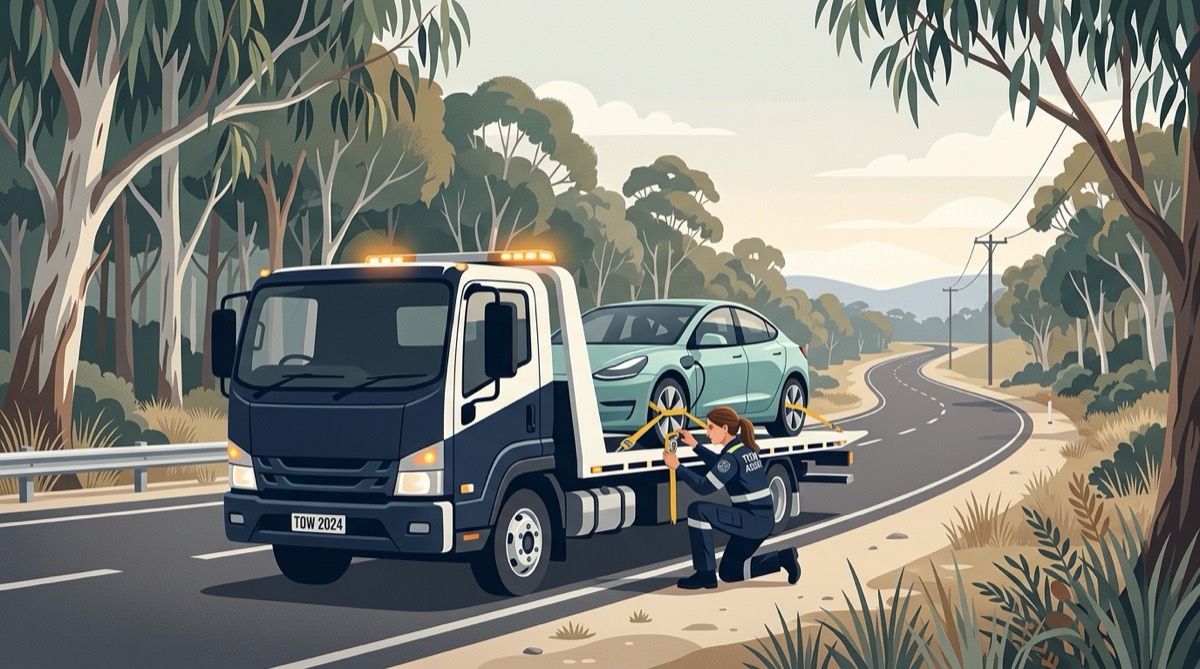
In practice this means: tell the operator you drive an EV when you call, so they send a flatbed (also called a tilt-tray in Australia) first time rather than a conventional hook truck. Many EVs also have a “transport” or “tow” mode that lets the car roll at walking pace onto the tray. The full detail, including the rare exceptions, is in our EV towing guide.
What does EV roadside assistance cost?
The clubs do not charge extra for EVs. As of mid-2026, indicative annual pricing for a single vehicle looks like this:
| Provider | Entry plan | Top plan | EV surcharge |
|---|---|---|---|
| NRMA (NSW/ACT) | From about $140/yr | About $330/yr | None |
| RACV (VIC) | From about $138/yr | About $318/yr | None |
| RACQ (QLD) | From around $95/yr | Varies by tier | None |
| Other clubs (RAC, RAA, RACT, AANT) | Check club website | Check club website | None |
Prices move around, so treat these as ranges and check the club’s current pricing before joining. The differences between tiers are mostly towing distance and extras like accommodation or hire-car cover after a breakdown far from home. If you regularly drive your EV beyond the metro fast-charging grid, the longer towing allowance on a higher tier is the feature that actually matters. Our NRMA EV coverage breakdown digs into what Australia’s biggest club specifically does and does not do for electric cars.
Do you need a club membership if your car came with roadside assistance?
For the first year or two, maybe not. Manufacturer programs will get you off the roadside, and Tesla’s runs for the length of your warranty. But there are three reasons many EV owners keep a club membership anyway.
First, manufacturer cover expires or comes with strings, like Kia’s requirement to service at a dealer to keep cover rolling. Second, club patrols fix things on the spot far more often, where manufacturer programs tend to default to a tow. Third, clubs are building the EV-specific kit, mobile chargers included, and club membership often brings discounts on public charging networks as well. The trade-offs are laid out in our comparison of the best roadside options for EV owners.
Does regional and interstate driving change the picture?
Yes, more than any other factor. In the capitals, the worst realistic outcome of an EV breakdown is a short flatbed ride; chargers, contractors and patrols are everywhere. Outside them, three things shift.
Towing distance becomes the headline feature. If the nearest fast charger or capable workshop is 150 km away, the difference between a 25 km entitlement and a 200 km one is the difference between covered and a large invoice.
Reciprocal club cover does the interstate work. Join your home-state club and the others assist you on their turf, so a Melbourne-registered EV broken down outside Dubbo is an NRMA job under your RACV membership. One membership genuinely covers the country.
Remote-area honesty. Across outback WA, the NT and the long crossings, response times stretch for every kind of vehicle, and mobile EV charging does not exist. Plan charging with margins so that roadside assistance is your backstop, not your itinerary.
How do you prepare before anything goes wrong?
A few minutes of setup makes a breakdown boring instead of stressful.
- Save your provider’s details in your phone and glovebox, and note your membership number.
- Know your car’s tow mode. Find it in the manual now, not at night on a road shoulder.
- Check whether you have a spare tyre. Many EVs ship with a repair kit only; decide if that is enough for your driving.
- Keep your charging apps set up with payment attached, so a low battery never becomes a flat one while you fumble with sign-ups.
- Plan regional trips around chargers, with a margin for headwinds, heat and hills.
We keep a printable run-through of exactly what to do when an electric car stops, in order, in the EV breakdown checklist.
The bottom line
EV roadside assistance in Australia is a solved problem with two genuine quirks: flat batteries get fixed with a charge or a tow to a charger rather than a jerry can, and tows need a flatbed. Every motoring club covers EVs at petrol-car prices, manufacturer programs provide a free safety net while they last, and mobile charging vans are slowly spreading through the capital cities. Pick a provider whose towing entitlement matches where you actually drive, tell them you drive an EV when you call, and the rest works the way it always has.
Frequently asked questions
Does roadside assistance cover electric cars in Australia?
Yes. Every state and territory motoring club, including NRMA, RACV, RACQ, RAC, RAA, RACT and AANT, covers electric vehicles under its standard roadside assistance plans at no extra cost. Patrols are trained to work safely around high-voltage systems, and towing or charge top-ups are included within your plan's normal entitlements.
What happens if my EV runs out of charge on the road?
Your provider will either give you a roadside top-up charge, where that service operates, or tow you to the nearest accessible charging station. Mobile charging units are still limited to certain cities, so a flatbed tow to a charger is the most common outcome. Either way you are covered under a standard club plan.
Do EVs need a special tow truck?
Usually, yes. Most manufacturers require an EV to be transported with all four wheels off the road, which means a flatbed truck. Towing an EV with its driven wheels rolling can generate current in the motor and damage the drivetrain. Always tell the operator you drive an EV when you call.
Is EV roadside assistance more expensive than for petrol cars?
No. The major Australian clubs charge the same price regardless of what powers your car. As of mid-2026, entry-level club plans sit roughly between $95 and $140 a year, rising to around $270 to $330 for top-tier plans with long-distance towing and extras.
How common is it for an EV to break down?
EVs have fewer moving parts than petrol cars, but they still get flat tyres, flat 12-volt batteries and lockouts, which are the most common callouts clubs report. Running the main battery completely flat is comparatively rare, and it is the one breakdown you can almost always plan your way out of.