Australia's EV Charging Gaps: Where You're Most Likely to Run Flat
What 1,267 public chargers reveal about where Australia's fast-charging network thins out — and where an EV road trip needs the most planning.
On this page
Australia’s public charging network looks healthy until you leave the southeast. Our analysis of 1,267 operational public chargers shows the fast-charging network is heavily concentrated in Victoria and New South Wales, thins dramatically across the west and centre, and leaves some of the country’s most iconic touring routes with hundreds of kilometres between fast chargers — including roughly 1,500 km of the Stuart Highway with none at all. For EV drivers, that’s the real geography of range anxiety, and it’s why a flat battery on a regional highway is a very different problem from one in the suburbs.
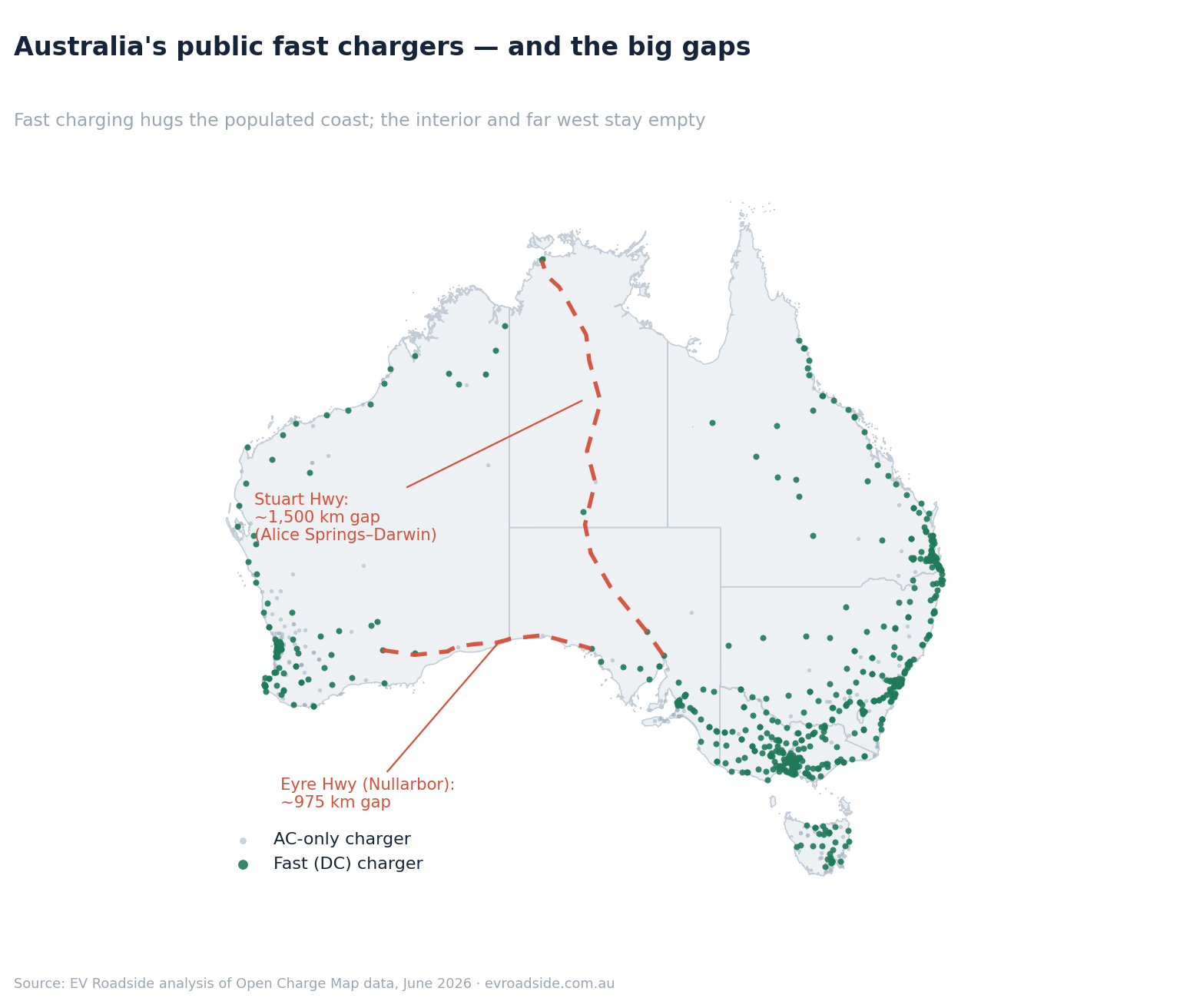 Every public charger in Australia, mapped. Fast (DC) chargers in green; the interior and far west stay sparse. Source: EV Roadside analysis of Open Charge Map data.
Fast charging is a southeastern story
Counting only fast (DC) chargers — the ones that make long-distance EV travel practical — the imbalance is stark. Victoria and New South Wales between them hold more than half the national total. The further you get from Melbourne and Sydney, the thinner the network becomes, both in raw numbers and relative to the enormous distances involved.
The table below ranks the states and territories by fast chargers per 10,000 km² — a measure of how far apart they’re spread.
| State / Territory | Public chargers | Fast (DC) | AC-only | Fast per 10,000 km² | Biggest network |
|---|---|---|---|---|---|
| Northern Territory | 7 | 3 | 57% | 0.02 | Evie (67%) |
| South Australia | 121 | 42 | 65% | 0.43 | Chargefox (45%) |
| Western Australia | 373 | 115 | 69% | 0.46 | Chargefox (60%) |
| Queensland | 131 | 113 | 14% | 0.65 | Evie (38%) |
| New South Wales | 268 | 169 | 37% | 2.11 | NRMA (22%) |
| Tasmania | 66 | 30 | 55% | 4.39 | Chargefox (83%) |
| Victoria | 281 | 208 | 26% | 9.15 | Chargefox (38%) |
| ACT | 20 | 8 | 60% | 33.93 | Evie (50%) |
Two patterns stand out. First, in the west and centre a large share of public charging is AC-only — slow charging that’s fine overnight but useless when you need to add range quickly on a long drive. Nearly 70% of WA’s public chargers fall into this category. Second, several markets depend on a single network: if Chargefox has an outage in Tasmania, 83% of the state’s public charging is affected at once. That concentration is a quiet reliability risk that rarely shows up in headline charger counts.
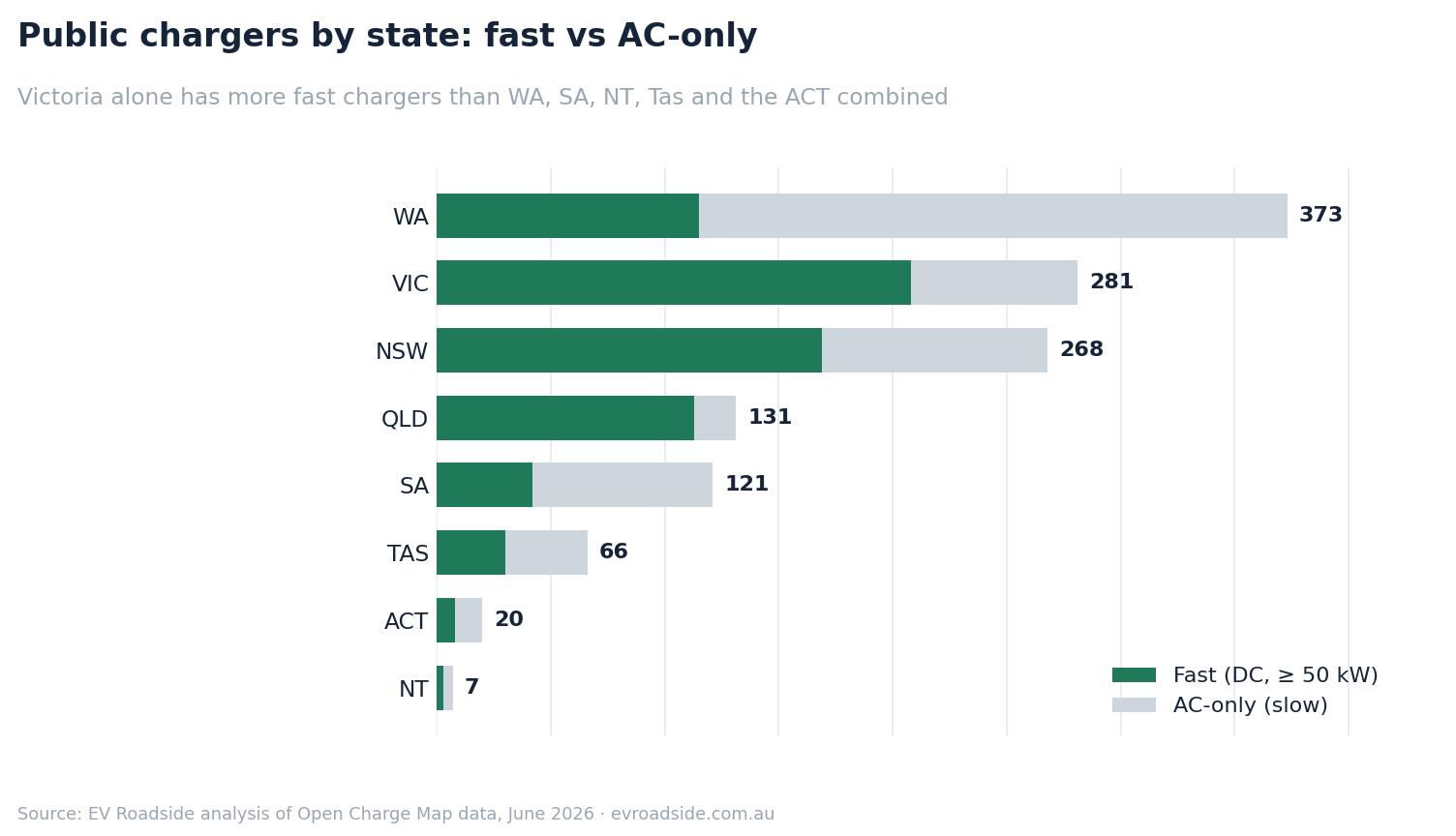 Fast (DC) vs AC-only public chargers by state. WA has the most chargers overall, but most are AC-only.
The route gaps that matter
Charger counts don’t tell you what a road trip actually feels like. To find the gaps that matter, we placed every fast charger along seven major touring routes and measured the longest stretch with none. The contrast between the populated corridors and the remote ones is extreme.
The remote routes are where EV travel still demands careful planning:
- Stuart Highway (Port Augusta – Darwin): the longest gap in the country. There is no public fast charger for roughly 1,500 km between Alice Springs and Darwin. Alice Springs itself has only AC charging in the dataset.
- Eyre Highway / Nullarbor (Norseman – Ceduna): about 975 km separates the fast chargers at Balladonia (WA) and Ceduna (SA).
- North West Coastal Highway (Perth – Broome): gaps of around 250 km in the far north.
The southeastern corridors, by contrast, are well covered. On the Hume (Sydney–Melbourne), Pacific (Sydney–Brisbane), Bruce (Brisbane–Cairns) and Western (Melbourne–Adelaide) highways, no gap between fast chargers exceeds about 150 km — comfortably within range for any current EV. The “can you even drive an EV across Australia?” anxiety is, for most people on most trips, misplaced. It’s the outback crossings, not the capital-to-capital runs, where the network still has real holes.
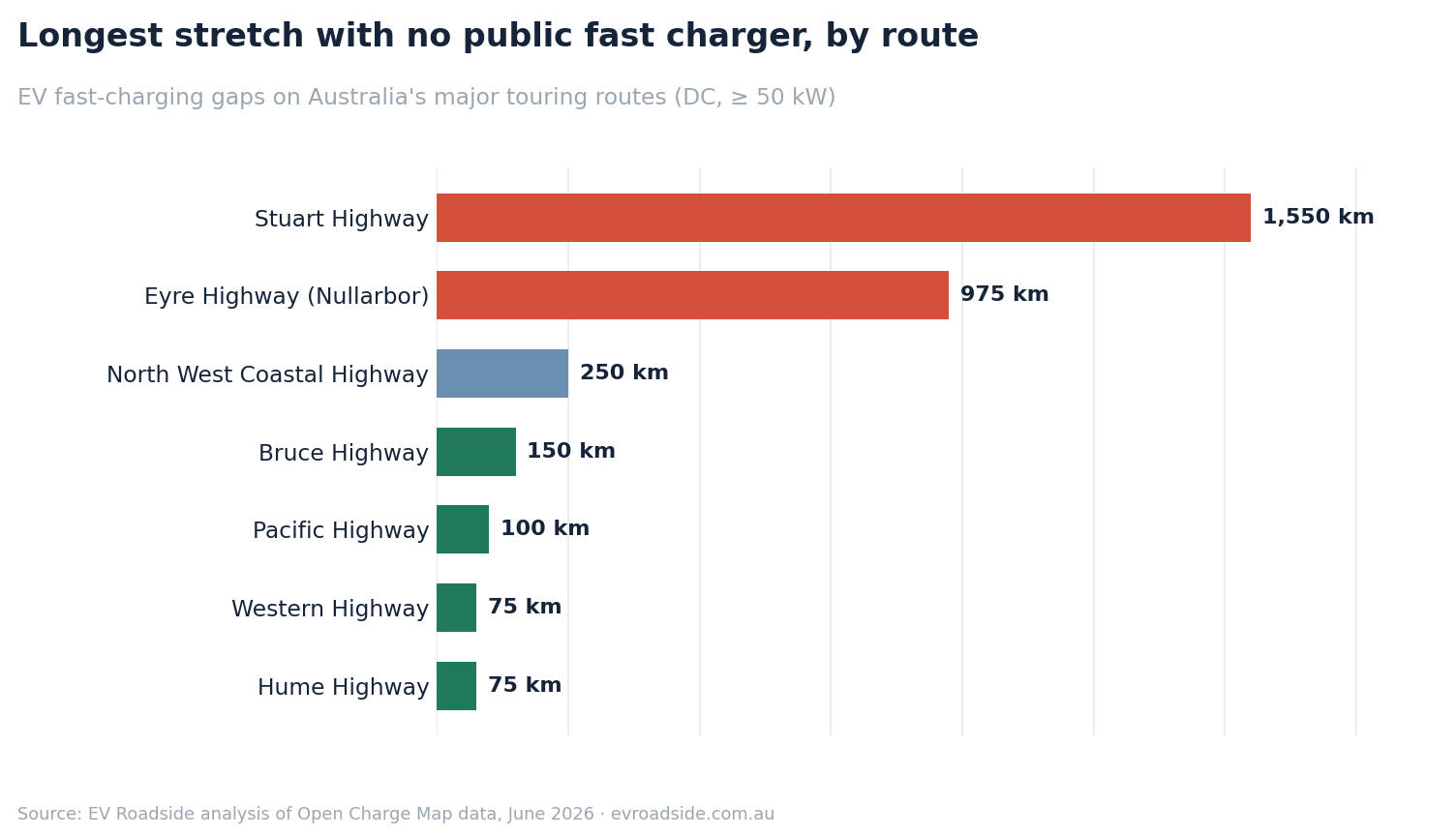 The longest stretch with no public fast charger on each major touring route. The busy southeastern corridors all stay under ~150 km.
Why this matters for roadside
A flat battery in the suburbs is an inconvenience — a tow of a few kilometres to a charger, covered by standard roadside assistance for EVs. On the Stuart Highway or the Nullarbor, the same situation is a genuinely remote breakdown, where the nearest fast charger could be hundreds of kilometres away and a tow is long and expensive. The charging map is, in effect, a roadside-risk map: the thinner the fast-charging network, the more a run to empty costs you.
If you’re planning a trip through these areas, our guides on what happens when an EV runs out of charge and the EV breakdown checklist are worth reading first, and the charger map shows exactly where the fast chargers are. You can also browse fast chargers by state.
Methodology & data
The analysis uses operational public charger data from Open Charge Map, licensed CC-BY-4.0, as of June 2026 (1,267 sites after removing non-operational, planned and out-of-bounds records). A “fast charger” is any site with a maximum power of 50 kW or more (DC). State counts and network shares come from our published charger dataset; route gaps were measured by placing every fast charger within a 50 km corridor of each highway and finding the longest stretch with none. Network and charger rollouts change quickly, so these gaps are closing over time.
The underlying figures are free to download and cite:
- State-level data: ev-charging-gaps-states.csv
- Route gaps: ev-charging-gaps-routes.csv
Please attribute to EV Roadside with a link to this page. For media enquiries, see our media & press page.
Frequently asked questions
Where are Australia's biggest EV charging gaps?
On the remote touring routes. Based on Open Charge Map data (June 2026), the Stuart Highway has no public fast charger for roughly 1,500 km between Alice Springs and Darwin, and the Eyre Highway across the Nullarbor has about 975 km between the fast chargers at Balladonia (WA) and Ceduna (SA). By contrast, the busy southeastern corridors — the Hume, Pacific and Western highways — have no gap larger than about 150 km.
Which state has the worst EV fast-charging coverage?
By fast chargers per unit of area, the Northern Territory is far behind, with just 3 public fast chargers across 1.35 million km². Western Australia and South Australia also rely heavily on slower AC charging — about 69% of WA's public chargers and 65% of SA's can only charge at AC speeds.
Is Australia's public charging network concentrated in the cities?
It's concentrated in the southeast. New South Wales and Victoria hold about 55% of the country's public fast chargers. Victoria alone (208) has more fast chargers than Western Australia, South Australia, the Northern Territory, Tasmania and the ACT combined (198).
What happens if I run out of charge in a regional area?
Away from the cities, the standard response is a flatbed tow to the nearest charging station, which standard roadside assistance covers for EVs. Mobile roadside charging exists only in parts of a few capital cities. On remote routes, planning around the known fast chargers — and carrying a buffer — matters far more than it does in town. See our guide on what happens when an EV runs out of charge.
How current is this charging data?
It reflects Open Charge Map's operational public chargers as of June 2026. Networks are actively expanding, especially on regional highways, so gaps are closing over time. We publish the underlying data so the figures can be checked and re-run.