Can You Charge an Electric Car With an Extension Cord?
An extension lead will charge an EV, and Tesla's manual says never to. The heat maths by conductor size, which lead is safe as a one-off, and the 15 A outlet that ends the question.
On this page
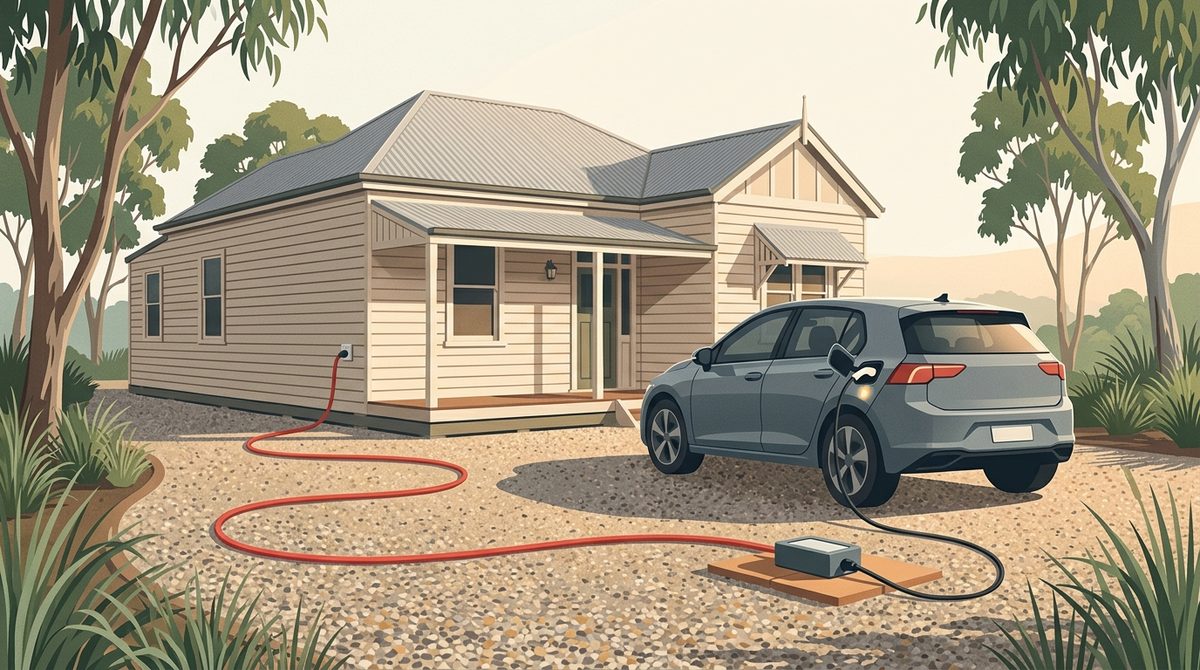
Yes, an extension cord will charge an electric car, and every manufacturer tells you not to do it. Both things are true. The car and its portable charger only see a powerpoint at the far end of the lead, so charging starts and runs normally. What the charger cannot see is the lead itself, and an ordinary 10-amp extension lead was never designed to carry 10 amps continuously for eight hours. Done carefully, with a heavy-duty tradesman lead of 1.5 mm² or thicker, as short as possible and fully unrolled, it is a reasonable one-off. Done with the lead from the shed, coiled on the ground, every night, it is how EV charging fires start. The proper fix is a 15 A outlet near the car, and it costs a few hundred dollars.
Why is an extension cord different for an EV?
Most things you plug into an extension lead are either low-power or brief. A drill pulls 5 amps in bursts, a fridge cycles, a heater runs for an evening. An EV charger pulls its full 10 amps, without pause, for as long as the car takes: typically 8 to 12 hours on a household socket. A lead rated at 10 amps can carry that, but the rating assumes a lead in good condition, laid out straight in free air. Coil it, kink it, leave it in the sun on hot concrete or in a puddle, and the same current has nowhere to shed its heat.
The charger cannot help. Its control box checks that the supply voltage and earth are present before it starts, then simply draws current. It has no idea whether that current is flowing through 2 metres of cable or 30, or through a socket whose contacts have gone slack after twenty years of vacuum cleaners. That is why the manufacturers’ answer is a flat no. Tesla’s Mobile Connector manual puts it in one warning: “Do not use an extension cord, a multi-outlet adapter, a multi-plug, a conversion plug, or a power strip to plug in the Mobile Connector.” Other portable chargers carry similar wording, and a fire traced to a lead the manual prohibits is a difficult warranty or insurance conversation.
How much heat does a lead actually make?
The number that matters is conductor size, printed on the lead as mm². Standard 10 A leads sold at hardware stores, such as HPM’s 15 m workshop lead, use 1.0 mm² copper. The 10 A extra heavy duty tradesman leads and the 15 A caravan leads use 1.5 mm². Purpose-made EV leads use 2.5 mm².
Using the standard resistance figures for flexible copper cord at 20°C, here is what a 20-metre lead does with a 10 A charger on the end of it. A warm lead loses more, because copper’s resistance rises with temperature.
| Lead | Conductor | Voltage drop over 20 m at 10 A | Heat lost in the lead |
|---|---|---|---|
| Standard 10 A | 1.0 mm² | About 8 V | About 80 W |
| Heavy-duty tradesman 10 A, or 15 A caravan | 1.5 mm² | About 5 V | About 55 W |
| Purpose-made EV lead | 2.5 mm² | About 3 V | About 30 W |
Eighty watts spread along 20 metres of unrolled lead is warm to the touch and no more. The same 80 watts inside a tight coil, or a reel, is a heater with no airflow; reels are rated for their full current only when completely unwound, and the inner turns of a wound reel are where the insulation fails. The energy is also simply wasted: 80 W out of the 2,400 W you are paying for is about 3 per cent of every charge going into warming the driveway.
The joints matter more than the copper. Fires from extension leads usually start at a plug or socket, where a slightly loose or corroded contact has a resistance of its own and 10 amps through it for hours makes a hot spot. Check the plugs at both ends of the lead after half an hour: warm is normal, hot to hold is a stop sign.
If you must, how do you do it safely?
The one-off case is real: the holiday house whose only outdoor socket is 15 metres from the parking spot, the friend’s place, the caravan park bay. For that, the rules are:
- Use a heavy-duty tradesman lead of 1.5 mm² or thicker, 2.5 mm² for anything over 20 metres. It has an ordinary 10 A plug, so it fits a normal socket. A 15 A caravan lead is the same copper but has a 15 A plug, which only fits a 15 A socket, so it is the lead for caravan-park bays rather than the house.
- As short as you can manage, and fully unrolled, laid out where it will not be driven over, kinked or coiled.
- One lead only. No daisy-chaining, no double adaptors, no power boards. Every extra joint is another hot spot.
- Keep the joins dry and off the ground. The charger’s control box is weather-rated; the join between the lead and the charger’s plug is not. Our guide to charging an EV in the rain covers what is and is not sealed.
- Socket on a circuit with a safety switch (RCD), which is every socket circuit in a house wired or rewired this century. An old outbuilding without one is the wrong place to start.
- Check the plugs for heat after 30 minutes, and again after a couple of hours. If either end is hot to hold, stop.
- Never across a footpath. Councils treat cables on public land as an enforcement matter and you carry the liability; the state of play, including the few council trials, is in our guide to charging without a driveway.
- Treat it as occasional. If you are doing this every night, the real answer is below.
Some portable chargers let you dial the current down to 6 or 8 amps. If yours does and you are on a long or thin lead, use it: at 8 amps the heat in the lead falls by more than a third, and you lose about a fifth of your charging speed.
Is a 15 amp charger the answer?
Often, yes, and it is the reason a lot of people searching for extension leads end up buying something else. A 15 A charger draws about 3.5 kW and adds roughly 20 km of range per hour, against 10 to 15 km from a 10 A unit. The catch is the plug: an Australian 15 A plug has a wider earth pin that will not fit a 10 A socket, and that is deliberate. A 15 A socket sits on its own circuit with its own breaker, which is exactly what continuous EV charging wants.
Filing the earth pin down, or using an unprotected adaptor, puts a 15 A load on a 10 A socket and circuit. Some adjustable chargers can be set to 10 A and run through an adaptor, which is safe for the socket only as long as nobody turns the dial back up. The proper route is an electrician installing a 15 A outdoor outlet where the car parks, typically a few hundred dollars, as described in our portable charger guide. Caravan parks have them on every powered site, which is why a 15 A charger is the road-tripper’s unit.
If you are installing a socket anyway, it is worth pricing the step beyond it: a 7 kW wallbox costs roughly $1,200 to $2,500 installed as of mid-2026 and adds 35 to 40 km of range per hour. Our home charging guide and the installation guide cover what that involves, and our home charger comparison covers which unit.
What about extending the Type 2 cable instead?
That is the other extension cord question, and the answer is firmer. The cable between the charger and the car is part of a certified assembly, and the international charging standard, IEC 61851-1, says a cord extension set or second cable assembly is not to be used for the connection between the car and the charger. That single clause is why reputable cable makers, including UK specialists who explain their refusal in public, do not sell Type 2 extensions, whatever the marketplaces list.
In practice the question only arises at BYO-cable AC chargers, because DC fast chargers are always tethered. The fix is a longer cable: seven metres reaches around a car parked the wrong way round at a kerbside charger, and a Type 2 cable of that length is an ordinary purchase, covered in our Type 2 charging guide.
The short version
An extension lead will charge your EV and the manufacturers say don’t. Between those two facts sits a narrow, defensible use: a heavy-duty tradesman lead, thick, short, unrolled, dry, checked for heat, used occasionally. Everything outside that narrow case is either a 15 A outlet you should have installed, a wallbox you were going to buy anyway, or a fire that started at a plug. Where extension leads sit among every other way to charge, from the powerpoint to the ultra-rapid, is in our guide to how to charge an electric car in Australia.
Frequently asked questions
Can you use an extension cord to charge an electric car?
It works, because the car and its portable charger only see a powerpoint at the far end. Every EV maker says not to, Tesla in writing, because a domestic lead is not built for 10 amps continuously for eight hours. If you must, use a heavy-duty lead with 1.5 mm² or thicker conductors (sold as tradesman leads), as short as possible, fully unrolled, dry, and treat it as a one-off rather than a routine.
What size extension lead do you need for EV charging?
Thicker than the standard lead. Ordinary 10 A leads sold in Australia use 1.0 mm² conductors; heavy-duty tradesman leads and 15 A caravan leads use 1.5 mm², and purpose-made EV leads use 2.5 mm². Over 20 metres at 10 amps a 1.0 mm² lead drops about 8 volts and dissipates around 80 watts as heat along its length. A 2.5 mm² lead loses less than half that.
Why do EV manufacturers say no extension cords?
Because the charger cannot see what it is plugged into. The control box checks the supply voltage and earth, then draws full current for hours; a thin, coiled or worn lead, or a tired socket at either end, heats up under that load and the charger has no way to know. Tesla's Mobile Connector manual warns against extension cords, multi-plugs, conversion plugs and power strips outright.
Can you run a 15 amp EV charger from a 10 amp socket?
Not directly: the 15 A plug has a wider earth pin so it will not fit a 10 A socket, and filing the pin down defeats the protection. Some adjustable chargers can be set to 10 A and used with a plug adaptor, but the socket and its circuit are still only rated for 10 A. The proper answer is a 15 A outlet on its own circuit, which an electrician installs for a few hundred dollars.
Can you extend the Type 2 charging cable itself?
The charging standard says no. IEC 61851-1 states that a cord extension set or second cable assembly is not to be used between the car and the charger, which is why the manufacturers will not endorse the Type 2 extension cables sold online. DC fast chargers are always tethered so the question never arises; for BYO-cable AC chargers, buy a longer cable (seven metres is the sensible length) rather than an extension.