Camping with an EV: Running Your Fridge, Lights and 12V Gear from an Electric Car
A fridge running all night costs your EV a few kilometres of range. Here is how to power a campsite from an electric car, and the 12V wiring traps to avoid.
On this page
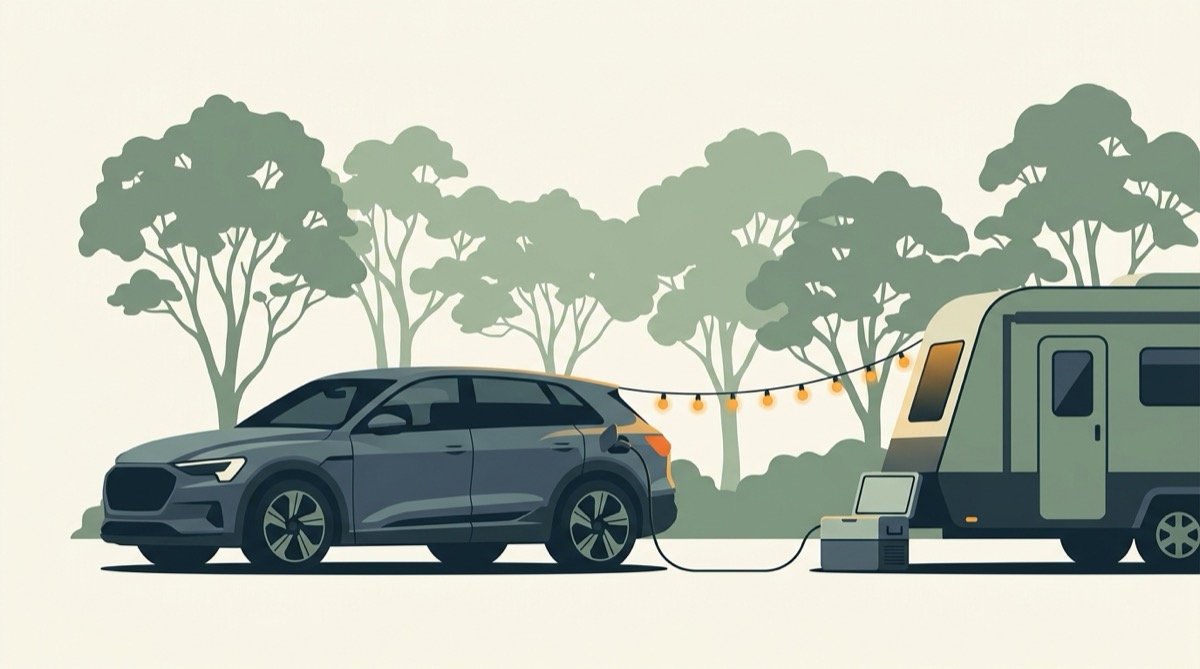
An electric car is quietly one of the best camping power sources you can own. A compressor fridge, lights, phone chargers and a water pump together draw less in a weekend than you would use driving to the shops, and an EV supplies it silently, with no generator, no fuel and no fumes. (The reverse question, whether a generator can charge the EV, has a much less satisfying answer.) The two questions that matter are which outlet to run your gear from, and whether the 12V wiring between the power source and your gear is up to the job.
What in an EV can actually power a campsite?
You have up to three outlets to work with, depending on the car.
| Power source | Typical limit | Best for |
|---|---|---|
| 12V accessory socket | 120 to 180W | One fridge, lights, phone charging |
| V2L 240V outlet | 2.2 to 3.6kW | Everything at once, including cooking |
| Portable battery box | Depends on box | Gear away from the car, redundancy |
The 12V accessory socket is the familiar option, and on an EV it is better than it was in your old petrol car. EVs keep their small 12V system topped up from the main drive battery through a DC-DC converter, so you are effectively sipping from a 60kWh-plus tank rather than a 50Ah starter battery. The catch is the socket’s own limit, usually 10 to 15 amps, and the fact that some models cut accessory power when the car locks. Look for a camping or utility mode in the settings, and test it in the driveway before you rely on it in the bush.
V2L is the upgrade. If your EV has vehicle-to-load, you get a full 240V powerpoint supplying up to 3.6kW, which turns the campsite question from “what can I run?” into “what do I feel like running?”. Most 12V camping fridges are dual-voltage and happily run from their 240V lead plugged straight into the V2L outlet.
A portable battery box still earns its place even with V2L, because it powers the fridge while the car is away on a day trip, and it is the natural home for gear mounted in a camper trailer.
Will a fridge flatten the battery overnight?
No, and the maths is worth seeing once so you can stop worrying about it. A 40 to 60 litre compressor fridge draws around 50 watts while the compressor runs, but the compressor cycles, so the average sits around 10 to 25 watts depending on the weather and how often the lid opens. Call it 0.25kWh over a 12-hour night. On a 60kWh battery that is roughly half a percent, or 2 to 3 kilometres of range on the real-world numbers most EVs deliver.
Run the fridge, lights and a diesel heater’s fan for an entire long weekend and you are still only a few percent down. The sensible precautions are the same ones from our V2L guide: set the car’s discharge floor if it offers one, and know your distance to the nearest charger so a relaxing weekend does not end as a chapter in our running out of charge guide.
Why does cable size matter so much at 12 volts?
Here is the trap that catches people moving from 240V thinking to 12V gear. Voltage drop over a cable is proportional to current, and delivering the same watts at 12V takes twenty times the current of 240V. A drop of a few volts is irrelevant at a powerpoint but catastrophic at 12V, where many fridges have battery-protection cutoffs between 10 and 12 volts. A healthy battery at one end of a long, thin extension lead can still present a voltage at the fridge end low enough to trigger the cutoff, which is why a fridge can die overnight next to a battery box showing full bars.
The fix is short, thick cable, sized for the run. Rather than guessing from the “it looks beefy” school of engineering, run your actual load and cable length through Volt & Grain’s 12V wire size calculator, which does the voltage-drop maths for DC circuits and shows its working. Thirty seconds there saves a warm esky at 2am.
This matters double if the 12V run is permanent: a fridge slide in the boot, a canopy setup, or a camper trailer with its own wiring loom. Undersized cable in a fixed install does not just brown out, it runs warm at continuous load, and at campsite currents that is a fire risk, not a quirk.
What about powering a camper trailer?
If you tow a camper with your EV, treat the trailer as its own electrical island. Most camper trailers carry a house battery, and that battery, not the car, should run the trailer’s fridge and lights. EVs vary in what their trailer wiring provides beyond lights, and many offer no charging feed at all, so plan on charging the trailer battery from solar or from a 240V charger plugged into the V2L outlet when you are stopped. A portable EV charger and a trailer battery charger can share that outlet across a weekend without getting close to the 3.6kW ceiling.
One honest caveat to end on: towing a camper costs an EV real range, often 30 to 50 percent, so the power maths above is never your constraint. The distance between chargers is. Sort the wiring once with the calculator, size the fridge cable properly, and the electrical side of EV camping becomes the part of the trip you never think about again.
Frequently asked questions
Can you run a 12V fridge from an electric car?
Yes, two ways. Plug it into the car's 12V accessory socket, which most EVs power from the main drive battery, or plug its 240V lead into a V2L outlet if your EV has one. A compressor fridge averages 10 to 25 watts, which is a trivial load for an EV battery.
Will running a fridge overnight flatten my EV battery?
No. A compressor camping fridge uses roughly 0.2 to 0.3kWh over a 12-hour night. On a 60kWh EV that is around half a percent of the battery, or about 2 to 3 kilometres of range. Set a discharge floor if your car offers one and you cannot strand yourself.
Do EV 12V sockets stay on when the car is parked?
It varies by model. Many EVs cut accessory power shortly after you lock the car, while others offer a camping or utility mode that keeps sockets live from the main battery. Check your manual for the setting before relying on it for a fridge overnight.
Is V2L or the 12V socket better for camping?
The 12V socket is fine for a single fridge or lights, but is usually limited to 120 to 180 watts. V2L supplies up to 3.6kW through a normal 240V powerpoint, so it handles the fridge plus induction cooktop, coffee machine and charging duties at once. If your EV has V2L, use it.