EV Battery Health Checks in Australia: Testing, Cost and When to Get One
State-of-health reports explained: what they measure, who offers them in Australia, what they cost, and why used-EV buyers should get one.
On this page
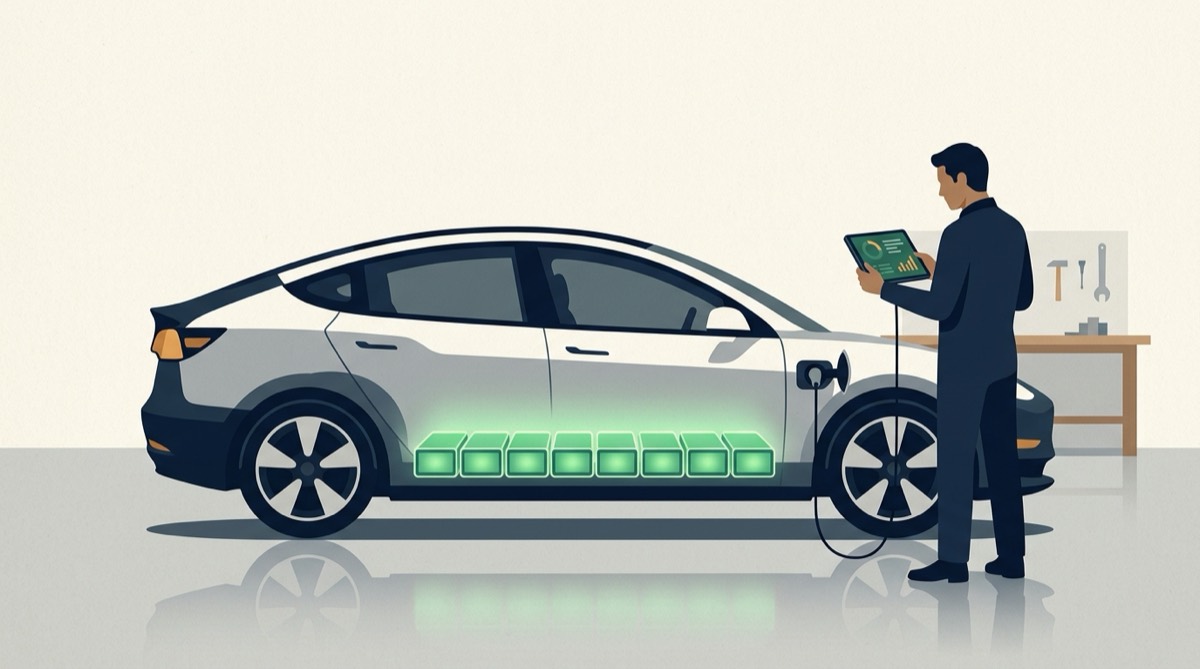
An EV battery health check is a diagnostic test that measures the battery’s state of health (SoH): how much usable capacity remains compared with when the car was new. In Australia you can get one from the NRMA (a mobile service run with diagnostics firm Aviloo, $250 for members, $300 for non-members), from mycar stores nationally, or as part of a pre-purchase inspection through RedBook Inspect. The report matters most when you’re buying or selling a used EV, because SoH directly determines real-world range and resale value.
What is a state of health report?
The terms get used interchangeably: an EV battery health check, a battery test, a state-of-health (SoH) test, a battery inspection and, loosely, “EV battery diagnostics” all describe the same thing — plugging into the car and reading how much usable capacity the pack has left. Whatever a provider calls it, the number that matters is the SoH percentage.
Every battery loses a little capacity as it ages and cycles. SoH expresses what’s left as a percentage of original capacity. A pack at 92 per cent SoH holds 92 per cent of the energy it held new, which translates almost directly into range: a car that originally managed 400 km will now manage about 368 km on the same charge.
A proper SoH test plugs into the car’s diagnostic port and reads real battery data rather than trusting the dashboard. Depending on the provider, the report covers remaining capacity, cell balance and charge-cycle history, and arrives as a written document with a score. The NRMA’s report, for example, is emailed to the buyer with a score out of 100 and detailed metrics on capacity and any performance concerns.
The key word is independent. The test isn’t relying on the car’s own marketing-adjacent range display, and it’s brand-neutral, which is exactly what you want when a few percentage points of capacity can move a used car’s price by thousands.
Who offers EV battery health checks in Australia?
As of mid-2026, the established options:
| Provider | Format | Price (mid-2026) |
|---|---|---|
| NRMA (with Aviloo) | Mobile: the tester comes to the car | $250 members / $300 non-members |
| mycar | In store, 275+ locations | Check current pricing |
| RedBook Inspect | Aviloo flash test within a mobile pre-purchase inspection | Check current pricing |
The NRMA’s check takes about five minutes and works with more than 90 per cent of EV and PHEV models on Australian roads (standard hybrids aren’t yet supported). Beyond these, some dealers run their own diagnostics, and auction house Pickles now includes battery health reports on its EV listings, a good sign of where the used market is heading.
One honest caveat: a health check is a snapshot. It doesn’t replace full manufacturer diagnostics, and it can’t guarantee future performance. What it does is remove the biggest unknown from a used-EV transaction.
Does it work for hybrids and PHEVs?
Plug-in hybrids (PHEVs) are covered. The NRMA’s Aviloo check works with more than 90 per cent of EV and PHEV models, so a used-PHEV buyer can get the same independent battery inspection an EV buyer would, and it matters just as much because a PHEV’s electric range depends entirely on a small, hard-worked pack.
Standard (non-plug-in) hybrids are the exception: the flash test doesn’t support them yet, and their high-voltage batteries are a different proposition, usually assessed through the manufacturer’s own diagnostics or a specialist. If you’re buying a used hybrid rather than a PHEV, ask the dealer for the latest hybrid battery diagnostic report rather than relying on an EV-style SoH check.
When should you get one?
Buying a used EV. This is the headline use case. For a car that’s out of warranty, close to it, or imported, a few hundred dollars settles the question that matters most. A strong report justifies the asking price; a weak one is negotiating leverage, since you now know what degraded capacity means against the real cost of battery replacement and where the warranty floor sits. The rest of the checklist, from warranty transfer to plug traps, is in our guide to buying a used electric car.
Selling your EV. A recent independent report answers the only hard question buyers ask, and may help the car fetch a stronger price.
Suspected warranty claims. If your battery seems to have degraded unusually fast inside the warranty period, an independent SoH report is useful evidence to bring to the dealer.
A noticeable range drop. Before assuming degradation, remember that range varies enormously with speed, temperature and load; our guide to how far an EV can really go covers the everyday factors. If range has genuinely fallen beyond those explanations, a health check tells you whether the battery is the cause.
Can you check battery health yourself?
Roughly, yes. Charge to 100 per cent and compare the indicated range against the car’s original WLTP figure; the gap gives a crude sense of capacity loss, though the estimate is skewed by your recent driving. Some models expose battery data through in-car menus, and OBD dongles with smartphone apps can read SoH on many cars if you’re comfortable with that.
None of these carries weight in a sale. For your own curiosity, free methods are fine; for a transaction, pay for the independent report.
It’s also worth knowing what a health check is not. It won’t tell you whether the brakes, suspension or 12-volt system are in good shape, so for a used purchase it pairs naturally with a conventional pre-purchase inspection rather than replacing one. Some providers, RedBook Inspect among them, bundle the two together for exactly that reason.
What’s a normal result?
Expect a dip of a few per cent in the first year or two, then a long, slow plateau; that front-loaded pattern is normal chemistry, not a fault. Recent industry data, including auction reporting cited by the NRMA, shows EV batteries proving more durable than expected. As a rule of thumb: high 90s for a near-new car, comfortably above 85 for a typical mid-life car, and anything approaching the 70 per cent warranty floor inside the warranty period is a conversation to have with the manufacturer, not the seller. For the long-run picture, our guide to how long EV batteries last walks through the real-world degradation data.
Frequently asked questions
How do I check the battery health of a used EV?
Book an independent state-of-health test. In Australia the NRMA offers a mobile Aviloo check for $250 (members) or $300 (non-members), mycar runs battery tests at over 275 stores, and RedBook Inspect includes a battery test in its EV pre-purchase inspections. You'll get a written report on remaining capacity.
What is a good state of health for an EV battery?
It depends on age. A few per cent of loss in the first year or two is normal, after which degradation typically slows. A late-model car should sit comfortably in the 90s. Most warranties only kick in below about 70 per cent, so anything in the high 80s or above on an older car is generally a sound battery.
How much does an EV battery health check cost in Australia?
The NRMA's mobile check costs $250 for members and $300 for non-members as of mid-2026. Other providers, including mycar and RedBook Inspect, price tests as standalone checks or as part of a broader pre-purchase inspection, so check current pricing when you book.
How long does a battery health check take?
Not long. The NRMA's Aviloo flash test takes about five minutes, plugging into the car's diagnostic port to read real battery data. More detailed diagnostic tests exist that monitor the battery over a full discharge, but for a pre-purchase decision the short test is usually enough.
Is an EV battery test the same as a battery health check?
Yes. An EV battery test, a state-of-health (SoH) test, a battery inspection and a battery health check all describe the same thing: plugging into the car to measure how much usable capacity the pack has left, reported as an SoH percentage. Providers just use different names for it.
Can you get a hybrid or PHEV battery check in Australia?
Plug-in hybrids are covered: the NRMA's Aviloo check works with more than 90 per cent of EV and PHEV models, so a used-PHEV buyer can get the same independent battery inspection. Standard (non-plug-in) hybrids aren't supported by the flash test and are usually assessed through the manufacturer's own diagnostics or a specialist.