Electric Utes in Australia: What You Can Actually Buy (2026)
Two electric utes are on sale in Australia and a third is weeks away; the rest are plug-in hybrids. Prices, battery, range, towing and payload for each, and what a trailer does to the range.
On this page
As of September 2026 you can buy two battery-electric utes new in Australia: the KGM Musso EV, from $60,000 drive-away, and the Toyota HiLux BEV, from $74,990 before on-road costs. A third, the MG U9 EV, is priced from $78,990 before on-roads and due in showrooms by the end of 2026. Most of the other utes marketed as electric, including the BYD Shark 6, the Ford Ranger Hybrid and the GWM Cannon Alpha, are plug-in hybrids with a petrol engine. The Musso EV is the cheapest; the MG is the one built to tow 3,500 kg.
Which electric utes can you buy in Australia?
These are the battery-electric utes sold new by their makers, with figures from the makers’ Australian websites and spec sheets. Payload is gross vehicle mass minus kerb weight, and it has to cover everyone in the cab as well as the load in the tray.
| Ute | Starting price | Battery and claimed range | Braked towing | Payload |
|---|---|---|---|---|
| KGM Musso EV | $60,000 drive-away (2WD), up to $64,700 across the range | 80.6 kWh; 419 km WLTP (2WD) | 1,800 kg (2WD), 2,300 kg (AWD) | Up to 905 kg |
| Toyota HiLux BEV | $74,990 before on-roads (SR cab-chassis); $76,490 SR pick-up | 59.2 kWh; 315 km NEDC (pick-up) | 2,000 kg | About 725 kg (SR pick-up) |
| MG U9 EV (due late 2026) | $78,990 before on-roads | 102 kWh; 430 km WLTP | 3,500 kg | 685 kg |
Sources: KGM’s Musso EV page for price, range, towing and payload, with the battery size from CarExpert; Toyota’s HiLux BEV launch release and HiLux BEV spec sheet, where the SR pick-up is listed at a 3,145 kg GVM and 2,420 kg kerb weight; MG’s U9 EV page and configurator, with the payload and timing from Drive.
Read the range column carefully. KGM and MG quote WLTP figures; Toyota quotes the older NEDC test, which is more generous, so the HiLux’s 315 km would be a smaller number on WLTP. Toyota’s own sheet gives the cab-chassis just 245 km NEDC.
The Musso EV is built on a car-like unibody rather than a ladder frame, and the entry version is front-wheel drive. The HiLux BEV is an all-wheel-drive dual cab only, aimed first at fleets, and Toyota says its SR and SR5 BEV grades do without the diesel’s rear diff lock. The MG U9 is the only one rated to tow 3,500 kg, the same as a diesel HiLux or Ranger.
Which “electric” utes are really plug-in hybrids?
Most of the utes you see advertised with a plug. A plug-in hybrid (PHEV) has a battery you charge at home and a petrol engine that takes over when it runs flat, so it tows and tours like a petrol ute but runs on electricity for short trips.
| Ute | Type | Claimed electric-only range | Braked towing | Starting price |
|---|---|---|---|---|
| BYD Shark 6 | Plug-in hybrid, 1.5 L petrol | 100 km NEDC (Dynamic, Premium) | 2,500 kg; 3,500 kg Performance | $57,900 before on-roads (Premium) |
| Ford Ranger Hybrid | Plug-in hybrid, 2.3 L petrol | Up to 50 km NEDC | 3,500 kg | About $59,000 drive-away (XL) |
| GWM Cannon Alpha PHEV | Plug-in hybrid, 2.0 L petrol | 115 km NEDC | 3,500 kg | About $57,490 drive-away (Lux) |
Sources: BYD’s Shark 6 page and configurator; Ford’s Ranger page, which lists the “Hybrid” as a plug-in hybrid; GWM’s Cannon Alpha page. The Shark 6 and Cannon Alpha electric ranges and the Ford and GWM prices are from CarExpert’s May 2026 roundup and may have moved since.
Ford now sells its Ranger PHEV as the Ranger Hybrid, which makes the confusion worse: it still has a plug, a battery and a petrol engine. None of these three qualifies for the electric car FBT exemption, and none of them is in our battery-EV data. If you are weighing a PHEV ute against an electric one, our EV vs hybrid guide sets out the trade-offs.
Which electric utes are not sold here?
- Kia Tasman EV. Kia has talked about an electric Tasman for years, but it has not announced an Australian date or price, and Kia Australia’s product planning chief told Drive in 2024 that demand will decide whether it comes.
- Ford F-150 Lightning. Never sold by Ford Australia. A small number were converted to right-hand drive and sold by importer AusEV, and Ford has since ended Lightning production, 4X4 Australia reported. AusEV plans to sell the range-extender successor from 2027.
- Tesla Cybertruck and Rivian R1T. Neither maker sells them here, and neither is built in right-hand drive; Drive has reported why the Cybertruck is not coming any time soon.
- LDV eT60 and eTerron 9. The eT60 was Australia’s first electric ute, but it is no longer in LDV Australia’s model line-up on its website. The eTerron 9, the U9’s twin, is unconfirmed; LDV told Drive it continues “to work with the factory”.
- Deepal E07. Sold here from $70,058 drive-away in Sydney, with a 550 km WLTP range, but Deepal markets it as an SUV with an opening load bay. It is rated for 600 kg stationary and 300 kg on the move, which rules it out as a work ute.
How far can an electric ute go when towing?
About half as far as it goes empty, and less at 110 km/h. Our guide to how far an EV can go covers the Australian test results: energy use rises 50 to 100 per cent with a caravan behind, depending on speed. A diesel ute pays a towing penalty too, but it starts with far more range and refuels in five minutes.
Worked through, the numbers look like this. Take the WLTP claim, knock it down to 60 to 75 per cent for steady highway driving, then halve it for the van. The Musso EV and MG U9 land at roughly 125 to 160 km between charges, and the HiLux BEV, starting from a smaller battery and an NEDC figure, will be shorter again. That is our planning estimate, not a maker’s figure; wind, hills and the van’s shape move it a lot. A 2-tonne caravan is also over the Musso EV 2WD’s 1,800 kg limit and at the HiLux BEV’s 2,000 kg ceiling, which leaves no margin.
The honest summary for grey-nomad touring with a big van is that none of today’s electric utes does it comfortably. For towing a box trailer to the tip, a camper around a region, or a boat to the local ramp, they work fine.
How do you charge a ute on a road trip?
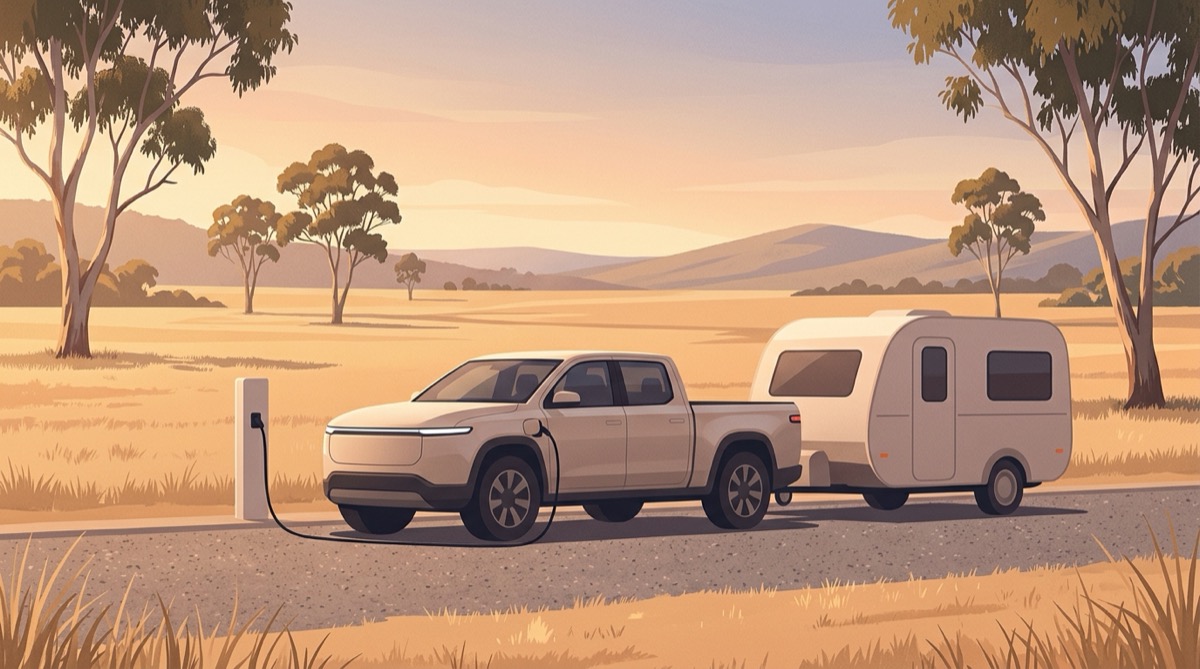
The practical problem is not the plug. All three use the CCS2 connector found on every DC fast charger in Australia. The problem is the bay. Many public fast-charging bays are laid out for a car to drive in nose-first, so with a trailer attached you often have to unhitch, charge, and hitch up again, or block the next bay. Before a towing trip, check each stop on our charger map or the network’s app for a pull-through bay or enough room to park across, and plan legs well inside your towing range.
Plan the no-charger stretches too. If you run flat with a trailer on, you need a flatbed for the ute and a second tow for the trailer, because an EV cannot be dragged on its wheels; our EV towing guide explains why and what to tell roadside assistance.
What does the battery do to payload?
It takes a slice of it. A battery weighs hundreds of kilograms, and it counts against the gross vehicle mass the same way a load in the tray does. The HiLux BEV SR pick-up weighs 2,420 kg at the kerb against a 3,145 kg GVM, leaving about 725 kg for people, gear and the towball download. Five adults and a toolbox can use most of that before you load the tray.
The same figure affects tax. The ATO’s electric car FBT exemption applies only to a “car designed to carry a load of less than one tonne”. All three electric utes are rated below a tonne, so they count as cars, and all three start under the $91,661 luxury car tax threshold for fuel-efficient vehicles. That puts them in scope for a tax-free novated lease under current rules, with the caveat that the proposed $75,000 cap from 1 April 2027 (announced, not yet law) would catch the HiLux pick-ups and the MG on their list prices. Confirm the exact variant with your lease provider before you order.
Should you buy an electric ute now?
If most of your driving is suburban, a work ute that comes home every night, or a fleet run with a charger at the depot, the Musso EV and HiLux BEV already make sense, and the running costs are a fraction of diesel. If you tow heavy or tour remote Australia, the current crop is not there yet, and a plug-in hybrid ute or a diesel remains the practical choice. Watch the MG U9’s first Australian towing tests this summer; it is the first electric ute here with the rated capacity to change that answer.
Frequently asked questions
What electric utes are available in Australia?
As of September 2026, two battery-electric utes are on sale new from their makers: the KGM Musso EV (from $60,000 drive-away) and the Toyota HiLux BEV (from $74,990 before on-roads). The MG U9 EV is priced from $78,990 before on-roads and due in showrooms between October and December 2026. The BYD Shark 6, Ford Ranger Hybrid and GWM Cannon Alpha are plug-in hybrids, not electric utes.
What is the cheapest electric ute in Australia?
The KGM Musso EV, from $60,000 drive-away for the front-wheel-drive version as of September 2026. It has an 80.6 kWh battery, a claimed 419 km of WLTP range, a 905 kg payload and a 1,800 kg braked towing limit. KGM's drive-away prices run up to $64,700, and the all-wheel-drive version tows up to 2,300 kg.
Is the BYD Shark 6 an electric ute?
No. The Shark 6 is a plug-in hybrid with a turbocharged petrol engine. It can drive on electricity alone for a claimed 100 km on the lenient NEDC test before the engine takes over. That makes it cheap to run on short trips, but it still needs petrol, and it does not qualify for the electric car FBT exemption.
How far can an electric ute go when towing?
Roughly half as far as without a trailer, and less again at highway speed. Australian towing tests have measured energy use rising 50 to 100 per cent with a caravan. As a planning figure, allow around 125 to 160 km between charges when towing a mid-size van with the Musso EV or MG U9, and less with the HiLux BEV, and check the route for chargers you can reach without unhitching.
Can you buy a Tesla Cybertruck or Rivian in Australia?
Not new from the makers. Tesla does not sell the Cybertruck in Australia and has no right-hand-drive version, and Rivian does not sell the R1T here. The Ford F-150 Lightning has only been available as a right-hand-drive conversion sold by a third-party importer, and Ford has stopped building it.