Best Home EV Chargers in Australia: What's Actually Worth Buying in 2026
Five home EV chargers stand out in Australia in 2026: Zappi for solar homes, Tesla Wall Connector for value, Evnex E2 on a budget. Compared on specs and price.
On this page
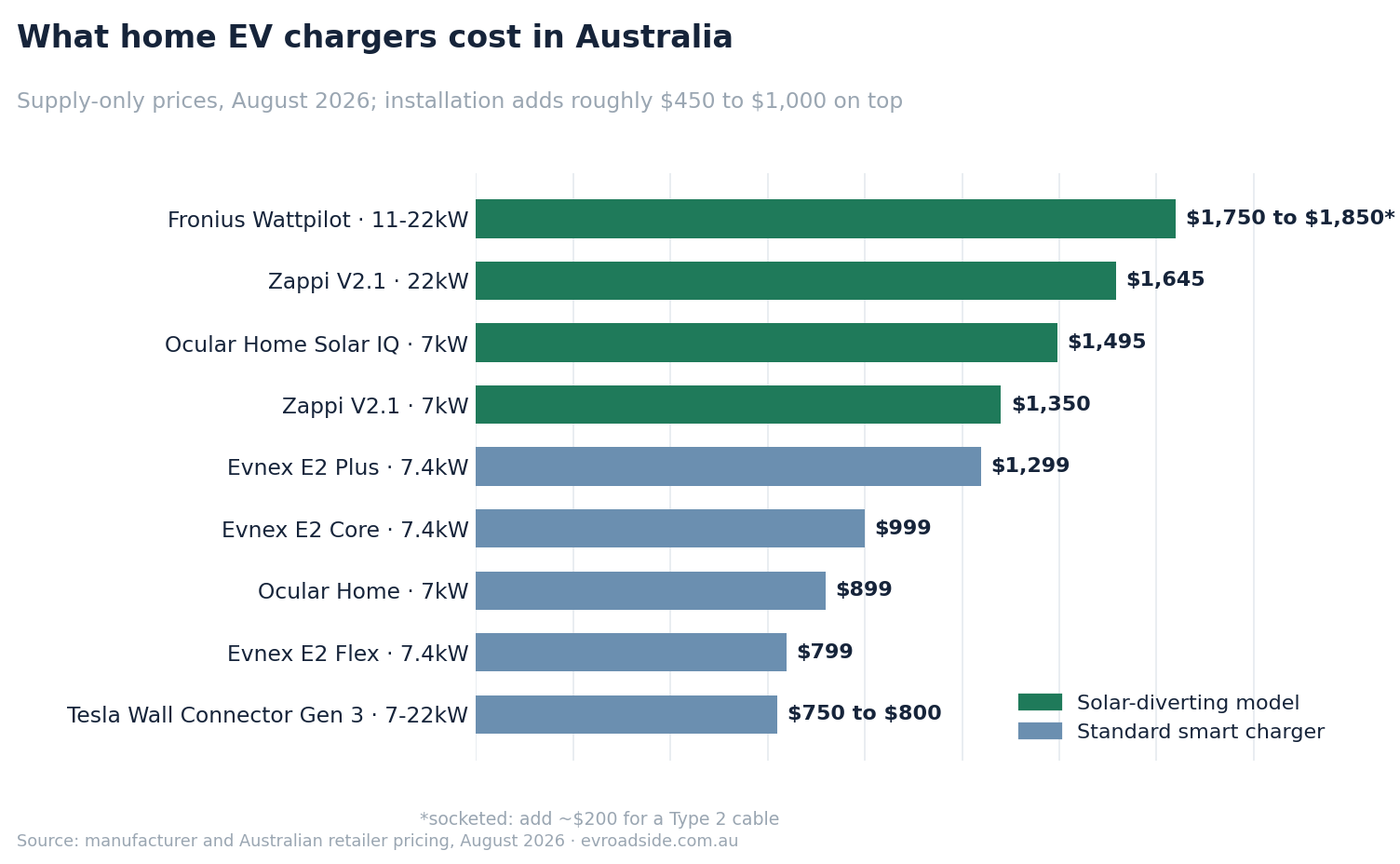
If you want the short answer: solar households should buy a myenergi Zappi V2.1 (about $1,350 to $1,650 supply), everyone else gets the most charger per dollar from a Tesla Wall Connector Gen 3 (roughly $750 to $800, and it charges any Type 2 EV, not just Teslas), and the Evnex E2 range from $799 is the best budget path to a proper smart charger. All prices are supply-only as of August 2026; installation adds roughly $450 to $1,000 on top. If the car is coming on a novated lease, budget for the charger separately: the ATO does not treat it as a car expense, so it cannot be salary packaged, as our EV novated lease guide explains.
How this comparison works
This is a spec and price comparison, not a hands-on test. We’ve compared manufacturer specifications against Australian retailer pricing as of August 2026, and cross-checked what installers and reviewers consistently recommend. Nobody paid to appear here and there are no affiliate links; we’re a charging and roadside-assistance information site, not a charger shop. Prices move, so treat them as a guide and get current quotes.
The short list
| Charger | Power | Solar smarts | Supply price (Aug 2026) | Best for |
|---|---|---|---|---|
| myenergi Zappi V2.1 | 7kW or 22kW | Native solar diversion (Eco / Eco+ modes) | ~$1,350 (7kW) to $1,645 (22kW) | Homes with solar |
| Tesla Wall Connector Gen 3 | 7kW single-phase, up to 22kW three-phase | Scheduling only (solar features need the Tesla ecosystem) | ~$750 to $800 | Best value from a big name |
| Evnex E2 (Flex / Core / Plus) | 7.4kW | Varies by model; OCPP on all | $799 / $999 / $1,299 | Smart features on a budget |
| Fronius Wattpilot | 11kW or 22kW | Native solar diversion with Fronius Smart Meter | ~$1,750 to $1,850 plus ~$200 cable | Homes with a Fronius inverter |
| Ocular Home | 7kW | Solar versions available (Home Solar IQ, $1,495) | ~$899 | Cheapest name-brand wallbox |
Best for solar homes: myenergi Zappi V2.1
The Zappi is the default recommendation for a reason: it was designed around solar from day one. Its Eco and Eco+ modes watch what your house is exporting and throttle the car’s charging up and down to match, so on a sunny day the car soaks up energy that would otherwise go to the grid for a few cents. It does this out of the box, with its own current sensors, no particular inverter brand required.
The trade-off is price: about $1,350 supply for the 7kW single-phase version and $1,645 for the 22kW multiphase unit, before installation. It also carries a three-year warranty and is now stocked at Bunnings, which says something about how mainstream it has become. If you have rooftop solar and drive an EV, the maths of charging on your own surplus usually justifies the premium.
Best value from a big name: Tesla Wall Connector Gen 3
At roughly $750 to $800 supply (and periodically discounted below that), the Wall Connector Gen 3 undercuts most comparable smart chargers by hundreds of dollars, and the common misconception is worth killing here: it charges any EV with a Type 2 port, which is every new EV sold in Australia. It handles single-phase 7kW or three-phase up to 22kW, is properly weather-rated, and has Tesla’s build quality.
What it lacks is universal solar diversion. Solar-optimised charging exists within Tesla’s own ecosystem, but if you want inverter-agnostic charge-from-surplus behaviour, that’s the Zappi’s territory. For households without solar, or with solar but happy to simply schedule charging into cheap overnight rates, it’s the value pick of the market.
Best smart charger on a budget: Evnex E2
The Evnex E2 range starts at $799 for the Flex, with the Core at $999 and the Plus at $1,299. All are 7.4kW single-phase units with the things that matter long-term: OCPP 1.6 compatibility (so you’re not locked into one company’s app), built-in load management, and a four-year warranty, one of the longest going. Solar-diversion capability differs between trims, so check the spec sheet of the exact model before buying if that matters to you.
Evnex is a New Zealand company with a real Australian presence, and its chargers keep showing up in local installers’ recommended lists. If the Zappi’s price stings and the Tesla’s ecosystem doesn’t appeal, this is the sensible middle.
Best for Fronius solar systems: Fronius Wattpilot
If your roof already runs through a Fronius inverter, the Wattpilot slots into that ecosystem and does genuine solar-excess charging via the Fronius Smart Meter. It comes in 11kW and 22kW versions, and uniquely in this list, the Go variant is portable: it plugs into a three-phase socket rather than being hardwired, so it can move house with you.
Budget around $1,750 to $1,850 supply, plus about $200 for a Type 2 cable since the unit is socketed rather than tethered. Outside a Fronius household it’s hard to justify over a Zappi; inside one, it’s the natural fit.
Cheapest name-brand wallbox: Ocular Home
Australian brand Ocular’s entry-level Home 7kW sells for about $899, with the solar-integrated Home Solar IQ at $1,495, and package deals with installation sometimes land under $1,500 all-in. You give up some polish and app sophistication compared with the chargers above, but the core job, safe 7kW charging on a dedicated circuit, is done for hundreds less. For a low-kilometre household that just wants overnight charging without ceremony, it’s enough charger.
Other brands worth a look
The market is moving fast. Sigenergy and Sungrow chargers are increasingly recommended by solar installers, particularly alongside their own battery and inverter systems; Anker’s Solix V1 and Enphase’s IQ EV Charger arrived recently from big names in consumer power gear; and GoodWe and Wallbox both have credible units. We’ve left them out of the main table only because their Australian pricing and availability are patchier; if your solar installer recommends one alongside your existing system, that advice is worth taking seriously.
How to choose
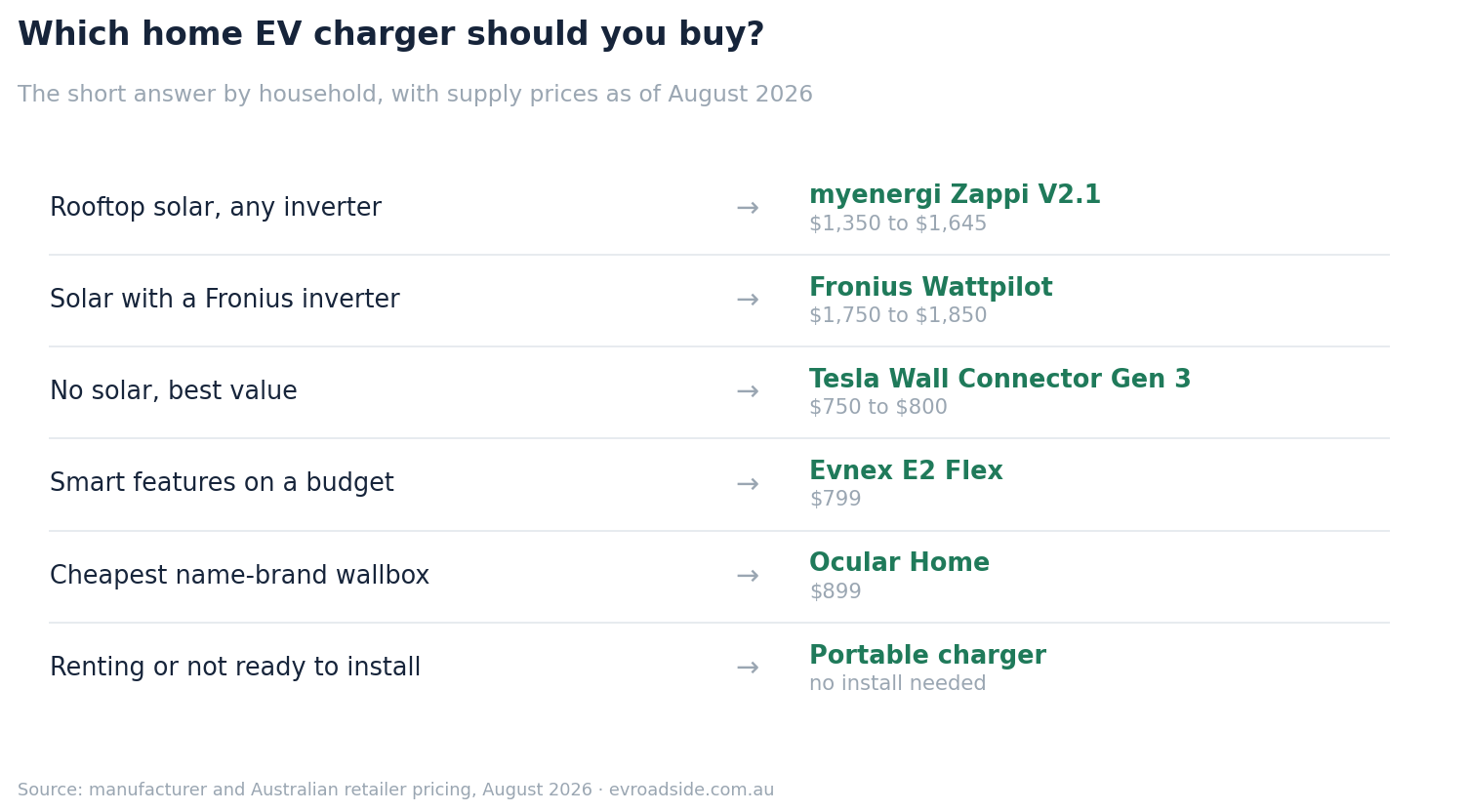
- Single-phase or three-phase. Most Australian homes are single-phase, which caps AC charging at 7.4kW: still 35 to 40km of range per hour, which refills almost any battery overnight. Pay for a 22kW unit only if your home has three-phase supply and your car’s onboard AC charger accepts more than 7kW; many cap at 7 to 11kW.
- Solar diversion or scheduling. True charge-from-surplus needs a charger built for it (Zappi, Wattpilot, and solar trims of others). If you don’t have panels, don’t pay for it; schedule charging into an off-peak window instead. Our solar EV charging guide runs the payback maths, and the cost-to-charge guide has the tariff numbers.
- Tethered or socketed. Tethered units have a permanently attached cable: more convenient daily. Socketed units take your own Type 2 cable: tidier, and the socket outlives cable wear.
- Insist on OCPP. OCPP-compatible chargers aren’t locked to one vendor’s app and can join future smart-tariff and demand-response programs. Our smart EV charger guide explains OCPP, load management and when your car’s own timer is enough.
- Renting, or not ready to commit? A portable charger on an ordinary powerpoint covers average daily driving overnight, with no installation at all. Our home charging guide walks through whether you need a wallbox in the first place.
One thing no charger on this list does is power your house from the car. Bidirectional chargers that do exist in Australia now, but at $4,850-plus they’re a different category (we cover whether an EV can power your house separately); the free version of the trick is vehicle-to-load, using the car’s own outlets.
What installation adds
Every charger here must be installed by a licensed electrician on a dedicated circuit. Budget roughly $450 to $1,000 for a straightforward single-phase job, more if your switchboard needs an upgrade or the cable run is long, which puts a typical all-in 7kW install at $1,200 to $2,500. Our EV charger installation guide breaks down where the money goes, what happens on the day, and which state rebates currently apply.
Frequently asked questions
What is the best home EV charger in Australia?
It depends on your setup. For solar homes, the myenergi Zappi V2.1 (about $1,350 to $1,650 supply as of August 2026) is the most proven solar-diverting charger. The Tesla Wall Connector Gen 3 is the best-value big name at roughly $750 to $800 and works with any Type 2 EV, not just Teslas. The Evnex E2 range, from $799, is the pick for smart features on a budget.
How much does a home EV charger cost in Australia?
As of August 2026, quality hardware runs from about $750 (Tesla Wall Connector Gen 3) to around $1,850 (Fronius Wattpilot), with most 7kW smart chargers between $800 and $1,650 supply. Installation adds roughly $450 to $1,000, so expect $1,200 to $2,500 all-in for a standard single-phase install.
Should I buy a 7kW or 22kW home charger?
A 7kW single-phase charger suits most homes and most cars: it adds 35 to 40km of range per hour and refills a battery overnight. A 22kW unit only charges faster if your home has three-phase power and your car's onboard AC charger accepts more than 7kW; many EVs cap AC charging at 7 to 11kW. Check both before paying extra.
Are home EV chargers AC or DC?
Home chargers are AC. They feed alternating current to the car's onboard charger, which converts it to DC for the battery. DC fast chargers, the 50kW-plus units at public sites, need commercial-grade power supply and cost tens of thousands of dollars, so they aren't installed in homes.
Can a home charger run straight off solar?
Yes, with the right unit. Solar-diverting chargers like the Zappi V2.1 and Fronius Wattpilot monitor your home's solar export and continuously adjust charging to soak up the surplus, so the car charges on power that would otherwise earn a few cents in feed-in tariff. Standard chargers can only approximate this by scheduling charging for daylight hours.